
Walk down any supplement aisle and you’ll find half a dozen forms of magnesium — glycinate, citrate, oxide, malate, threonate, taurate, chelate, “complex”. For most consumers it’s a wash; the bottle says magnesium, the label says minerals, you grab one. A month later, nothing’s changed, and magnesium gets crossed off the list.
Almost always, the form was wrong for the goal. Magnesium’s effects are real, but the form determines which effects you get and in what tissue. Two forms — glycinate and citrate — cover 90% of consumer use cases between them. Picking correctly between those two is the entire game.
What both forms have in common
Both are well-absorbed (45–55% bioavailability, against magnesium oxide’s roughly 4%). Both are safe at sane doses. Both deliver enough elemental magnesium per serving to actually move blood and tissue levels, which is the threshold question — many cheaper formulations don’t.
The difference is what happens after absorption.
Glycinate: the calm one
Glycinate is magnesium chelated to glycine — an amino acid that’s mildly inhibitory in its own right. Glycine is one of the body’s downregulating neurotransmitters; it’s the molecule your spinal cord uses to keep motor reflexes from overshooting. Bound to magnesium, it makes the chelate exceptionally gentle on the gut and adds a subtle calming layer to whatever the magnesium itself is doing.
In practice, glycinate is the form for:
- Trouble falling asleep (the wired-but-tired pattern)
- Muscle tightness, calf cramps, eyelid twitches
- Anxious overdrive that won’t downshift after work
- PMS-related tension and headaches
- Anyone with a sensitive gut who’s tried citrate and bailed
The downside is cost. Glycinate is more expensive per gram of elemental magnesium than citrate, and the chelation makes the molecule larger — you’ll see “1,000 mg magnesium glycinate” delivering only 200 mg of elemental magnesium. That’s normal. Read the elemental number on the back of the bottle, not the front-of-pack figure.
Citrate: the gut one
Citrate is magnesium bound to citric acid. It’s better absorbed than oxide, but a meaningful fraction of the dose draws water into the bowel — that’s the laxative effect that makes magnesium citrate a standard pre-colonoscopy prep.
For day-to-day use, that water-pulling property is exactly what you want if you’re constipated, and exactly what you don’t want if you aren’t. Citrate’s natural home is:
- Chronic constipation (especially the slow-motility kind)
- Travel constipation that doesn’t respond to fibre
- Occasional use after rich, dehydrating meals
- Anyone with normal motility on a budget — citrate is cheap
If you take citrate at bedtime hoping for sleep benefits, you’ll get the magnesium effect in the morning along with a bowel movement you didn’t ask for. Many people then switch forms and discover their sleep was supposed to feel different all along.
A worked example
A reader recently described what she called “magnesium roulette”: one month on citrate gave her loose stools, the next on oxide felt like nothing at all, the third on a “complex” gave neither effect. Her actual problem was sleep-onset and PMS-related tightness. The right form for that pattern — glycinate — she’d never tried.
Two weeks of 200 mg elemental magnesium glycinate at bedtime: tighter sleep, no gut effects. The supplement wasn’t broken; the form was.
So: which one?
Start with what you’re trying to fix.
- Sleep, tension, calm: glycinate, 200–400 mg elemental, evening.
- Constipation: citrate, 200–400 mg elemental, with a glass of water, any time of day.
- Both problems at once: glycinate as your daily, citrate ad hoc when needed.
Buy from a brand that prints the elemental amount clearly. Skip anything that just says “1,000 mg magnesium” without specifying the form — that’s almost always oxide, and that’s almost always why magnesium hasn’t worked for you.
Supplements mentioned
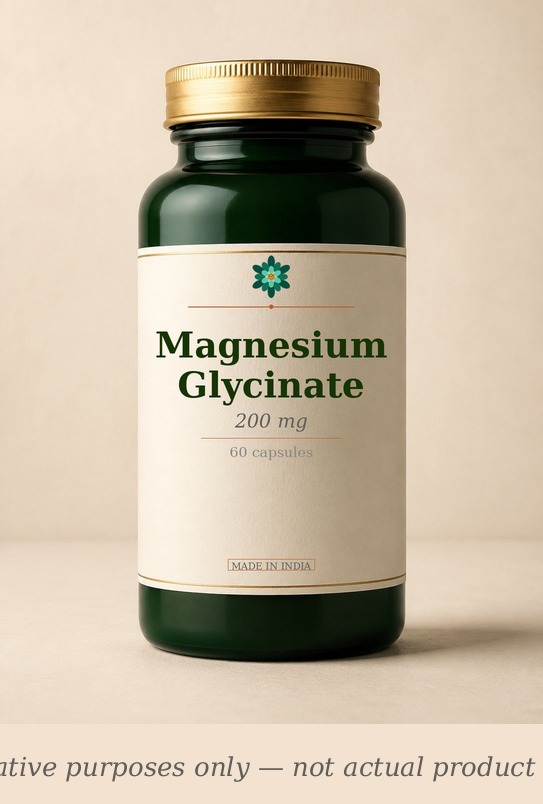
Magnesium Glycinate
Mineral · 200 mg · 60 caps
People also ask
Can I take both forms together?
What about magnesium oxide and threonate?
How do I know which one I need?
Keep reading

ZMA for Sleep: protocol, dose, and what to track
How to use ZMA specifically for Sleep — the right dose, timing, blood markers to track, and how to know if it is working.
ZMA: complete India guide
Everything you need to know about ZMA — mechanism, dose, safety, buying guide for India, and what the research actually says.

Vanadyl Sulfate for insulin resistance: protocol, dose, and what to track
How to use Vanadyl Sulfate specifically for insulin resistance — the right dose, timing, blood markers to track, and how to know if it is working.