
India’s wellness market is growing fast, but with hundreds of products on Amazon.in and little standardisation, knowing what to actually buy is harder than it should be. This guide covers Shatavari (High Dose) from first principles — what it is, how it works, who it suits, and how to use it safely.
What is Shatavari (High Dose)?
Shatavari (Asparagus racemosus Willd.) is a climbing shrub in the Asparagaceae family, native to India and the Himalayas. Its tuberous roots are one of the most important herbs in Ayurveda, classified as a Rasayana (rejuvenative tonic) and specifically as the premier female reproductive tonic (Stree Rasayana). The root contains steroidal saponins (shatavarins I–IV), flavonoids, alkaloids and polysaccharides. This entry focuses on high-dose clinical use (500 mg–2 g/day of standardised extract) distinct from lower-dose general wellness products.
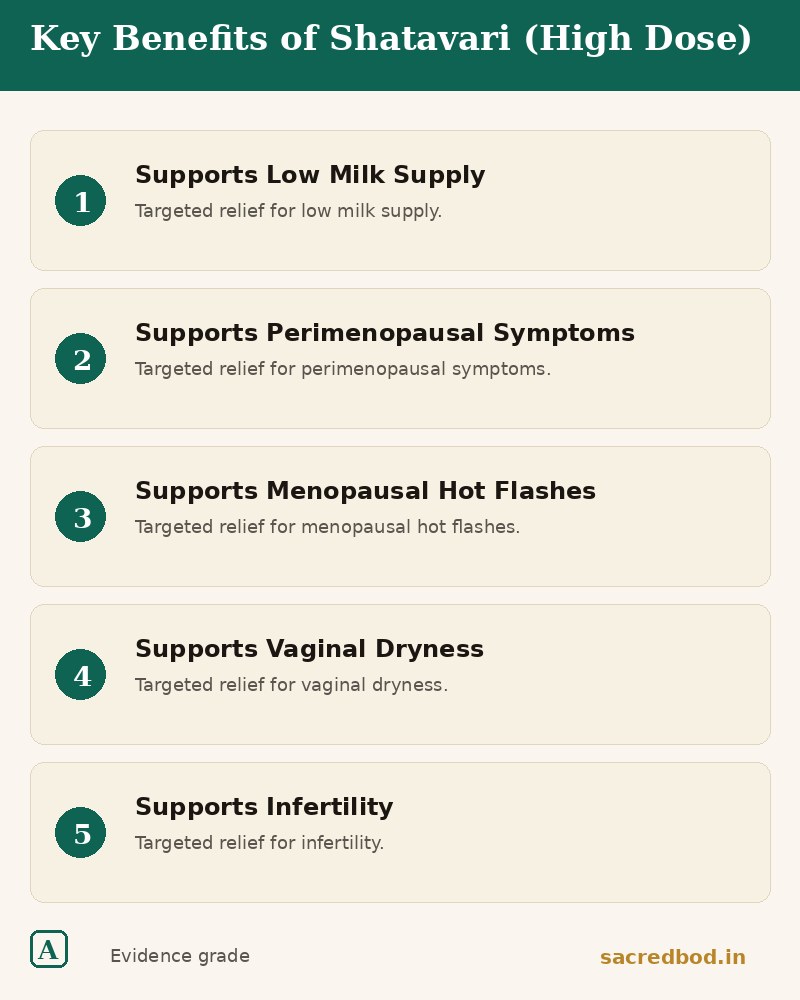
It sits in the Botanical category and is most relevant for people dealing with low milk supply, perimenopausal symptoms, menopausal hot flashes.
How does Shatavari (High Dose) work?
Shatavari’s steroidal saponins (shatavarins) have phytoestrogenic activity, binding weakly to estrogen receptors and modulating hypothalamic-pituitary-ovarian axis function. A 2025 double-blind RCT of 60 perimenopausal women found that 500 mg/day Shatavari extract significantly improved menopausal symptoms (hot flashes, night sweats, vaginal dryness, mood swings) and quality of life (MENQOL scores) over 12 weeks. A 2025 RCT in 100 menopausal women showed 1,000 mg/day significantly reduced Kupperman Index scores and improved sleep quality. For lactation, a 1996 RCT showed Shatavari increased prolactin levels and milk production in nursing mothers. The galactagogue effect is mediated via prolactin stimulation and mammary gland alveolar cell proliferation.
It primarily acts on the reproductive system, mammary glands, uterus, ovaries, immune system, and effects are dose-dependent rather than immediate.
Who should consider Shatavari (High Dose)?
Nursing mothers seeking galactagogue support (under lactation consultant guidance). Perimenopausal and menopausal women seeking evidence-based herbal symptom relief. Women with fertility concerns or irregular cycles seeking Ayurvedic reproductive tonic support. Those recovering from illness or debility (Rasayana use). Individuals interested in the most clinically validated Ayurvedic women’s health herb.
How much Shatavari (High Dose) should you take?
A typical dose is 500 mg, best taken with food, usually in the morning. Most people can expect noticeable effects within 2–4 weeks for lactation; 4–8 weeks for menopausal symptoms; 8–12 weeks for fertility. Consistency matters more than a single large dose.
Safety and who should avoid it
Pregnant women (traditional texts are mixed — some use it for pregnancy support, others caution in first trimester; consult Ayurvedic practitioner). Individuals with estrogen-sensitive cancers without oncologist approval. Those with severe kidney disease (Asparagus genus may increase uric acid). People with asparagus allergy. Not for children except under paediatric guidance.
Side effects: Generally well-tolerated at 500 mg–2 g/day. Mild gastrointestinal upset or loose stools in sensitive individuals. May cause weight gain at very high doses due to anabolic Rasayana properties. Those with estrogen-sensitive conditions should use cautiously due to phytoestrogen content. Rare allergic reactions.
How to combine Shatavari (High Dose)
Shatavari (High Dose) is often layered into a broader protocol rather than taken alone. See the “Goes with” panel on its product page for evidence-aligned pairings, and introduce one new supplement at a time so you can attribute any change to the right product.
Frequently asked questions
Is Shatavari (High Dose) available in India? Yes — it is sold on Amazon.in. Prioritise standardised, third-party-tested products.
How long until it works? Around 2–4 weeks for lactation; 4–8 weeks for menopausal symptoms; 8–12 weeks for fertility.
Can vegetarians take it? Check the label for a vegetable-cellulose capsule rather than gelatin.
What to realistically expect
Supplements rarely produce dramatic overnight change. With an evidence grade of A, Shatavari (High Dose) is best understood as a steady, cumulative input rather than a quick fix. Expect gradual rather than sudden change over 2–4 weeks for lactation; 4–8 weeks for menopausal symptoms; 8–12 weeks for fertility, and measure against your own baseline. If after a fair trial at 500 mg you notice nothing — subjectively or on relevant lab markers — that is useful information, and it is reasonable to stop.
Storage and stability
Heat and humidity are real considerations across much of India. Store Shatavari (High Dose) in a cool, dry place away from direct sunlight, keep the bottle tightly closed, and avoid leaving it in a hot car or on a sunny kitchen shelf. A capsules kept in stable conditions retains potency far better than one repeatedly exposed to monsoon humidity. If your product arrives with a desiccant sachet, leave it in the bottle.
Where to buy Shatavari (High Dose) in India
Shatavari (High Dose) is available on Amazon.in. When buying, prioritise products that state the standardised active percentage, third-party testing (NSF, USP or Informed Sport), and a clear vegetarian-capsule declaration if that matters to you. Use the buy button on the Shatavari (High Dose) page to see the current verified listing with the SacredBod tag.
This article is for informational purposes only. Consult a qualified healthcare provider before starting any supplement, especially if you take prescription medication or have a medical condition.
Supplements mentioned
People also ask
Is Shatavari (High Dose) available in India?
Yes, Shatavari (High Dose) is available on Amazon.in. Look for standardised, third-party-tested products with a clear label.
What is the typical Shatavari (High Dose) dose?
A typical dose is 500 mg, taken with food. Always follow the product label and your clinician's advice.
How long does Shatavari (High Dose) take to work?
About 2–4 weeks for lactation; 4–8 weeks for menopausal symptoms; 8–12 weeks for fertility.
Keep reading
- ZMA: complete India guide
Everything you need to know about ZMA — mechanism, dose, safety, buying guide for India, and what the research actually says.
- Zinc: complete India guide
Everything you need to know about Zinc — mechanism, dose, safety, buying guide for India, and what the research actually says.
- Yohimbine HCl: complete India guide
Everything you need to know about Yohimbine HCl — mechanism, dose, safety, buying guide for India, and what the research actually says.