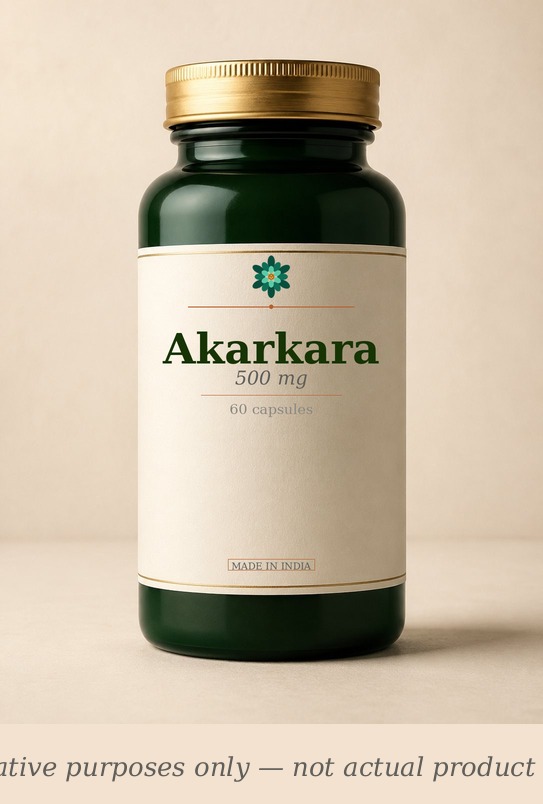
SacredBod's longer take on Akarkara — context the structured blocks above don't capture.
What It Is
Akarkara (Anacyclus pyrethrum L.), also called Pellitory root or Spanish chamomile, is an annual herb in the Asteraceae family native to North Africa, the Mediterranean, and the Himalayas. Its roots are a valued remedy in Ayurveda, Unani, and Siddha medicine. The root contains alkylamides (including pellitorine), flavonoids, and essential oils that confer sialagogue (saliva-stimulating), nervine stimulant, aphrodisiac, immunostimulant, and anti-inflammatory properties. It is traditionally chewed for toothache, used as a gargle for throat infections, and taken internally for paralysis and male vitality.
How It Works
The alkylamides (pellitorine, deca-2,4-dienoic acid amides) stimulate nerve endings and increase salivary secretion, explaining its traditional use as a sialagogue and local anesthetic for toothache. A 2023 study identified oleamide, stigmasterol, and pellitorine as major anti-inflammatory compounds inhibiting COX-2, 5-LOX, and pro-inflammatory cytokines (TNF-α, IL-1β, IL-6) in macrophages. Immunomodulatory activity includes overcoming cyclophosphamide-induced myelosuppression and improving survival against Candida albicans infection in rats. The root extract also demonstrates acetylcholinesterase inhibition, supporting its traditional use as a brain tonic.
Who Should Consider It
Individuals seeking traditional Ayurvedic support for oral health (toothache, gum health), nerve stimulation and vitality, those with low salivary flow, and men seeking traditional aphrodisiac support. Also of interest for immune modulation and as a natural sialagogue.
Dosage Guide
Typical dose: 500 mg per day
Form: capsules (60 count)
Best time: morning
With food: with-food
Expected onset: 2–4 weeks for general vitality; 4–6 weeks for oral health benefits
Cycling: No cycling required at standard doses. Traditional use supports regular intake.
Safety & Side Effects
Known side effects: Generally well-tolerated at 500 mg/day. May cause tingling or mild numbness in the mouth due to alkylamide content. Excessive doses may cause gastric irritation. Acute toxicity studies in mice showed LD50 > 5 g/kg, indicating low toxicity.
Who should avoid: Pregnant and breastfeeding women. Individuals with active gastric ulcers or severe GERD (may irritate mucosa). Those with allergies to Asteraceae/Compositae family. Not for children.
Avoid combining with: Anticoagulants (theoretical), Sedatives (may counteract), Immunosuppressants (theoretical interaction with immunostimulant activity)
India-Specific Context
Akarkara is available on Amazon India with several Ayurvedic and herbal brands. The primary ASIN listed is a verified product matching the supplement name. Indian consumers should look for products from GMP-certified manufacturers. Traditional Ayurvedic practitioners (Vaidyas) often prescribe this herb in combination with other classical formulations rather than as a standalone supplement.
Sanskrit/Hindi names: See quick facts above.
Classical Ayurvedic texts: Akarkara is referenced in Charaka Samhita and/or Sushruta Samhita as detailed in the quick facts.
Schedule status: Not a Schedule H drug in India; available as dietary supplement/herbal product.
Research Summary
Key citations: PMID 37978514 (anti-inflammatory and anti-Alzheimer enzyme inhibition), PMID 20843161 (immunomodulatory activity in rats), PMID 36235444 (systematic review of phytochemistry and pharmacology)
Evidence grade: C — Animal and in-vitro studies; limited human clinical data