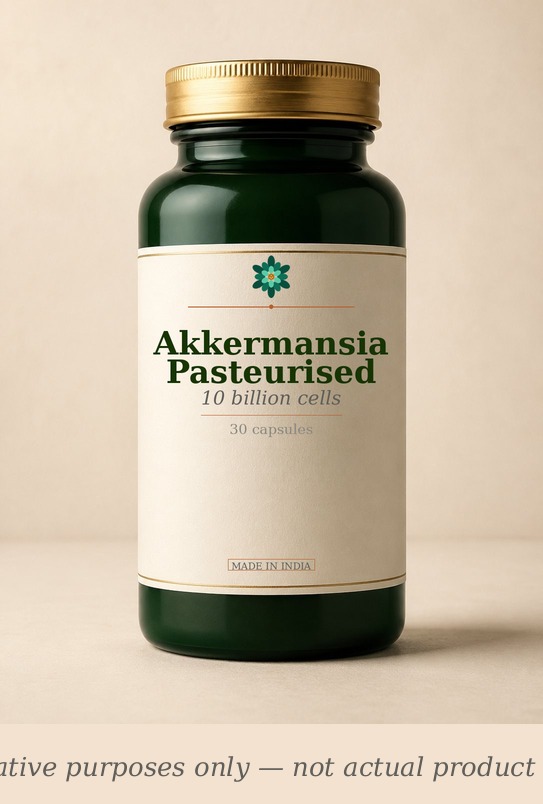
SacredBod's longer take on Akkermansia Pasteurised — context the structured blocks above don't capture.
What Is Pasteurised Akkermansia?
Akkermansia muciniphila is a remarkable bacterium. It makes up 1–5% of the gut microbiome in healthy people and is virtually absent in those with obesity, diabetes and metabolic syndrome. It lives in the mucus layer of the intestine, where it literally eats mucin (the protein in mucus) and transforms it into beneficial metabolites.
But here is the twist that shocked microbiome researchers: pasteurised (heat-killed) Akkermansia works better than live Akkermansia.
The 2019 Depommier trial in Nature Medicine demonstrated that pasteurised Akkermansia improved insulin sensitivity by 28.6%, reduced insulin by 34% and lowered cholesterol by 8.7% — while live Akkermansia produced only non-significant trends. Pasteurisation exposes the outer membrane protein Amuc_1100, which interacts with TLR2 receptors to strengthen the gut barrier and reduce metabolic endotoxemia.
This discovery transformed Akkermansia from a probiotic into a postbiotic — a non-viable bacterial preparation with therapeutic effects.
How Does It Work?
Pasteurised Akkermansia operates through three validated mechanisms:
- Gut barrier reinforcement: Amuc_1100 and extracellular vesicles increase tight junction protein expression (occludin, ZO-1) and restore mucus thickness — even though the bacteria are dead.
- Metabolic endotoxemia reduction: Plasma LPS (bacterial endotoxin) decreased by 24% in the Depommier trial, indicating a sealed gut barrier and reduced systemic inflammation.
- Immune modulation: TLR2 activation promotes anti-inflammatory M2 macrophages and regulatory T-cells, reducing the chronic low-grade inflammation that drives insulin resistance.
The 2026 Mount trial (Nature Medicine, n=90) extended these findings to weight loss maintenance, showing that pasteurised MucT reduced weight regain by 2 kg compared to placebo over 24 weeks.
Who Benefits Most?
- Overweight/obese individuals: The Depommier and Mount trials both targeted this population.
- Type 2 diabetes: The 2025 Zhang trial showed HbA1c and fat mass reductions in T2D patients with low baseline Akkermansia.
- Insulin resistance: HOMA-IR improved significantly in multiple trials.
- Fatty liver disease: Reduced gamma-GT and AST indicate improved liver function.
- Low Akkermansia baseline: The 2025 trial confirmed that those with low starting levels benefit most.
- Metabolic syndrome: Comprehensive improvements in lipids, inflammation and glucose.
Dosage Guide
- Standard dose: 10 billion pasteurised cells daily.
- Timing: Morning on an empty stomach for optimal absorption.
- Form: Capsules or sachets. Pasteurised form is stable at room temperature.
- Duration: Minimum 3 months for metabolic benefits; 6 months for weight maintenance.
Safety & Interactions
Pasteurised Akkermansia has an excellent safety profile. The main considerations:
- Antibiotics: Separate by 2 hours.
- Immunocompromise: Consult physician (though pasteurised form carries no infection risk).
- Pregnancy: Limited data; consult obstetrician.
India-Specific Context
Sanskrit/Hindi name: Not applicable — Akkermansia is a modern bacterial discovery (first described in 2004 by Derrien et al.).
Availability: Akkermansia supplements are emerging on Amazon.in:
- Gut Shield (ASIN B0FVFBPFJ8) — combination product containing Akkermansia, ₹800–1,200.
- Generic Akkermansia supplement (ASIN B0FVF1D7TP) — verify pasteurised vs live form.
- The original Pendulum/Enterobiome MucT pasteurised product is not widely distributed in India and typically requires import.
It is not a Schedule H drug.
Ayurvedic parallel: The concept of “Agni” (metabolic fire) and “Meda Dhatu” (fat tissue) in Charaka Samhita aligns with Akkermansia’s metabolic effects. Guduchi (Tinospora cordifolia) is the classical metabolic and immune Rasayana, while Methi (fenugreek) and Karela (bitter melon) are the traditional blood sugar regulators. A modern integrative approach might combine pasteurised Akkermansia with Methi extract for comprehensive metabolic syndrome support.
Traditional use: None in Indian classical medicine — Akkermansia was discovered in 2004. However, traditional Indian diets rich in polyphenols (spices, tea, colourful vegetables) and fibre naturally support Akkermansia abundance. The modern supplement simply concentrates what a traditional Indian diet already promotes.