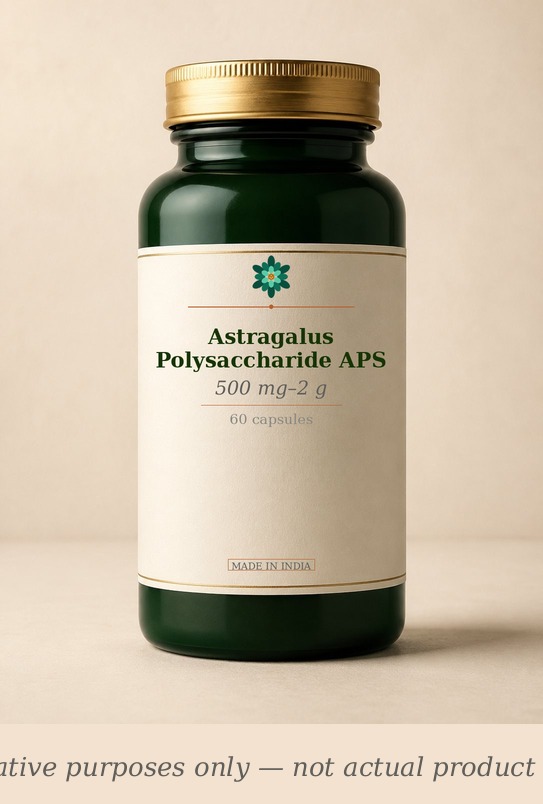
SacredBod's longer take on Astragalus Polysaccharide APS — context the structured blocks above don't capture.
What Is Astragalus Polysaccharide APS?
Astragalus membranaceus (Huang Qi) is one of the most important herbs in Traditional Chinese Medicine — used for over 2,000 years to strengthen “Wei Qi” (defensive energy) and promote longevity. But the root powder contains hundreds of compounds. The polysaccharide fraction (APS) is where the immune and anti-ageing magic lives.
APS is a complex mixture of arabinose, glucose, rhamnose, galactose and other sugars bound into heteropolysaccharides. These large molecules are not digested for calories — they are recognised by immune cell receptors (TLR4, Dectin-1) and trigger profound immune activation. More remarkably, APS has been shown to activate telomerase — the enzyme that rebuilds the protective caps on chromosomes, effectively reversing cellular ageing in immune cells.
In India, astragalus is not a classical Ayurvedic herb, but it is increasingly available as a modern adaptogenic and immune supplement.
How Does It Work?
APS operates through multiple validated pathways:
- Telomerase activation: Upregulates TERT (telomerase reverse transcriptase) via the PI3K/Akt/mTOR pathway, extending telomere length in T-cells and haematopoietic stem cells.
- Hippo/YAP pathway modulation: In irradiated bone marrow, APS reduces LATS1/2 and increases YAP, TEAD and TERT — restoring stem cell function and reversing telomere depletion.
- NK cell mobilisation: Significantly enhances natural killer cell cytotoxicity and number in animal models.
- Cytokine enhancement: Increases IL-2, IFN-gamma and TNF-alpha — the Th1 cytokines critical for viral and cancer defence.
- Dendritic cell maturation: Promotes antigen presentation, bridging innate and adaptive immunity.
Who Benefits Most?
- Adults over 50: Telomere shortening in immune cells is a hallmark of immunosenescence; APS is one of the few botanicals with telomerase-activating evidence.
- Cancer patients: Used in China as adjunctive support during chemotherapy to reduce myelosuppression and maintain immune function.
- Post-radiation recovery: Animal studies show APS protects bone marrow stem cells from radiation-induced damage.
- Chronic fatigue: Immune senescence contributes to persistent fatigue; APS addresses the cellular root.
- Biohackers: Those seeking telomere support without the cost of patented cycloastragenol (TA-65).
Dosage Guide
- Standard immune support: 500 mg–1 g daily of APS-standardised extract.
- Therapeutic / anti-ageing: 1–2 g daily.
- Timing: With meals; polysaccharides absorb better with food.
- Form: Capsules or powder; standardised to ≥50% polysaccharides.
- Duration: Minimum 3 months for immune benefits; 6–12 months for potential telomere effects.
Safety & Interactions
Astragalus is extremely safe. It is a staple of Chinese medicine with a 2,000-year safety record. Key cautions:
- Autoimmune disease: Immune stimulation may theoretically aggravate symptoms.
- Immunosuppressants: May reduce drug efficacy.
- Lithium: Astragalus may increase lithium blood levels.
- Cyclophosphamide: May interfere with chemotherapy timing.
India-Specific Context
Sanskrit/Hindi name: Not applicable — Astragalus membranaceus is native to China and Mongolia and does not appear in Charaka Samhita or Sushruta Samhita. It is a modern import from Traditional Chinese Medicine.
Availability: Astragalus supplements are widely available on Amazon.in:
- Biotic Natural Astragalus 500 mg (ASIN B08LZSYL62) — ₹400–500, Indian-made.
- Nutricost Astragalus 550 mg, 240 capsules (ASIN B082BKBBTR) — imported, ~₹1,500.
- Now Foods Astragalus 500 mg (ASIN B000MGR2EE) — imported, ~₹800–1,000.
- VREEX Astragalus 500 mg (ASIN B0FT2RR44C) — immune support focus.
- ZESPO Astragalus 600 mg (ASIN B0CL39WNDC) — plant-based wellness.
- Humming Herbs Astragalus (ASIN B0CRKSNSV3) — immune, cardiovascular and liver health.
It is not a Schedule H drug.
Ayurvedic parallel: While not classical Ayurveda, astragalus’s immune and vitality effects align with the “Rasayana” class of rejuvenative herbs. In modern integrative practice, it is often paired with Ashwagandha (Indian ginseng) for combined adaptogenic and immune support. Guduchi provides the classical Ayurvedic immunomodulatory complement.
Traditional use: None in Indian classical medicine. Used in China for over 2,000 years as a Qi tonic for fatigue, immune weakness, wound healing and longevity.