
SacredBod
0
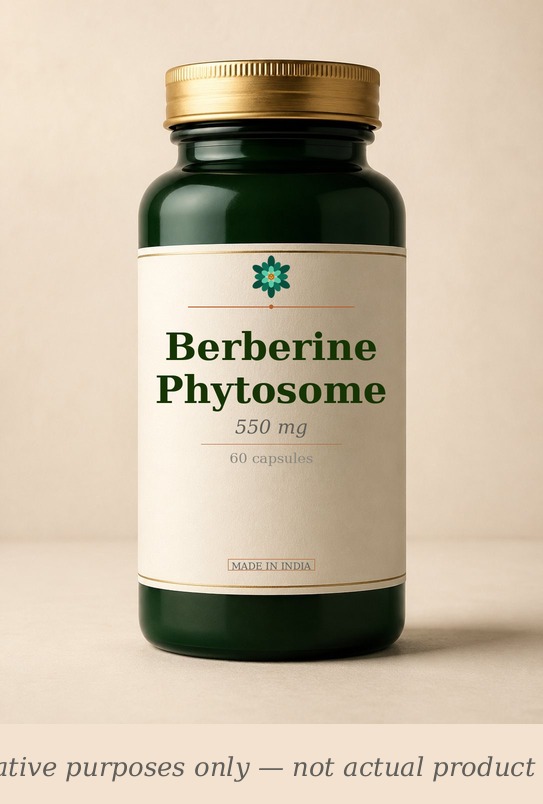
Berberine Phytosome — SacredBod supplement bottle (illustrative)
Supplement · AMPK Activator & Glucose/Lipid Control

Berberine Phytosome

550 mg · vegan · gluten-free · 60 caps

High blood sugarHigh cholesterolInsulin resistanceMetabolic syndromePCOSNAFLD LiverPancreasIntestinesMuscles
BUY on Amazon →

Affiliate link · we earn from qualifying purchases. No paid placements.

What it is

Berberine is a golden-yellow alkaloid found in Berberis aristata (Daruharidra/Indian Barberry), Coptis chinensis (Huang Lian), and Phellodendron amurense (Amur Cork Tree). The phytosome form complexes berberine with phospholipids (lecithin), creating a lipophilic delivery system that bypasses berberine's notoriously poor oral bioavailability (<1%). This increases absorption by 3–5x, allowing lower doses to achieve therapeutic effects while reducing gastrointestinal side effects.

How it works

Berberine activates AMP-activated protein kinase (AMPK) — the cellular energy sensor that regulates glucose and lipid metabolism. AMPK activation increases insulin receptor expression, enhances GLUT4 translocation, suppresses hepatic gluconeogenesis, and upregulates LDL receptors in the liver. The phytosome delivery system protects berberine from P-glycoprotein efflux in the gut (the primary reason for its poor bioavailability) and enhances membrane permeability. Clinical trials show phytosome berberine at 550 mg produces effects comparable to 1500 mg of standard berberine HCl.

Who should take it

Individuals with Type 2 diabetes, prediabetes, metabolic syndrome, high cholesterol, PCOS, or non-alcoholic fatty liver disease (NAFLD). Relevant for India — berberine's source plant Daruharidra is native to the Himalayas and has been used in Ayurveda for millennia. The phytosome form is ideal for those who cannot tolerate high-dose standard berberine due to GI side effects.

Avoid / careful

Pregnant or breastfeeding women (berberine may cause uterine contractions and kernicterus in infants), people with low blood pressure (berberine is hypotensive), those on multiple medications metabolised by CYP3A4 (berberine inhibits this enzyme), individuals with G6PD deficiency (hemolysis risk). Side effects: The phytosome form dramatically reduces GI side effects compared to standard berberine. Rarely: mild stomach upset, constipation, or headache. Standard berberine at high doses commonly causes cramping, diarrhea, and nausea — the phytosome form avoids most of these issues.

When to take it

Morning
Noon
Evening
Night

How to take it

With food
Empty stomach
Before food

FAQs

Frequently asked

How long before I see results?
Glucose improvements typically appear within 2–4 weeks. Lipid changes (LDL, triglycerides) require 4–8 weeks. Metabolic syndrome markers and liver enzymes improve over 8–12 weeks. The phytosome form works faster than standard berberine due to superior absorption.
Is phytosome really 5x better?
Yes — pharmacokinetic studies show the berberine-phospholipid complex achieves 3–5x higher plasma concentrations than standard berberine HCl at equivalent doses. This means 550 mg phytosome delivers comparable effects to 1500–2000 mg of standard berberine, with far fewer GI side effects.
Can I take it with metformin?
Yes, but monitor blood sugar closely. Berberine and metformin both activate AMPK and lower hepatic glucose output — combined effects may be synergistic. Some patients can reduce metformin dose when adding berberine. Always inform your diabetologist.

In plain English

A plain-English read of the literature behind this supplement. Not a clinical recommendation.

Key citations: PMID 34684666 (Berberine phytosome improves PCOS metabolic & hormonal disorders, 2021), PMC7235753 (Phytosome approaches enhance berberine bioavailability 3–5x, 2020), PMC8538182 (Berberine pharmacokinetics & therapeutic potential, 2022)

Editorial notes

SacredBod's longer take on Berberine Phytosome — context the structured blocks above don't capture.

Berberine is one of the most exciting natural compounds in metabolic medicine — a plant alkaloid that activates AMPK (the same pathway as metformin) and produces comparable glucose and lipid improvements. But standard berberine has a fatal flaw: oral bioavailability of less than 1% due to P-glycoprotein efflux in the gut. The phytosome form solves this by wrapping berberine in a phospholipid shell, increasing absorption 3–5x and eliminating the GI side effects that cause 30% of users to quit standard berberine.

What the Research Shows

A 2021 clinical study (PMID 34684666) gave 12 PCOS women a berberine-phospholipid complex (550 mg/day) for 60 days. Results were striking: HOMA-IR (insulin resistance) decreased significantly, CRP and TNF-α (inflammation markers) dropped, triglycerides fell, testosterone decreased, and SHBG increased. Visceral adipose tissue and fat mass both decreased. Crucially, no GI side effects were reported — the phytosome formulation eliminated berberine’s main tolerability issue.

A 2020 review (PMC7235753) cataloged formulation approaches for berberine and confirmed that phospholipid complexes (phytosomes) improve oral bioavailability by 3-fold in animal studies and achieve plasma levels comparable to 3–5x higher doses of unformulated berberine. The mechanism involves bypassing P-glycoprotein efflux and enhancing membrane permeability through lipid solubility.

The landmark 2008 RCT comparing berberine to metformin found that 500 mg berberine three times daily produced comparable glucose and lipid improvements to 500 mg metformin three times daily — establishing berberine as a genuine metformin alternative. The phytosome form achieves these effects at roughly one-third the dose.

India Context

  • Availability: Liposomal/phytosome berberine products are emerging on Amazon India. Generic liposomal berberine 25% (B0GXB6WLFP, B0GXB21BCV) and Vlado’s Himalayan Organics liposomal berberine with piperine are available. Most berberine products are standard HCl or extracts from Berberis aristata (Daruharidra).
  • Price: ₹600–₹1,200 for 60 capsules (liposomal/phytosome form). Standard berberine is cheaper at ₹400–₹800.
  • Ayurvedic heritage: Daruharidra (Berberis aristata) is the primary Ayurvedic source of berberine (Rasanjana). It is described in Charaka Samhita for prameha (diabetes), kustha (skin diseases), and jwara (fever). The Himalayan plant is wild-harvested and sustainably cultivated in Uttarakhand and Himachal Pradesh.
  • Metabolic disease crisis: India faces a perfect storm of metabolic disease — 77 million diabetics, 200+ million with dyslipidemia, and rising NAFLD rates. Berberine addresses all three simultaneously through AMPK activation.
  • Quality concern: Many Indian berberine supplements use inconsistent extraction methods. Look for products standardised to 95% berberine HCl or verified phytosome formulations. The phytosome form is worth the premium for those who experienced GI intolerance with standard berberine.

Dosage & Safety

  • Standard dose: 550 mg twice daily with meals (phytosome form)
  • Equivalent standard dose: 1500–2000 mg/day of standard berberine HCl
  • Best time: Morning and evening with food
  • Critical caution: Do not combine with statins, warfarin, or immunosuppressants without medical supervision (CYP3A4 inhibition). Not for pregnancy. Monitor blood sugar if on diabetes medication.
Added to your stack.