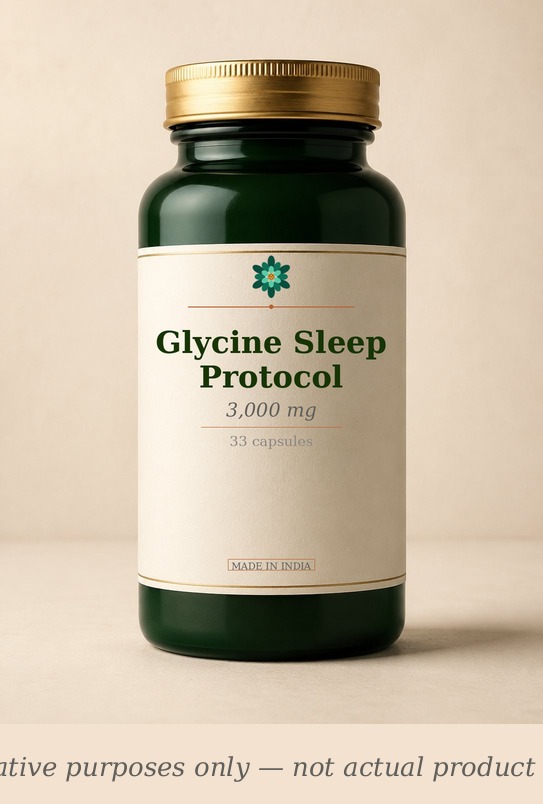
SacredBod's longer take on Glycine Sleep Protocol — context the structured blocks above don't capture.
What It Is
Glycine Sleep Protocol delivers 3,000 mg of the smallest amino acid — a compound that serves dual roles in sleep promotion. In the central nervous system, glycine is an inhibitory neurotransmitter that quiets neuronal activity. In the hypothalamus, it acts as an excitatory co-agonist at NMDA receptors in the suprachiasmatic nucleus (SCN), triggering a cascade that dilates peripheral blood vessels and lowers core body temperature. This thermoregulatory effect mimics the body’s natural sleep-onset signal, making glycine unique among sleep supplements — it works with physiology rather than sedating the brain.
How It Works
- SCN-mediated vasodilation — Glycine binds NMDA receptors in the hypothalamic “master clock,” signalling the body to open blood vessels in the skin and extremities. Heat dissipates, core temperature drops 1–2°F, and the brain receives the chemical message that it is time to sleep.
- Inhibitory neurotransmission — In the brainstem and spinal cord, glycine activates strychnine-sensitive glycine receptors (GlyR), hyperpolarising neurons and reducing CNS excitability — a direct calming effect.
- Sleep architecture preservation — Unlike benzodiazepines that suppress deep sleep, glycine shortens latency to slow-wave sleep (SWS) without altering the proportion of SWS, REM or light sleep stages.
Who Benefits Most
- Poor sleepers who take >30 minutes to fall asleep.
- Shift workers and jet-lag sufferers whose circadian temperature rhythms are disrupted.
- Sleep-restricted professionals and students — glycine preserves next-day psychomotor vigilance and reduces subjective fatigue.
- Those who wake unrefreshed despite adequate time in bed.
Dosage Guide
| Goal | Dose | Timing |
|---|
| Sleep onset and quality | 3,000 mg (3g) | 30–60 minutes before bed, on empty stomach |
| Maintenance / mild support | 1,000–2,000 mg | As above |
| Sleep restriction recovery | 3,000 mg nightly | During restricted sleep periods |
Mix the powder in 200–300 ml of warm water. Glycine is sweet-tasting and water-soluble — no need for capsules. If using 500 mg capsules, take 6 capsules to reach the 3g clinical dose.
Safety and Interactions
Glycine is exceptionally safe. The body produces ~45 g daily and obtains 3–5 g from diet. No toxicity, dependence or withdrawal has been documented. The only notable interaction is with clozapine — glycine may reduce its antipsychotic efficacy by modulating NMDA receptor function.
India-Specific Context
- Hindi/Sanskrit name: No classical equivalent; glycine is a modern amino acid discovery. However, the concept of using small molecules for Medhya Rasayana (brain rejuvenation) aligns with glycine’s neurotransmitter role.
- Local availability: Widely available on Amazon.in from NutriJa (powder, 3g/serving), Himalayan Organics (500mg capsules), Trexgenics (pure powder 250g) and HealthyHey at ₹250–700. Powder form is ideal for the 3g sleep protocol; capsules are convenient for lower doses.
- Regulatory status: Not a Schedule H drug; sold as a dietary supplement and amino acid.
- Dietary sources: Bone broth, meat, poultry, fish, dairy, legumes. However, achieving the 3g therapeutic dose from food alone is impractical — supplementation is necessary.
- Ayurvedic parallel: While glycine itself is not in classical texts, the principle of using sweet, cooling substances for Pitta-type insomnia and nervous overstimulation aligns with glycine’s calming, non-sedating profile. Modern integrative practitioners sometimes combine glycine with Brahmi or Jatamansi for comprehensive sleep support.
Traditional Use in Indian Medicine
Glycine does not appear in classical Ayurvedic texts — it was isolated as an amino acid in 1820. However, the concept of using dietary constituents to support sleep is embedded in Ayurvedic Pathya (dietary rules). Warm milk with nutmeg (Jaiphal) is a traditional Indian sleep remedy; the milk naturally contains ~1–2 g of glycine per litre. Modern supplementation simply concentrates this amino acid to the 3g dose validated in clinical trials. Some Indian integrative sleep clinics now recommend glycine powder as a first-line non-habit-forming sleep aid, particularly for patients who cannot tolerate or wish to avoid pharmaceutical hypnotics.