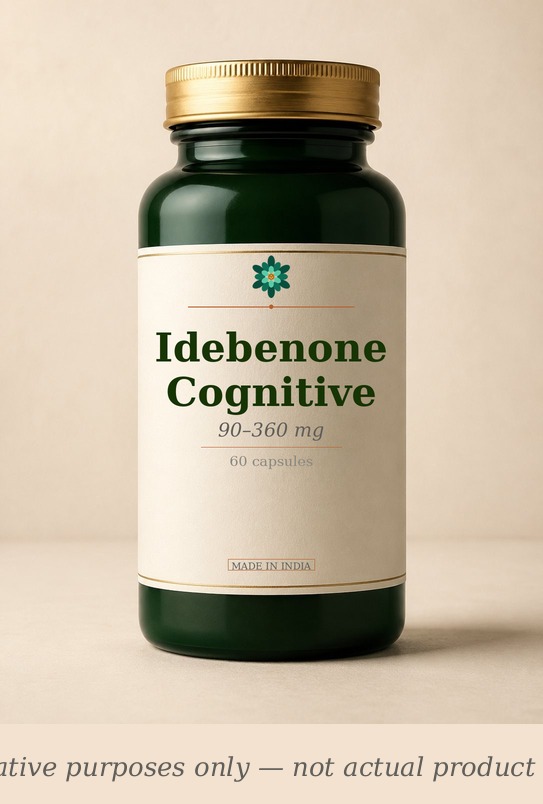
SacredBod's longer take on Idebenone Cognitive — context the structured blocks above don't capture.
What Is Idebenone?
Idebenone is what chemists call a “short-chain CoQ10 analogue.” It keeps the same redox-active benzoquinone head as CoQ10 but replaces the long, oily tail with a short hydroxydecyl chain. The result is a molecule that dissolves better in water, penetrates cell membranes faster and — most importantly — crosses the blood-brain barrier efficiently. While CoQ10 struggles to reach brain mitochondria in meaningful concentrations, idebenone arrives ready to work.
It is approved in Japan for Alzheimer’s disease and in the European Union as an orphan drug for Leber’s hereditary optic neuropathy (LHON). In India, it is not marketed by major pharmaceutical companies for dementia, but is available through import channels and compounding pharmacies.
How Does It Work?
Idebenone operates on three levels. First, as an electron carrier in the mitochondrial respiratory chain, it shuttles electrons from Complexes I and II to Complex III, maintaining ATP synthesis even when native CoQ10 is deficient. Second, as a potent lipid-soluble antioxidant, it neutralises peroxyl radicals in mitochondrial membranes, preventing the chain-reaction damage that kills neurons. Third, it modulates apoptosis signalling — upregulating anti-apoptotic Bcl-2 and downregulating caspase activity — which is critical in neurodegenerative diseases where premature cell death drives symptom progression.
Who Benefits Most?
- Alzheimer’s disease: The 1992 multicentre trial showed statistically significant improvements in memory, attention and behaviour after one month.
- Friedreich’s ataxia: High-dose idebenone (up to 2,250 mg/day) showed good tolerability and stabilised neurological function.
- LHON: The RODHOS randomised trial demonstrated efficacy in preserving visual function during the acute phase.
- Parkinson’s disease: Preclinical studies show protection against MPTP-induced dopaminergic neurotoxicity.
- Cognitive biohackers: Used at lower doses (90–180 mg) for mental clarity and neuroprotection.
Dosage Guide
- Cognitive support: 90 mg twice daily with meals.
- Neurodegenerative disease: 180–360 mg three times daily (540–1,080 mg total), under medical supervision.
- Mitochondrial disease (LHON/FA): Up to 2,250 mg/day in divided doses — specialist-only territory.
- Timing: Morning and midday with fat-containing meals.
- Form: Capsules or tablets; powder requires precise weighing.
Safety & Interactions
Idebenone is one of the best-tolerated mitochondrial drugs studied. Even at gram-level doses in FA, adverse effects were mild. The main caution is a theoretical reduction in warfarin effect (like CoQ10), so INR monitoring is advised. Rare liver enzyme elevations warrant periodic testing in long-term high-dose users.
India-Specific Context
Sanskrit/Hindi name: Not applicable — synthetic nootropic compound.
Availability: Idebenone is not available on Amazon.in and is not marketed by Indian pharma giants like Sun Pharma or Cipla. It can be sourced from international nootropic suppliers or compounded by specialty pharmacies in Mumbai, Bangalore or Hyderabad. It is not a Schedule H drug in India, meaning it does not require a prescription, but its orphan-drug status in Europe means supplies are limited.
Ayurvedic parallel: The “Medhya Rasayana” class of herbs — Brahmi, Shankhapushpi, Mandukaparni — targets the same cognitive domains as idebenone. A modern integrative approach might combine idebenone (mitochondrial energy) with Brahmi extract (acetylcholine support) and Ashwagandha (stress reduction) for comprehensive brain support.
Traditional use: None in Indian classical texts — this is a 20th-century synthetic mitochondrial agent.