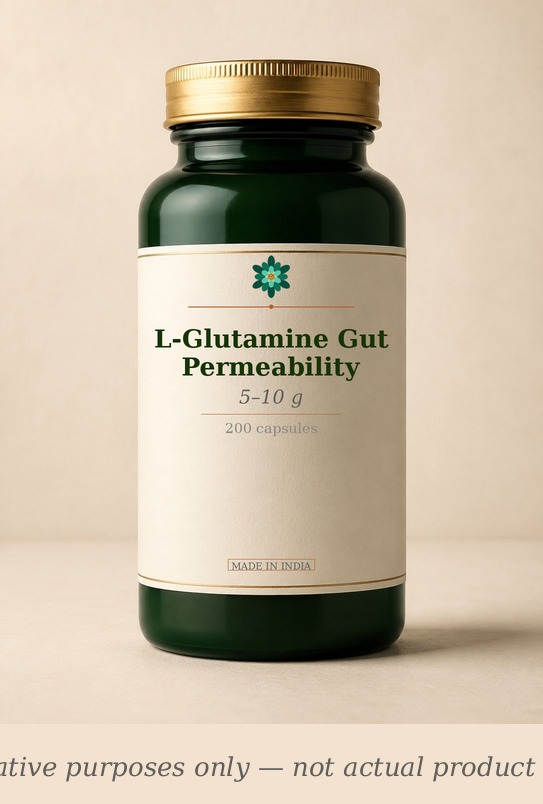
SacredBod's longer take on L-Glutamine Gut Permeability — context the structured blocks above don't capture.
What Is L-Glutamine for Gut Permeability?
L-Glutamine is not just a sports supplement for muscle recovery. It is the single most important nutrient for intestinal health. The cells lining your gut (enterocytes) are the fastest-dividing cells in the body, turning over every 3–5 days. They require enormous amounts of energy and building blocks — and glutamine is their preferred fuel.
When you are stressed, sick, exercising intensely or eating poorly, your body’s glutamine stores deplete. The gut is the first organ to suffer because it is the largest consumer of glutamine. Villi shrink, tight junctions loosen and the intestinal barrier becomes permeable — the “leaky gut” that allows toxins, undigested proteins and bacterial endotoxins to enter the bloodstream.
Supplemental L-glutamine at 5–10 g/day reverses this process. It is the foundational nutrient in every functional medicine leaky gut protocol.
How Does It Work?
Glutamine repairs the gut barrier through three validated mechanisms:
- Enterocyte fuel: Glutamine is the primary oxidative fuel for intestinal epithelial cells. It provides ATP for cell division, protein synthesis and mucus production. Without adequate glutamine, enterocytes atrophy and the barrier weakens.
- Tight junction synthesis: Glutamine activates CaMKK2-AMPK signalling, which upregulates tight junction proteins — occludin, claudin-1 and ZO-1. These proteins form the physical “zipper” that seals intestinal cells together.
- Heat shock protection: Glutamine induces HSP70 (heat shock protein 70), which protects enterocytes from stress-induced apoptosis and oxidative damage.
The 2014 exercise study demonstrated that 0.9 g/kg/day of glutamine for 7 days completely prevented exercise-induced intestinal permeability in endurance athletes — a remarkable finding that established glutamine as the go-to nutrient for gut barrier protection.
Who Benefits Most?
- Leaky gut sufferers: The foundational nutrient for barrier repair protocols.
- IBS and IBD patients: Supports mucosal healing and reduces inflammation.
- Athletes: Prevents exercise-induced GI distress and permeability.
- Food intolerance: Reduces antigen penetration through a sealed barrier.
- Post-surgical / post-infection: Supports rapid mucosal regeneration.
- Chronic fatigue: Leaky gut contributes to systemic inflammation and fatigue.
Dosage Guide
- Standard maintenance: 5 g daily.
- Therapeutic / leaky gut: 10 g daily in divided doses.
- High-dose / acute: 15–30 g daily for 1–2 weeks (as used in clinical trials).
- Timing: 5 g with breakfast, 5 g with dinner.
- Form: Powder dissolves in water, juice or smoothies. Capsules require many pills for gram doses.
- Duration: Minimum 4–8 weeks for chronic conditions; 1–2 weeks for acute exercise-induced permeability.
Safety & Interactions
Glutamine is extremely safe. The main considerations:
- Kidney disease: Impaired ammonia clearance; consult physician.
- Cancer: Theoretical concern that glutamine may fuel certain tumours; discuss with oncologist.
- Bipolar / seizures: Rare reports of mood or seizure effects at high doses.
India-Specific Context
Sanskrit/Hindi name: Not applicable — L-glutamine is a modern amino acid supplement.
Availability: L-glutamine powder is widely available on Amazon.in:
- Autoimmunity Care L-Glutamine 200g (ASIN B0CF2Q5LW7) — ₹649.
- AS-IT-IS Nutrition L-Glutamine 250g (ASIN B07B7LPP8C) — ₹699.
- HealthyHey L-Glutamine 300g (ASIN B082MKDZFS) — ₹749.
- MuscleBlaze L-Glutamine 250g (ASIN B07H3SP3YZ) — ₹600–700.
- Nutricost L-Glutamine 500g (ASIN B0C6J5XW1L) — imported, ~₹1,500.
It is not a Schedule H drug.
Ayurvedic parallel: The concept of “Kostha” (gastrointestinal tract) and “Agni” (digestive fire) in Charaka Samhita aligns with glutamine’s role in maintaining intestinal integrity. Shatavari (Asparagus racemosus) is the classical mucosal healing herb — it promotes the “Kledaka Kapha” that lubricates and protects the gut lining. A modern integrative approach might combine L-glutamine powder with Shatavari extract for comprehensive mucosal repair.
Traditional use: None in classical Indian medicine as an isolate. However, glutamine-rich foods (dairy, meat, beans, cabbage, beets) have been consumed traditionally. The isolated amino acid supplement is a 20th-century development.