SacredBod
0
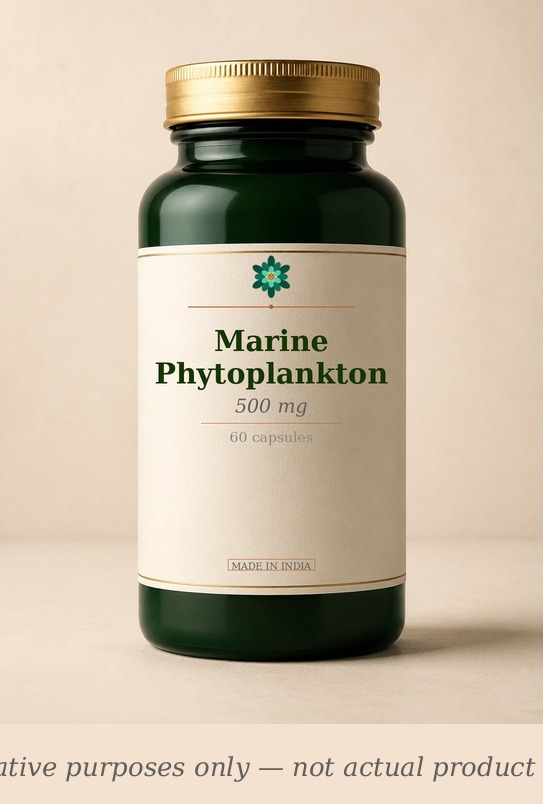
Marine Phytoplankton — SacredBod supplement bottle (illustrative)
Supplement · Whole-Food Nutrition

Marine Phytoplankton

500 mg · vegan · gluten-free · 60 caps

Low energyOmega-3 deficiencyPoor skin healthWeak immunityNutritional gaps BrainHeartSkinLiverImmune system
BUY on Amazon →

Affiliate link · we earn from qualifying purchases. No paid placements.

What it is

Marine phytoplankton (Nannochloropsis oceanica) is a microscopic green algae that forms the base of the ocean food chain. It is one of the most nutrient-dense organisms on Earth, containing complete protein (all essential amino acids), EPA omega-3 fatty acids, vitamins (A, B1, B2, B12, C, D, E, K), minerals, carotenoids (astaxanthin, lutein, zeaxanthin), and antioxidant enzymes (SOD, catalase, glutathione reductase).

How it works

Nannochloropsis provides EPA in polar lipid form (phospholipids and glycolipids) — which has 3x higher bioavailability than triglyceride-form fish oil EPA. The complete amino acid profile supports muscle protein synthesis and neurotransmitter production. Carotenoids activate Nrf2 antioxidant pathways. The combination addresses multiple nutritional gaps simultaneously, particularly for vegetarians and vegans who lack EPA from fish sources.

Who should take it

Vegans and vegetarians seeking EPA omega-3, individuals with low energy or nutritional deficiencies, those wanting a whole-food multivitamin alternative, and people interested in sustainable algae-based nutrition. Relevant for India's large vegetarian population lacking long-chain omega-3s.

Avoid / careful

People with severe autoimmune conditions without medical guidance (theoretical immune-stimulating concern), those with specific algae allergies. Side effects: Very safe. Marine phytoplankton is GRAS. Rarely: mild stomach upset or greenish stool coloration. The high chlorophyll content may cause temporary body odor changes.

When to take it

Morning
Noon
Evening
Night

How to take it

With food
Empty stomach
Before food

FAQs

Frequently asked

How long before I see omega-3 results?
The Omega-3 Index begins rising within 2–4 weeks. Significant changes in cholesterol markers require 8–12 weeks. Energy and vitality improvements may be noticed within 2–4 weeks.
Is it better than fish oil?
For vegetarians and vegans, absolutely — it's the only vegan EPA source. The polar lipid form has 3x higher bioavailability than fish oil triglycerides. For non-vegetarians, fish oil provides both EPA and DHA, while Nannochloropsis provides EPA only.
Is it safe to take daily?
Yes. Nannochloropsis is a food-grade microalgae with GRAS status. Daily doses of 500 mg–1 g are well-tolerated. The 2020 RCT used 1 g/day for 12 weeks with excellent safety.

In plain English

A plain-English read of the literature behind this supplement. Not a clinical recommendation.

Key citations: PMID 32585854 (Nannochloropsis EPA decreases cholesterol in RCT, 2020), PMID 39967180 (N. oceanica regulates gut microbiota & liver fibrosis, 2025), PMID 25708183 (Rapid EPA induction in Nannochloropsis, 2015)

Editorial notes

SacredBod's longer take on Marine Phytoplankton — context the structured blocks above don't capture.

Marine phytoplankton — Nannochloropsis oceanica — is the foundation of the ocean food chain and arguably the most nutrient-dense single cell on Earth. This microscopic green algae contains everything from complete protein and EPA omega-3 to rare carotenoids and antioxidant enzymes — all in a sustainable, vegan-friendly package.

What the Research Shows

A landmark 2020 randomized controlled trial (PMID 32585854) gave 120 healthy adults 1 g/day of Almega®PL — a polar lipid extract from Nannochloropsis — for 12 weeks. Results were striking: the Omega-3 Index increased significantly, VLDL cholesterol dropped by 25%, and total cholesterol decreased compared to placebo. Crucially, LDL did not increase — a benefit specific to EPA-only formulations unlike mixed EPA/DHA products.

A 2025 study (PMID 39967180) found that EPA-rich Nannochloropsis biomass protected against CCl4-induced liver fibrosis in rats, reduced inflammatory cytokines, and significantly increased beneficial SCFA-producing gut bacteria (Blautia, Limosilactobacillus reuteri). The effects were comparable to fish oil at equivalent EPA doses.

The 2015 study (PMID 25708183) demonstrated that UV-C radiation could rapidly induce EPA biosynthesis in Nannochloropsis, pushing EPA content to 30% of total fatty acids and 12% of dry weight — confirming its status as one of the most efficient EPA producers on the planet.

India Context

  • Availability: RawRX has pioneered Nannochloropsis-based vegan omega-3 supplements on Amazon India — marketed as “India’s first Omega 3 made from Nannochloropsis Algae Oil.” Products include capsules with 150 mg DHA, 30 mg EPA, and 100 mg ALA per serving.
  • Price: ₹800–₹1,500 for 90 capsules (3-month supply)
  • Vegetarian relevance: With 30–40% of India’s population vegetarian, Nannochloropsis fills a critical nutritional gap. Indians have very low EPA/DHA levels due to limited fish consumption.
  • Sustainability: Unlike fish oil (which depletes ocean stocks), Nannochloropsis is grown in controlled bioreactors with minimal environmental impact. This aligns with India’s growing sustainability consciousness.

Dosage & Safety

  • Standard dose: 500 mg–1 g daily with food
  • Omega-3 protocol: 1 g daily for cholesterol support
  • Best time: Morning with breakfast
  • Caution: Very safe. GRAS status. The chlorophyll content may cause temporary greenish stool — harmless. Not for those with specific algae allergies.

Added to your stack.