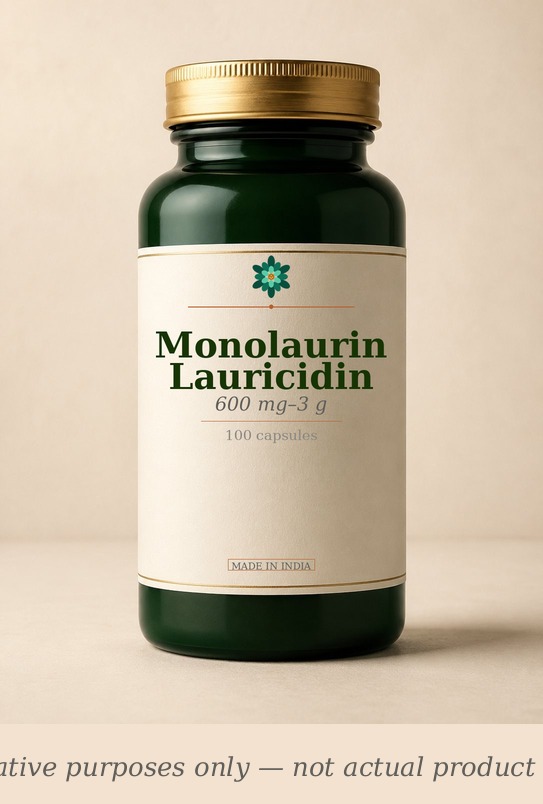
SacredBod's longer take on Monolaurin Lauricidin — context the structured blocks above don't capture.
What Is Monolaurin?
Monolaurin is nature’s detergent. It is a simple molecule — one lauric acid molecule attached to one glycerol molecule — that occurs naturally in coconut oil and human breast milk. This molecule has a unique talent: it dissolves the fatty outer coats (envelopes) of viruses and bacteria while leaving human cells unharmed.
The discovery dates to the 1960s, when researchers noticed that human breast milk protected infants from infections. They isolated monolaurin as one of the key protective factors. Today, it is FDA GRAS (Generally Recognized As Safe) and used as a food preservative. As a supplement, it offers broad-spectrum antimicrobial defence without the side effects or resistance issues of pharmaceutical antibiotics.
In India, monolaurin is relatively new but gaining traction among those seeking natural antiviral support, especially for herpes and recurrent infections.
How Does It Work?
Monolaurin is a surfactant — a fat-soluble molecule with a water-loving head. This dual nature allows it to insert itself into microbial lipid membranes and literally pull them apart:
- Enveloped viruses: Herpes simplex, influenza, HIV, coronaviruses and Zika all have lipid envelopes. Monolaurin disrupts these envelopes, rendering the virus non-infectious. Electron microscopy shows complete envelope disintegration after monolaurin exposure.
- Gram-positive bacteria: Staphylococcus aureus (including MRSA), Streptococcus pyogenes, Listeria and Bacillus anthracis are all susceptible. Monolaurin is up to 200 times more potent than lauric acid alone.
- Biofilms: Monolaurin prevents biofilm formation and disrupts existing biofilms, making it valuable for chronic infections and Candida overgrowth.
- Exotoxin blockade: Prevents the release of toxic shock syndrome toxin and streptococcal pyrogenic exotoxins.
Who Benefits Most?
- Herpes sufferers: In vitro studies show potent HSV-1 and HSV-2 inhibition. Anecdotal clinical reports cite reduced outbreak frequency and severity.
- People with recurrent infections: Broad-spectrum antimicrobial support for those with frequent colds, flu, sore throats or skin infections.
- Gut dysbiosis: Targets pathogenic gram-positive bacteria and Candida while sparing beneficial Lactobacillus species.
- Travellers: Natural defence against foodborne pathogens and travel-related infections.
- Biohackers: Part of a “natural antimicrobial” stack alongside oregano oil and berberine.
Dosage Guide
- Maintenance: 600 mg–1 g daily.
- Acute infection: 1.5–3 g daily in divided doses.
- High-dose / biofilm: Up to 5 g daily under supervision.
- Timing: With meals to enhance absorption and reduce nausea.
- Form: Capsules or pellets (Lauricidin). Powder is sticky and difficult to handle.
- Ramp-up: Start at 600 mg and increase by 600 mg every 3 days to avoid GI upset.
Safety & Interactions
Monolaurin has an exceptional safety profile. It is a normal food component. The main issue is gastrointestinal tolerance at high doses. No drug interactions are known. The only contraindication is coconut allergy (rare but possible).
India-Specific Context
Sanskrit/Hindi name: Not applicable — monolaurin is a modern biochemical isolate, though its source (coconut, नारियल) is deeply embedded in Indian culture and Ayurveda.
Availability:
- Natural Cure Labs Premium Monolaurin 600 mg, 100 capsules (ASIN B017RHHEVG) — imported via Amazon.in at ~₹2,000–2,500.
- Lauricidin pellets — not consistently stocked on Amazon.in; typically sourced from US distributors.
- Generic monolaurin capsules — search Amazon.in Global Store for “glycerol monolaurate” or “monolaurin 600 mg.”
It is not a Schedule H drug.
Ayurvedic parallel: Coconut oil (नारियल तेल) is extensively used in Ayurveda for skin health, oil pulling and wound healing. Its antimicrobial properties are well-known in traditional practice. Monolaurin can be viewed as the “concentrated active principle” of coconut’s immune benefits. Neem (Azadirachta indica) and Tulsi (Ocimum sanctum) are the classical Ayurvedic antimicrobials that pair well with monolaurin for comprehensive natural infection defence.
Traditional use: Coconut has been used in Indian medicine for thousands of years for its cooling, antimicrobial and nourishing properties. Monolaurin as an isolated supplement is a 20th-century development.