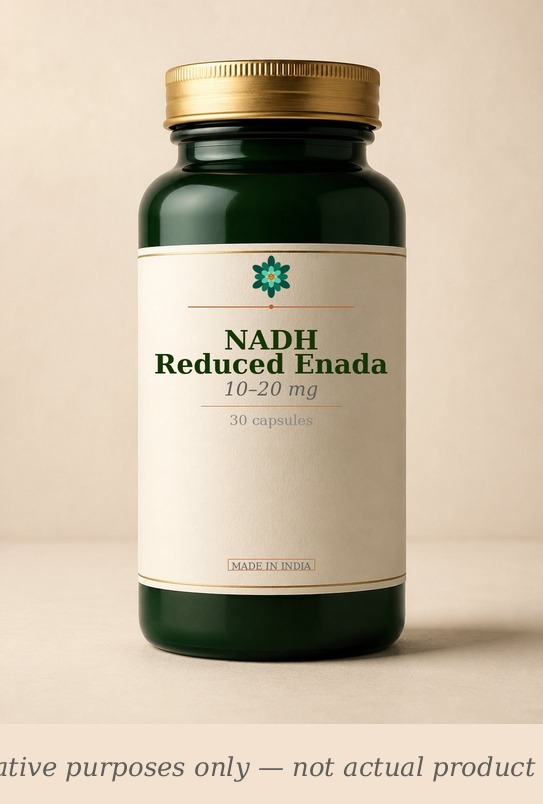
SacredBod's longer take on NADH Reduced Enada — context the structured blocks above don't capture.
What Is NADH Reduced Enada?
NADH is the reduced, electron-charged form of nicotinamide adenine dinucleotide — essentially vitamin B3 after it has been activated and loaded with energy. Every ATP molecule your body makes depends on NADH feeding electrons into the mitochondrial engine. ENADA is a patented stabilisation technology that protects this fragile molecule from stomach acid, allowing it to reach the small intestine intact. Without stabilisation, oral NADH is largely destroyed before absorption.
In India, NADH is slowly gaining recognition among biohackers and functional-medicine practitioners, though it remains far less known than Nicotinamide Riboside (NR) or NMN.
How Does It Work?
NADH performs two critical jobs. First, it is the primary electron donor to Complex I of the electron transport chain — the entry point where fuel meets oxygen to make ATP. More NADH means more electrons, which means more proton pumping, which means more ATP. Second, NADH is required as a cofactor for the synthesis of dopamine, serotonin and noradrenaline, explaining its mood and cognitive benefits. It also regenerates the body’s master antioxidant, glutathione.
Who Benefits Most?
- Chronic fatigue syndrome / ME: The 1999 crossover RCT showed 31% response rate vs. 8% placebo. The 2021 large RCT confirmed CoQ10 + NADH significantly reduced cognitive fatigue.
- Parkinson’s disease: Open-label trials showed 20–80% of patients experienced reduced disability; younger patients with shorter disease duration responded best.
- Depression-related fatigue: NADH’s role in neurotransmitter synthesis makes it useful for anergic depression where standard antidepressants fail.
- Cognitive decline: Improves attention, processing speed and mental clarity in age-related fatigue.
Dosage Guide
- Standard dose: 10–20 mg daily, taken on an empty stomach 30 minutes before breakfast.
- Maintenance: 5–10 mg daily.
- Timing: Morning only — late-day dosing can cause insomnia.
- Form: Stabilised tablets (ENADA) or enteric-coated capsules. Avoid non-stabilised powders.
Safety & Interactions
NADH is remarkably safe. It is a naturally occurring metabolite, and excess is rapidly excreted. The main caution is timing — morning dosing prevents sleep disruption. People with bipolar disorder should start low and monitor mood. Separate from levodopa by at least 2 hours to avoid absorption competition.
India-Specific Context
Sanskrit/Hindi name: Not applicable — NADH is a biochemical coenzyme.
Availability: Ecological Formulas NADH 5 mg (ASIN B009603AV6) is available on Amazon.in Global Store at approximately ₹5,465 for 120 tablets. Higher-dose ENADA (10–20 mg) is rarely stocked on Amazon.in and usually sourced from iHerb or European distributors. It is not a Schedule H drug.
Ayurvedic parallel: The concept of “Agni” (digestive and metabolic fire) in Charaka Samhita aligns with NADH’s role in cellular combustion. Ayurvedic practitioners might pair NADH with Trikatu or Pippali to enhance metabolic fire, though this combination is not classical.
Traditional use: None in Indian medicine — this is a modern mitochondrial electron donor.