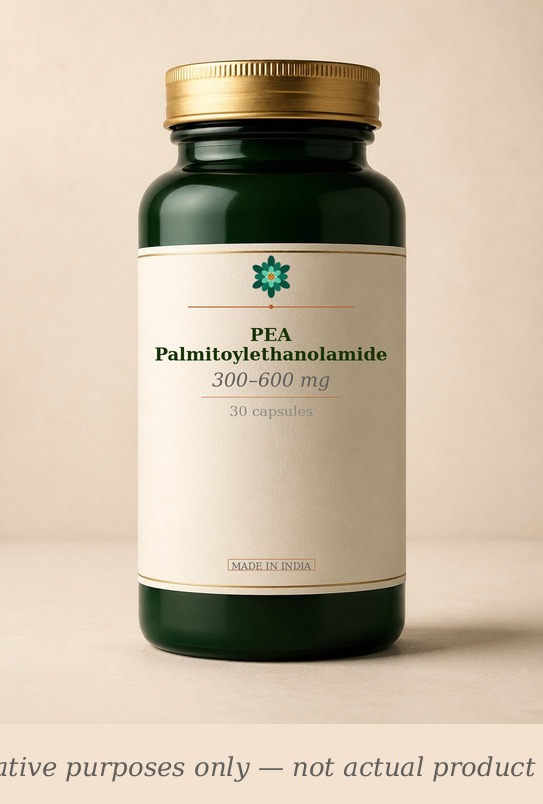
SacredBod's longer take on PEA Palmitoylethanolamide — context the structured blocks above don't capture.
What Is PEA?
Palmitoylethanolamide (PEA) is a mouthful of a name for a simple concept: it is a fatty acid amide that your body makes on demand when tissues are injured or inflamed. It belongs to the same chemical family as the endocannabinoid anandamide, but unlike THC or CBD, it does not bind to CB1 or CB2 receptors — so there is no psychoactivity, no high, no impairment.
The “ultra-micronised” (um-PEA) formulation is critical. Standard PEA has poor bioavailability because its particles are too large to dissolve efficiently. Ultra-micronisation reduces particle size to under 10 microns, increasing absorption by approximately 2-fold and accelerating onset of pain relief. This is the form used in the majority of clinical trials.
In India, PEA is emerging as a premium neuropathic pain supplement, particularly for fibromyalgia and sciatica patients who have exhausted conventional options.
How Does It Work?
PEA operates through three complementary mechanisms:
- PPAR-α activation: PEA binds to peroxisome proliferator-activated receptor-alpha, a nuclear receptor that turns off inflammatory genes and reduces mast cell activation — the root of neuroinflammation.
- FAAH inhibition: By reducing the enzyme that breaks down anandamide, PEA indirectly increases the body’s own “bliss molecule” — enhancing endocannabinoid tone without external cannabinoids.
- Mast cell stabilisation: Mast cells release histamine and inflammatory cytokines that sensitise nerves. PEA stabilises mast cell membranes, reducing peripheral sensitisation and central wind-up.
The 2023 meta-analysis of um-PEA in chronic pain demonstrated statistically significant reductions in VAS pain scores across multiple neuropathic and inflammatory pain conditions.
Who Benefits Most?
- Fibromyalgia patients: The n=407 trial showed significant improvements in pain, fatigue and quality of life.
- Neuropathic pain sufferers: Diabetic neuropathy, post-herpetic neuralgia, chemotherapy-induced neuropathy.
- Sciatica and radiculopathy: PEA’s anti-neuroinflammatory effect targets nerve root inflammation.
- CRPS (Complex Regional Pain Syndrome): Emerging evidence supports PEA as adjunctive therapy.
- Carpal tunnel syndrome: Reduces median nerve inflammation and improves symptoms.
- Endometriosis pain: Mast cell stabilisation addresses the inflammatory component of endometriotic lesions.
Dosage Guide
- Standard dose: 300–600 mg twice daily (600–1,200 mg total).
- Loading protocol: 600 mg three times daily for the first 2–4 weeks, then reduce to maintenance.
- Maintenance: 300–600 mg once or twice daily.
- Timing: With meals containing fat (ghee, nuts, avocado) to enhance absorption.
- Form: Capsules or powder. Ultra-micronised is essential — do not buy non-micronised PEA.
Safety & Interactions
PEA has one of the best safety profiles in pain medicine. It is endogenous, non-addictive and non-psychoactive. No drug interactions are known. The main caution is theoretical with warfarin (fatty acid metabolism overlap), so monitor INR if combining.
India-Specific Context
Sanskrit/Hindi name: Not applicable — PEA is a modern biochemical compound discovered in the mid-20th century.
Availability: PEA supplements are now available on Amazon.in:
- NutraLiebe PEA 400 mg, 90 capsules (ASIN B0DHWH5KCN) — ₹1,200–1,500.
- Nervana Pro Micronized PEA 600 mg, 30 capsules (ASIN B0CVL7MGDD) — ₹679.
- Nervana Micronized PEA 400 mg, 30 capsules (ASIN B09S6BL23P) — ₹450–550.
- Nervana Ultra Micronized PEA Powder 1200 mg (ASIN B0F7ZN4HCV) — powder option.
It is not a Schedule H drug in India.
Ayurvedic parallel: The concept of “Vata” imbalance in Ayurveda — which manifests as nerve pain, tingling and hypersensitivity — aligns with PEA’s neuropathic pain mechanism. A modern integrative practitioner might pair PEA with Ashwagandha (nervine tonic) and Shallaki (anti-inflammatory) for a comprehensive pain management approach.
Traditional use: None in Indian classical medicine. PEA was first isolated from egg yolk, peanuts and soybean lecithin in the 1950s and its pain-modulating properties were elucidated in the 1990s.