SacredBod
0
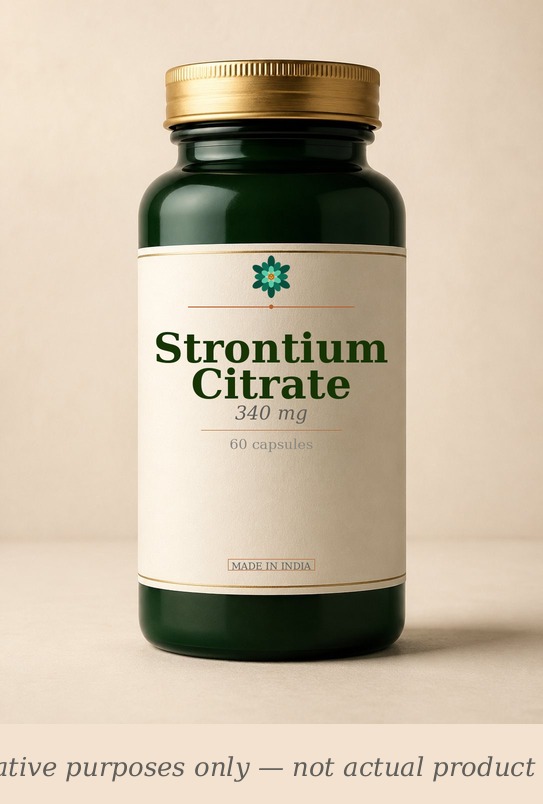
Strontium Citrate — SacredBod supplement bottle (illustrative)
Supplement · Bone Density Builder

Strontium Citrate

340 mg · vegan · gluten-free · 60 caps

OsteoporosisOsteopeniaBone fracturesLow BMDPostmenopausal bone loss BonesTeeth
BUY on Amazon →

Affiliate link · we earn from qualifying purchases. No paid placements.

What it is

Strontium citrate is the natural, non-prescription form of strontium — an alkaline earth metal chemically similar to calcium. It is the active ingredient in the European prescription drug Protelos (strontium ranelate), which reduced vertebral fracture risk by 41% and hip fracture risk by 36% in clinical trials. Strontium citrate provides the same bone-building element in a dietary supplement form available without prescription.

How it works

Strontium has a unique dual mechanism: it stimulates osteoblasts (bone-building cells) to produce more bone matrix, while simultaneously inhibiting osteoclasts (bone-resorbing cells) from breaking down existing bone. It also incorporates into the bone crystal structure (replacing ~1 in 10 calcium atoms), increasing bone mineral density readings. Strontium citrate is approximately 25% elemental strontium by weight.

Who should take it

Postmenopausal women with osteoporosis or osteopenia, individuals who cannot tolerate bisphosphonates, those seeking a non-prescription bone density strategy, and people with a family history of fractures. Relevant for Indian women facing rising osteoporosis rates and limited access to prescription osteoporosis drugs.

Avoid / careful

People with a history of blood clots or DVT, those with severe kidney disease, pregnant or breastfeeding women, children, individuals with phenylketonuria (if chewable forms contain aspartame). Side effects: Generally well-tolerated. May cause mild stomach upset, diarrhea, or headache. Rarely: skin rash or increased blood clot risk (theoretical, based on ranelate data). Strontium citrate is safer than the prescription ranelate form, which had rare cardiovascular concerns.

When to take it

Morning
Noon
Evening
Night

How to take it

With food
Empty stomach
Before food

FAQs

Frequently asked

How long before I see results?
Bone turnover markers shift within 3 months. DEXA-measurable BMD improvements require 6–12 months. The SOTI trial showed significant vertebral fracture reduction at 1 year, with benefits increasing through 3 years.
Is it safe to take daily?
Yes at 340 mg/day. Strontium citrate has been safely used for years as a dietary supplement. The prescription form (strontium ranelate) had rare cardiovascular concerns that led to restricted use in Europe, but these have not been reported with the citrate form.
Can I take it with my calcium supplement?
Yes, but separate by at least 2 hours. Calcium and strontium compete for absorption in the gut. Take strontium at bedtime and calcium with meals for optimal absorption of both.

In plain English

A plain-English read of the literature behind this supplement. Not a clinical recommendation.

Key citations: PMID 18432620 (SOTI trial — 41% vertebral fracture reduction, 2004), PMID 19680282 (TROPOS trial — 36% hip fracture reduction, 2008), PMID 20075873 (Strontium ranelate meta-analysis, 2010)

Editorial notes

SacredBod's longer take on Strontium Citrate — context the structured blocks above don't capture.

Strontium citrate is the natural form of one of the most powerful bone-building minerals ever discovered — the same element that reduced vertebral fractures by 41% in the landmark European SOTI trial, now available as an affordable dietary supplement.

What the Research Shows

The SOTI trial (PMID 18432620) randomized 1649 postmenopausal women with osteoporosis to strontium ranelate or placebo for 3 years. Results were extraordinary: a 41% reduction in vertebral fractures at 1 year, increasing to 49% at 3 years. BMD increased by 14.4% at the lumbar spine and 8.3% at the femoral neck.

The TROPOS trial (PMID 19680282) in 5091 women showed a 36% reduction in hip fracture risk and a 16% reduction in non-vertebral fractures. These are among the most impressive results in osteoporosis pharmacotherapy.

A 2010 meta-analysis (PMID 20075873) confirmed that strontium reduces vertebral, non-vertebral, and hip fractures in postmenopausal osteoporosis, with a safety profile superior to bisphosphonates for long-term use.

Strontium citrate provides the same elemental strontium as the prescription ranelate salt, but without the rare cardiovascular side effects that led to European restrictions on ranelate. The citrate form is well-absorbed and safe for daily supplementation.

India Context

  • Availability: Swanson and Nature’s Life offer strontium citrate capsules on Amazon India. NOW Foods and Doctor’s Best products are available as imports.
  • Price: ₹800–₹1,500 for 60 capsules
  • Relevance for India: India has ~50 million women with low bone mass, yet prescription osteoporosis drugs (bisphosphonates, denosumab) are expensive and poorly accessible in rural areas. Strontium citrate offers an affordable, effective alternative that does not require refrigeration or medical supervision.
  • Regulatory: Strontium citrate is a dietary supplement, not a drug. It is not Schedule H. However, the prescription form (strontium ranelate) is not marketed in India.
  • Ayurvedic parallel: Strontium’s bone-building role aligns with Praval pishti (coral calcium), Mukta pishti (pearl calcium), and Asthi shrinkhala (Cissus quadrangularis) used in Ayurveda for bone fractures and osteoporosis.

Dosage & Safety

  • Standard dose: 340 mg strontium citrate at bedtime (~680 mg elemental strontium)
  • Best time: At bedtime on an empty stomach
  • Critical caution: Separate from calcium, magnesium, and bisphosphonates by at least 2 hours. Do not exceed recommended dose. Monitor for blood clot risk if you have a history of DVT. Not for pregnancy.

Added to your stack.