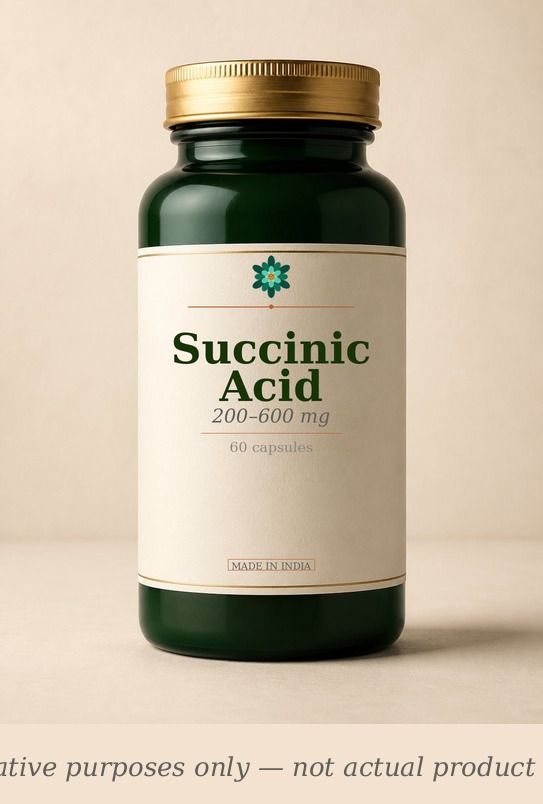
SacredBod's longer take on Succinic Acid — context the structured blocks above don't capture.
What Is Succinic Acid?
Succinic acid — also called amber acid because it was first isolated from Baltic amber — is a humble four-carbon molecule that sits at the very heart of cellular respiration. Every time you breathe, every time your heart beats, succinic acid is being formed and consumed in the mitochondrial matrix. It is so central to life that the enzyme that processes it, succinate dehydrogenase, is simultaneously part of the Krebs cycle and the electron transport chain (as Complex II).
In Russia and Eastern Europe, succinic acid has been used for decades as an over-the-counter anti-fatigue and adaptogenic agent. In India, it is virtually unknown as a supplement, though it appears in cosmetic formulations and as a food additive.
How Does It Work?
Succinic acid offers a unique “backdoor” into ATP production. While glucose must traverse glycolysis, pyruvate dehydrogenase and multiple TCA steps to reach the electron transport chain, succinic acid enters directly at Complex II. This means:
- Rapid ATP precursor delivery: Especially useful when upstream metabolic pathways are compromised.
- Hypoxia adaptation: Succinate accumulation signals low-oxygen stress and triggers protective HIF responses that precondition cells against future damage.
- Antioxidant preconditioning: Low-level succinate stress “hardens” mitochondria against larger oxidative insults — a hormetic effect.
Who Benefits Most?
- General fatigue: Popular in Russian medicine for non-specific tiredness and convalescence.
- Athletes: May improve lactate clearance and oxygen utilisation at the cellular level.
- Altitude travellers: Succinate metabolism is oxygen-efficient; some evidence suggests improved tolerance to hypobaric hypoxia.
- Mitochondrial disease patients: Those with Complex I deficiencies may bypass the bottleneck via Complex II.
- Adaptogen seekers: Provides cellular-level stress resistance without the adrenal stimulation of classical adaptogens.
Dosage Guide
- Standard dose: 200–600 mg daily, divided into two or three doses.
- Timing: With meals to reduce gastric acidity.
- Form: Tablets or capsules; powder is extremely acidic and must be buffered.
- Cycling: Not required, but some users prefer 5-days-on, 2-days-off.
Safety & Interactions
Succinic acid is exceptionally safe. It is a normal cellular metabolite and a GRAS food additive. The only issue is gastric acidity — the molecule is, after all, an acid. Those with ulcers or reflux should use enteric-coated forms or take it with substantial food. No significant drug interactions are known.
India-Specific Context
Sanskrit/Hindi name: Not applicable — biochemical metabolite.
Availability: Succinic acid is not available as a dietary supplement on Amazon.in. Listings are limited to cosmetic-grade powder (for serums and creams) or industrial chemicals. Ingestible pharmaceutical-grade succinic acid tablets must be imported from Russia, Ukraine or Eastern European pharmacies. It is not a Schedule H drug.
Ayurvedic parallel: Shilajit (Sanskrit: शिलाजतु) is the closest Ayurvedic equivalent. Charaka Samhita describes Shilajit as a “conqueror of mountains and destroyer of weakness.” Modern analysis shows Shilajit contains dibenzo-alpha-pyrones and fulvic acid that enhance mitochondrial electron transport — functionally similar to succinic acid’s Krebs cycle support. A traditional practitioner might view succinic acid as a ” purified Shilajit fraction.”
Traditional use: None in classical Indian medicine, but Shilajit’s mitochondrial role provides conceptual continuity.