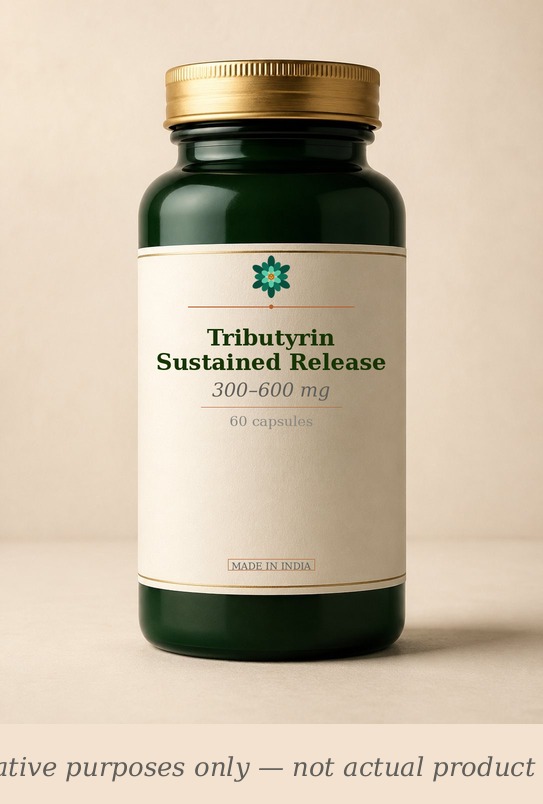
SacredBod's longer take on Tributyrin Sustained Release — context the structured blocks above don't capture.
What Is Tributyrin?
Tributyrin is butyrate in its most natural packaging. In butter and ghee (clarified butter), butyric acid exists primarily as tributyrin — a triglyceride with three butyrate molecules attached to a glycerol backbone. This molecular arrangement is not accidental: it protects butyrate from stomach acid, allows it to travel intact to the small intestine and colon, and then releases it gradually through the action of pancreatic and intestinal lipases.
Sodium butyrate, by contrast, dissolves almost immediately upon reaching the stomach. Much of it is absorbed in the small intestine and never reaches the distal colon — the very place where butyrate is most needed. Tributyrin solves this pharmacokinetic problem elegantly.
In India, where ghee is a dietary staple, tributyrin is consumed daily in small amounts (ghee contains ~3–4% butyrate, mostly as tributyrin). However, therapeutic doses require supplementation.
How Does It Work?
Tributyrin’s sustained-release mechanism provides unique advantages:
- Colonic targeting: The triglyceride structure survives gastric transit and reaches the ileum and colon intact.
- Gradual hydrolysis: Lipases cleave butyrate from the glycerol backbone over 4–6 hours, providing sustained colonocyte fuel.
- Superior bioavailability: Animal studies show tributyrin achieves 3x higher colonic butyrate concentrations than equivalent doses of sodium butyrate.
- Anti-inflammatory cascade: Sustained GPR109A activation maintains immune tolerance and reduces NF-kappaB signalling over extended periods.
The 2020 study demonstrated that tributyrin reduced IL-1β and TNF-alpha in adipose tissue while increasing IL-10 and M2 macrophages — a comprehensive anti-inflammatory reprogramming.
Who Benefits Most?
- IBD patients: Sustained colonic delivery is ideal for ulcerative colitis and Crohn’s disease.
- IBS sufferers: Reduces visceral hypersensitivity through gut barrier repair.
- Metabolic syndrome: Improves insulin sensitivity and reduces systemic inflammation.
- Leaky gut: Provides distal colon barrier support where sodium butyrate may not reach.
- Post-surgical GI recovery: Supports anastomosis healing and mucosal regeneration.
- Biohackers: Those seeking the most bioavailable butyrate delivery system.
Dosage Guide
- Standard dose: 300–600 mg daily.
- Therapeutic / IBD: 600–1,000 mg daily in divided doses.
- Timing: With meals containing some fat to stimulate lipase secretion.
- Form: Capsules or liquid. Liquid tributyrin has an extremely strong odour.
- Duration: Minimum 4–8 weeks for gut benefits; 8–12 weeks for metabolic effects.
Safety & Interactions
Tributyrin is extremely safe — it is literally a food component. The main considerations:
- Pancreatic insufficiency: Reduced lipase activity may impair hydrolysis.
- Orlistat: This weight-loss drug inhibits lipases and may reduce tributyrin absorption.
- Gallbladder disease: Fat digestion may be impaired.
India-Specific Context
Sanskrit/Hindi name: Not applicable — tributyrin is a biochemical constituent of ghee.
Availability: Tributyrin is not widely available as a standalone supplement on Amazon.in. The Humming Herbs product (ASIN B0GJDW13DG) is sodium butyrate, not tributyrin. Indian buyers typically:
- Import CoreBiome or Butyricum tributyrin from iHerb or US vendors.
- Use ghee therapeutically (1–2 tablespoons daily provides ~1–2 g butyrate as tributyrin).
- Request compounding from specialty pharmacies in Mumbai, Bangalore or Delhi.
It is not a Schedule H drug.
Ayurvedic parallel: Ghee (Sanskrit: घृत, Ghrita) is perhaps the most sacred substance in Ayurveda. Charaka Samhita describes it as the ultimate Rasayana — promoting intellect, memory, digestion and longevity. Modern science now understands that ghee’s tributyrin content contributes to its gut-healing and anti-inflammatory properties. A modern integrative practitioner might view supplemental tributyrin as “concentrated ghee extract” — delivering the active principle without the calories.
Traditional use: Ghee has been used in India for over 5,000 years as food, medicine and ritual offering. Every Ayurvedic preparation uses ghee as a carrier (anupana) to enhance absorption. The tributyrin in ghee is now recognised as a key bioactive component responsible for many of its traditional benefits.