
India’s wellness market is growing fast, but with hundreds of products on Amazon.in and little standardisation, knowing what to actually buy is harder than it should be. This guide covers Kutaj from first principles — what it is, how it works, who it suits, and how to use it safely.
What is Kutaj?
Kutaj (Holarrhena antidysenterica Wall., also called H. pubescens or Kurchi), is a deciduous tree in the Apocynaceae family native to India, Nepal, and Southeast Asia. Its bark and seeds are among the most important anti-dysenteric remedies in Ayurveda. The bark contains steroidal alkaloids (conessine, conessimine, holarrhenine), tannins, and flavonoids. It is classified as Tikta-Kashaya (bitter-astringent) rasa and Shita virya (cooling potency). Mentioned in Charaka Samhita for Atisara (diarrhea), Pravahika (dysentery), and Kustha (skin diseases). The seeds are used as anthelmintic.
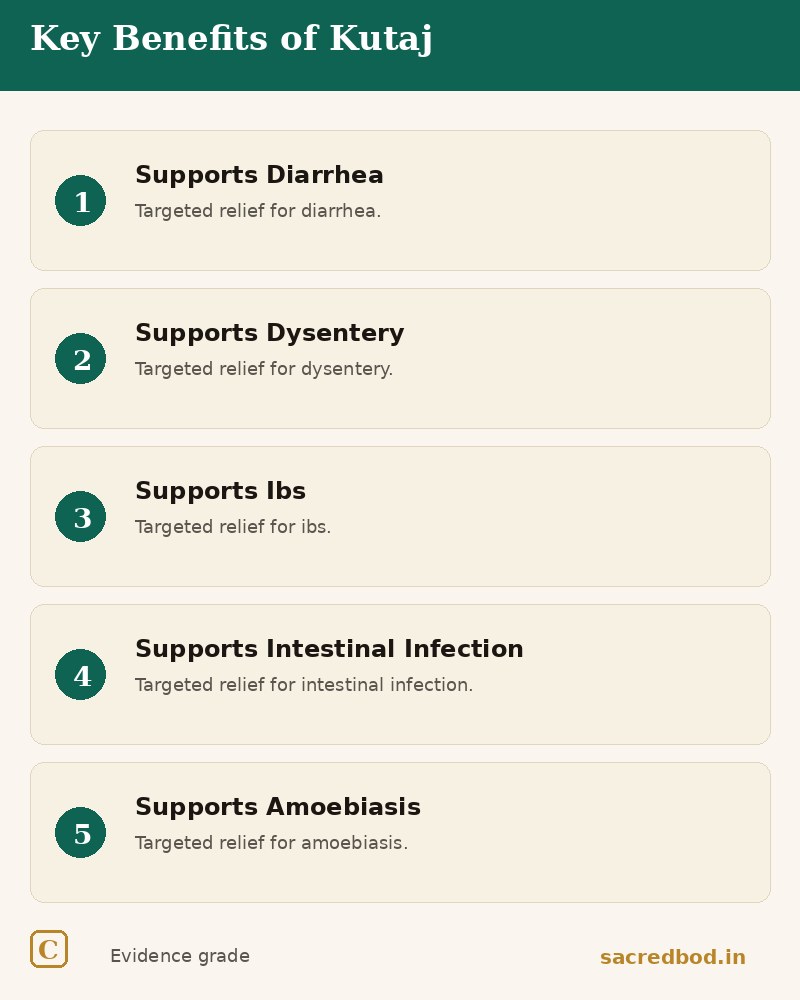
It sits in the Botanical category and is most relevant for people dealing with diarrhea, dysentery, ibs.
How does Kutaj work?
The steroidal alkaloids (conessine, conessimine) are the primary bioactives responsible for anti-amoebic and anti-bacterial activity against enteropathogens including E. coli, Shigella, Salmonella typhi, and Vibrio cholerae. The bark extract reduces intestinal secretions by inhibiting enterotoxin production and blocks bacterial adherence to intestinal epithelium. Anti-diarrheal activity is evidenced by increased feces dry weight and reduced defecation frequency in castor oil-induced diarrhea models. A 1986 clinical study showed 70% good response in Entamoeba histolytica cyst passers. The alkaloids also demonstrate CNS-stimulant, anti-inflammatory, and hypoglycaemic activities.
It primarily acts on the intestines, colon, liver, stomach, and effects are dose-dependent rather than immediate.
Who should consider Kutaj?
Individuals with acute or chronic intestinal issues (diarrhea, dysentery, IBS) seeking Ayurvedic gut support. Those with amoebic concerns (under medical supervision). People interested in classical Ayurvedic intestinal herbs. Note: Not a replacement for antibiotics or antiparasitic medication in severe infections.
How much Kutaj should you take?
A typical dose is 500 mg, best taken with food, usually in the morning. Most people can expect noticeable effects within 3–7 days for acute intestinal symptoms; 2–4 weeks for chronic gut support. Consistency matters more than a single large dose.
Safety and who should avoid it
Pregnant and breastfeeding women. Individuals with severe constipation or intestinal obstruction. Those with CNS hyperexcitability or seizure disorders (alkaloids have CNS-stimulant activity). Not for children under 12 without medical supervision.
Side effects: Generally well-tolerated at 500 mg/day. High doses may cause constipation due to astringent action. Bark alkaloids may cause mild CNS stimulation. Rare nausea or abdominal cramping.
How to combine Kutaj
Kutaj is often layered into a broader protocol rather than taken alone. See the “Goes with” panel on its product page for evidence-aligned pairings, and introduce one new supplement at a time so you can attribute any change to the right product.
Frequently asked questions
Is Kutaj available in India? Yes — it is sold on Amazon.in. Prioritise standardised, third-party-tested products.
How long until it works? Around 3–7 days for acute intestinal symptoms; 2–4 weeks for chronic gut support.
Can vegetarians take it? Check the label for a vegetable-cellulose capsule rather than gelatin.
What to realistically expect
Supplements rarely produce dramatic overnight change. With an evidence grade of C, Kutaj is best understood as a steady, cumulative input rather than a quick fix. Expect gradual rather than sudden change over 3–7 days for acute intestinal symptoms; 2–4 weeks for chronic gut support, and measure against your own baseline. If after a fair trial at 500 mg you notice nothing — subjectively or on relevant lab markers — that is useful information, and it is reasonable to stop.
Storage and stability
Heat and humidity are real considerations across much of India. Store Kutaj in a cool, dry place away from direct sunlight, keep the bottle tightly closed, and avoid leaving it in a hot car or on a sunny kitchen shelf. A capsules kept in stable conditions retains potency far better than one repeatedly exposed to monsoon humidity. If your product arrives with a desiccant sachet, leave it in the bottle.
How to track whether it is working
The most objective approach is to measure before and after. Keep a simple weekly log of the specific outcome you care about, and where relevant test Stool pathogens, Blood glucose, Intestinal inflammation before starting Kutaj and again at 8-12 weeks. Interpreting a number against your own baseline — and against how you feel — is far more reliable than reacting to day-to-day fluctuations. The SacredBod analyzer can track blood marker changes across reports over time.
Where to buy Kutaj in India
Kutaj is available on Amazon.in. When buying, prioritise products that state the standardised active percentage, third-party testing (NSF, USP or Informed Sport), and a clear vegetarian-capsule declaration if that matters to you. Use the buy button on the Kutaj page to see the current verified listing with the SacredBod tag.
This article is for informational purposes only. Consult a qualified healthcare provider before starting any supplement, especially if you take prescription medication or have a medical condition.
Supplements mentioned
People also ask
Is Kutaj available in India?
Yes, Kutaj is available on Amazon.in. Look for standardised, third-party-tested products with a clear label.
What is the typical Kutaj dose?
A typical dose is 500 mg, taken with food. Always follow the product label and your clinician's advice.
How long does Kutaj take to work?
About 3–7 days for acute intestinal symptoms; 2–4 weeks for chronic gut support.
Keep reading
- ZMA: complete India guide
Everything you need to know about ZMA — mechanism, dose, safety, buying guide for India, and what the research actually says.
- Zinc: complete India guide
Everything you need to know about Zinc — mechanism, dose, safety, buying guide for India, and what the research actually says.
- Yohimbine HCl: complete India guide
Everything you need to know about Yohimbine HCl — mechanism, dose, safety, buying guide for India, and what the research actually says.