
India’s wellness market is growing fast, but with hundreds of products on Amazon.in and little standardisation, knowing what to actually buy is harder than it should be. This guide covers Nagarmotha from first principles — what it is, how it works, who it suits, and how to use it safely.
What is Nagarmotha?
Nagarmotha (Cyperus rotundus L.), also called Mustaka or Nut Grass, is a perennial sedge in the Cyperaceae family. Despite being considered one of the world’s most invasive weeds, it holds deep Ayurvedic roots as a digestive, carminative, and anti-inflammatory herb. The rhizome contains essential oils (cyperene, cyperol, patchoulenol), flavonoids, and sesquiterpenes. It is classified as Tikta-Katu (bitter-pungent) rasa and Ushna virya (heating potency). Mentioned in Charaka Samhita for digestive disorders, fever, and inflammatory conditions.
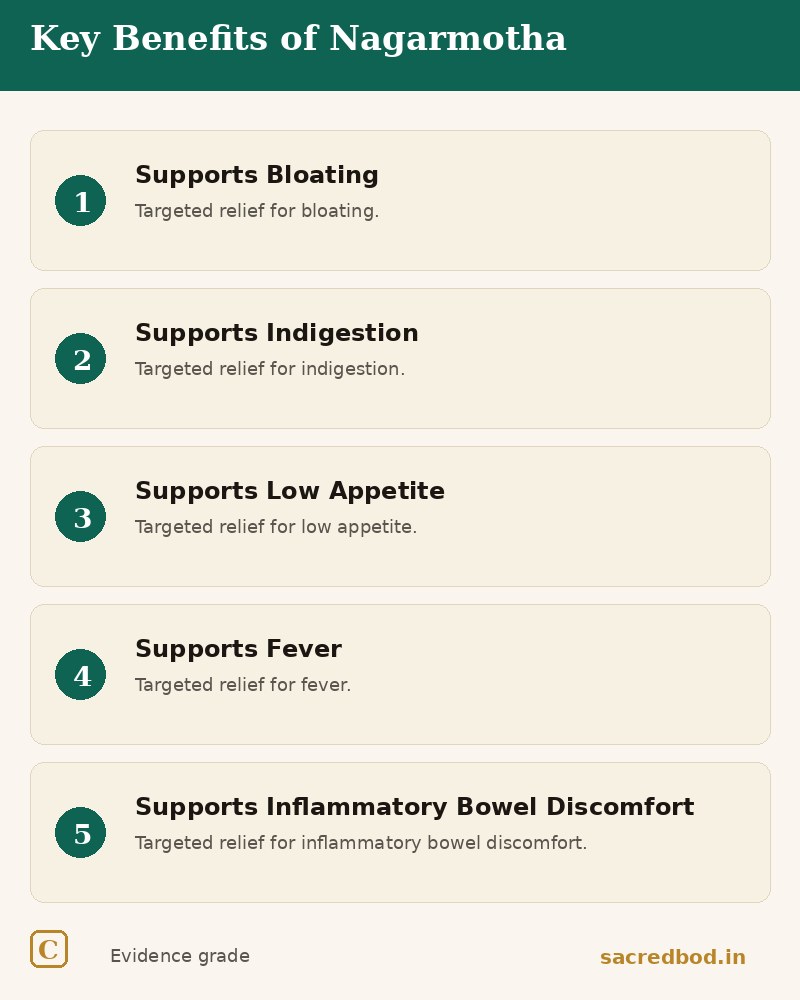
It sits in the Botanical category and is most relevant for people dealing with bloating, indigestion, low appetite.
How does Nagarmotha work?
The rhizome extract demonstrates anti-inflammatory activity via inhibition of pro-inflammatory cytokines (IL-4, IL-6, IL-12, IFN-γ) in experimental inflammatory bowel disease, comparable to 5-aminosalicylic acid. Gastric mucosal protection is achieved through antioxidant mechanisms — increasing SOD, glutathione, and glutathione peroxidase while inhibiting lipid peroxidation in aspirin-induced ulcer models. Anti-pyretic activity is comparable to acetylsalicylic acid in yeast-induced pyrexia. The essential oils and sesquiterpenes also show α-glucosidase inhibitory activity, supporting traditional anti-obesity use. Anti-allergic activity has been demonstrated via inhibition of mast cell degranulation.
It primarily acts on the digestive system, liver, intestines, skin, and effects are dose-dependent rather than immediate.
Who should consider Nagarmotha?
Individuals with digestive discomfort, bloating, or poor appetite seeking Ayurvedic carminative support. Those with inflammatory bowel concerns (as adjunct, not replacement for medical care). People interested in traditional anti-obesity and metabolic support. Also used in Ayurveda for fever and inflammatory conditions.
How much Nagarmotha should you take?
A typical dose is 500 mg, best taken with food, usually in the morning. Most people can expect noticeable effects within 2–4 weeks for digestive benefits; 4–6 weeks for anti-inflammatory effects. Consistency matters more than a single large dose.
Safety and who should avoid it
Pregnant and breastfeeding women (traditional texts note uterine stimulant activity). Individuals with severe hyperacidity or Pitta excess. Those with gallbladder obstruction (may stimulate bile flow).
Side effects: Generally well-tolerated at 500 mg/day. Heating nature may aggravate Pitta in excess. Rare cases of mild gastric irritation. Essential oil content may cause photosensitivity in very high doses.
How to combine Nagarmotha
Nagarmotha is often layered into a broader protocol rather than taken alone. See the “Goes with” panel on its product page for evidence-aligned pairings, and introduce one new supplement at a time so you can attribute any change to the right product.
Frequently asked questions
Is Nagarmotha available in India? Yes — it is sold on Amazon.in. Prioritise standardised, third-party-tested products.
How long until it works? Around 2–4 weeks for digestive benefits; 4–6 weeks for anti-inflammatory effects.
Can vegetarians take it? Check the label for a vegetable-cellulose capsule rather than gelatin.
Common mistakes to avoid
The two most common mistakes with Nagarmotha are inconsistency and impatience. Skipping days resets progress, and judging results before 2–4 weeks for digestive benefits; 4–6 weeks for anti-inflammatory effects leads people to quit just before benefits appear. A third mistake is stacking several new products at once, which makes it impossible to know what is actually working. Start Nagarmotha on its own, at 500 mg, and add anything else only later.
Fitting Nagarmotha into a daily routine
Adherence is easier when a supplement is anchored to an existing habit. Most people take Nagarmotha in the morning, with food — pairing it with a daily meal or your morning routine makes it hard to forget. Keep the bottle where you will see it. Remember that Nagarmotha is one input among many: sleep, diet, movement and stress management all act on the same digestive system, liver, intestines, skin and will amplify or blunt what any supplement can do.
What to realistically expect
Supplements rarely produce dramatic overnight change. With an evidence grade of C, Nagarmotha is best understood as a steady, cumulative input rather than a quick fix. Expect gradual rather than sudden change over 2–4 weeks for digestive benefits; 4–6 weeks for anti-inflammatory effects, and measure against your own baseline. If after a fair trial at 500 mg you notice nothing — subjectively or on relevant lab markers — that is useful information, and it is reasonable to stop.
Where to buy Nagarmotha in India
Nagarmotha is available on Amazon.in. When buying, prioritise products that state the standardised active percentage, third-party testing (NSF, USP or Informed Sport), and a clear vegetarian-capsule declaration if that matters to you. Use the buy button on the Nagarmotha page to see the current verified listing with the SacredBod tag.
This article is for informational purposes only. Consult a qualified healthcare provider before starting any supplement, especially if you take prescription medication or have a medical condition.
Supplements mentioned
People also ask
Is Nagarmotha available in India?
Yes, Nagarmotha is available on Amazon.in. Look for standardised, third-party-tested products with a clear label.
What is the typical Nagarmotha dose?
A typical dose is 500 mg, taken with food. Always follow the product label and your clinician's advice.
How long does Nagarmotha take to work?
About 2–4 weeks for digestive benefits; 4–6 weeks for anti-inflammatory effects.
Keep reading
- ZMA: complete India guide
Everything you need to know about ZMA — mechanism, dose, safety, buying guide for India, and what the research actually says.
- Zinc: complete India guide
Everything you need to know about Zinc — mechanism, dose, safety, buying guide for India, and what the research actually says.
- Yohimbine HCl: complete India guide
Everything you need to know about Yohimbine HCl — mechanism, dose, safety, buying guide for India, and what the research actually says.