
India’s wellness market is growing fast, but with hundreds of products on Amazon.in and little standardisation, knowing what to actually buy is harder than it should be. This guide covers Palmitoylethanolamide (PEA) from first principles — what it is, how it works, who it suits, and how to use it safely.
What is Palmitoylethanolamide (PEA)?
Palmitoylethanolamide (PEA) is an endogenous fatty acid amide belonging to the N-acylethanolamine family, structurally related to the endocannabinoid anandamide. It is produced on demand by the body in response to tissue injury, inflammation and pain. PEA acts as a glial cell modulator and mast cell stabiliser, reducing neuroinflammation and peripheral sensitisation. Micronised PEA (m-PEA) has superior absorption and is the form used in most clinical trials. It is not a classic analgesic but rather a disease-modifying anti-inflammatory agent for neuropathic and inflammatory pain conditions.
It sits in the Lipid category and is most relevant for people dealing with neuropathic pain, sciatica, diabetic neuropathy.
How does Palmitoylethanolamide (PEA) work?
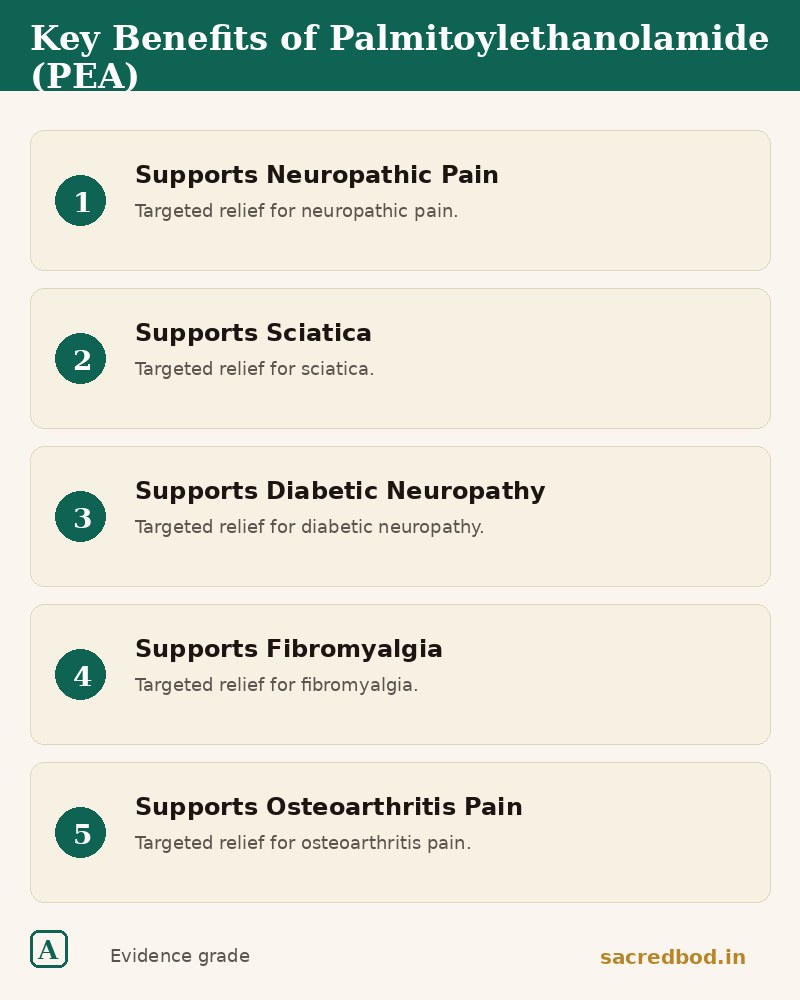
PEA activates peroxisome proliferator-activated receptor-alpha (PPAR-α), which downregulates pro-inflammatory gene expression and reduces microglial activation in the CNS. It also inhibits mast cell degranulation and reduces substance P release, lowering neurogenic inflammation. A 2025 meta-analysis of 14 RCTs (n=1,422) found PEA significantly reduced pain intensity in diabetic neuropathy, fibromyalgia, osteoarthritis and sciatica. It does not act on classical cannabinoid receptors (CB1/CB2) at therapeutic doses, avoiding psychoactive effects. The ‘entourage effect’ with anandamide may enhance endocannabinoid tone indirectly.
It primarily acts on the nervous system, joints, bladder, immune system, and effects are dose-dependent rather than immediate.
Who should consider Palmitoylethanolamide (PEA)?
Individuals with neuropathic pain (diabetic neuropathy, sciatica, post-herpetic neuralgia), fibromyalgia, osteoarthritis, or interstitial cystitis. Those seeking a non-opioid, non-NSAID alternative for chronic pain with an excellent safety profile. People with mast cell activation syndrome (MCAS) or neuroinflammatory conditions.
How much Palmitoylethanolamide (PEA) should you take?
A typical dose is 400 mg, best taken with food, usually in the morning. Most people can expect noticeable effects within 2–4 weeks for pain relief; 4–8 weeks for nerve regeneration support. Consistency matters more than a single large dose.
Safety and who should avoid it
Pregnant and breastfeeding women (safety not established, though endogenous PEA is present in breast milk naturally). Individuals with severe liver disease (theoretical concern, though no hepatotoxicity reported). Not for acute traumatic pain or surgical pain as a standalone agent.
Side effects: Extremely well-tolerated with negligible side effects. Rare mild gastrointestinal upset or headache. No known organ toxicity, addiction potential or withdrawal syndrome. Safe in elderly populations and compatible with most medications. Over 40 years of clinical use in Europe with an excellent safety record.
How to combine Palmitoylethanolamide (PEA)
Palmitoylethanolamide (PEA) is often layered into a broader protocol rather than taken alone. See the “Goes with” panel on its product page for evidence-aligned pairings, and introduce one new supplement at a time so you can attribute any change to the right product.
Frequently asked questions
Is Palmitoylethanolamide (PEA) available in India? Yes — it is sold on Amazon.in. Prioritise standardised, third-party-tested products.
How long until it works? Around 2–4 weeks for pain relief; 4–8 weeks for nerve regeneration support.
Can vegetarians take it? Check the label for a vegetable-cellulose capsule rather than gelatin.
Choosing a quality Palmitoylethanolamide (PEA) product in India
The Indian supplement market is large but lightly regulated, so quality varies widely between brands on Amazon.in. For Palmitoylethanolamide (PEA), look past marketing claims and check three things on the label: the standardised active content (not just the total extract weight), third-party testing such as NSF, USP or Informed Sport, and the exact capsules form. Generic ‘natural’ or ‘herbal’ labelling without standardisation data is a red flag. The price gap between a well-made and a poorly-made product is usually small; the gap in real-world results is not.
Common mistakes to avoid
The two most common mistakes with Palmitoylethanolamide (PEA) are inconsistency and impatience. Skipping days resets progress, and judging results before 2–4 weeks for pain relief; 4–8 weeks for nerve regeneration support leads people to quit just before benefits appear. A third mistake is stacking several new products at once, which makes it impossible to know what is actually working. Start Palmitoylethanolamide (PEA) on its own, at 400 mg, and add anything else only later.
Fitting Palmitoylethanolamide (PEA) into a daily routine
Adherence is easier when a supplement is anchored to an existing habit. Most people take Palmitoylethanolamide (PEA) in the morning, with food — pairing it with a daily meal or your morning routine makes it hard to forget. Keep the bottle where you will see it. Remember that Palmitoylethanolamide (PEA) is one input among many: sleep, diet, movement and stress management all act on the same nervous system, joints, bladder, immune system and will amplify or blunt what any supplement can do.
Where to buy Palmitoylethanolamide (PEA) in India
Palmitoylethanolamide (PEA) is available on Amazon.in. When buying, prioritise products that state the standardised active percentage, third-party testing (NSF, USP or Informed Sport), and a clear vegetarian-capsule declaration if that matters to you. Use the buy button on the Palmitoylethanolamide (PEA) page to see the current verified listing with the SacredBod tag.
This article is for informational purposes only. Consult a qualified healthcare provider before starting any supplement, especially if you take prescription medication or have a medical condition.
Shop Palmitoylethanolamide (PEA)
Supplements mentioned
People also ask
Is Palmitoylethanolamide (PEA) available in India?
Yes, Palmitoylethanolamide (PEA) is available on Amazon.in. Look for standardised, third-party-tested products with a clear label.
What is the typical Palmitoylethanolamide (PEA) dose?
A typical dose is 400 mg, taken with food. Always follow the product label and your clinician's advice.
How long does Palmitoylethanolamide (PEA) take to work?
About 2–4 weeks for pain relief; 4–8 weeks for nerve regeneration support.
Keep reading
- ZMA: complete India guide
Everything you need to know about ZMA — mechanism, dose, safety, buying guide for India, and what the research actually says.
- Zinc: complete India guide
Everything you need to know about Zinc — mechanism, dose, safety, buying guide for India, and what the research actually says.
- Yohimbine HCl: complete India guide
Everything you need to know about Yohimbine HCl — mechanism, dose, safety, buying guide for India, and what the research actually says.