
India’s wellness market is growing fast, but with hundreds of products on Amazon.in and little standardisation, knowing what to actually buy is harder than it should be. This guide covers PEA Palmitoylethanolamide from first principles — what it is, how it works, who it suits, and how to use it safely.
What is PEA Palmitoylethanolamide?
Palmitoylethanolamide (PEA) is a naturally occurring fatty acid amide produced on demand by the body in response to tissue injury, inflammation and pain. Ultra-micronised PEA (um-PEA) is a patented formulation with particle size <10 microns that achieves superior bioavailability and faster onset compared to standard PEA.
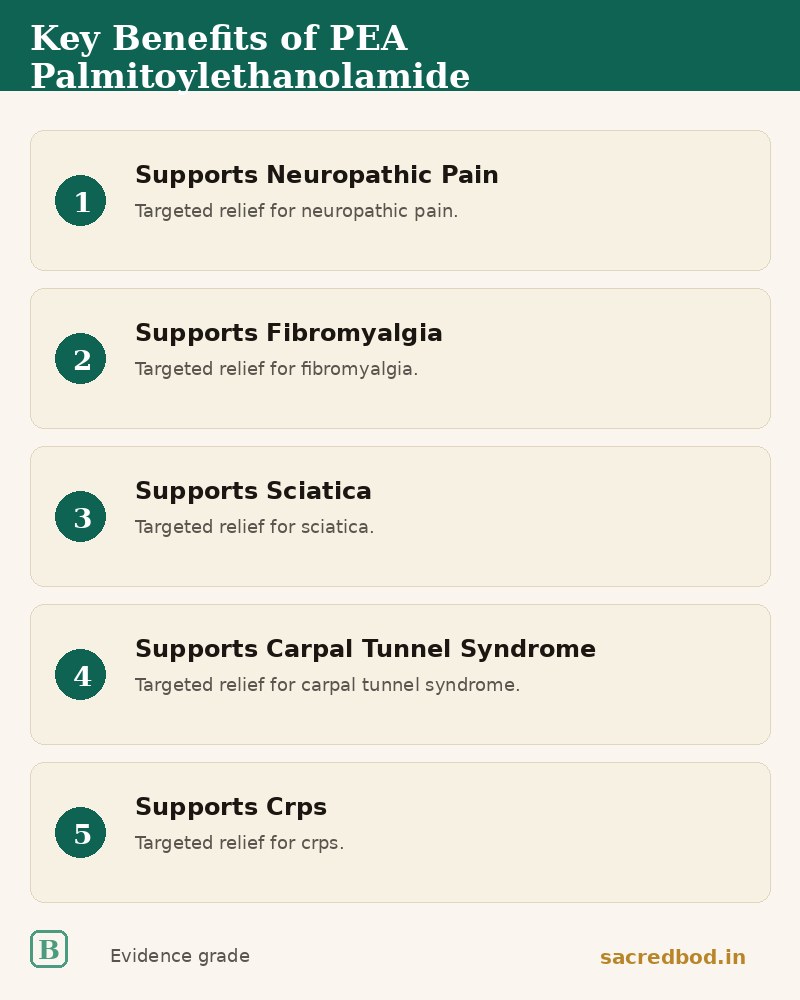
It sits in the Natural Pain Management category and is most relevant for people dealing with neuropathic pain, fibromyalgia, sciatica.
How does PEA Palmitoylethanolamide work?
PEA activates peroxisome proliferator-activated receptor-alpha (PPAR-α) and inhibits mast cell degranulation, reducing neuroinflammation and peripheral sensitisation. It also modulates the endocannabinoid system by downregulating FAAH (the enzyme that breaks down anandamide), indirectly increasing endogenous cannabinoid tone without binding CB1/CB2 receptors — hence no psychoactivity.
It primarily acts on the nervous system, muscles, joints, and effects are dose-dependent rather than immediate.
Who should consider PEA Palmitoylethanolamide?
People with neuropathic pain, fibromyalgia, complex regional pain syndrome (CRPS), carpal tunnel syndrome, sciatica, endometriosis-related pain and post-herpetic neuralgia benefit most. It is particularly valuable for those who cannot tolerate prescription neuropathic pain medications or who want a non-addictive alternative.
How much PEA Palmitoylethanolamide should you take?
A typical dose is 300–600 mg, best taken with food, usually in the morning. Most people can expect noticeable effects within 2–4 weeks; maximal benefits at 6–8 weeks. Consistency matters more than a single large dose.
Safety and who should avoid it
Pregnant or breastfeeding women due to limited safety data. Those with severe liver disease should consult a physician.
Side effects: Extremely well tolerated. Rare mild GI upset, drowsiness or headache. No serious adverse events in clinical trials exceeding 1,200 mg/day. No addiction, tolerance or withdrawal potential.
How to combine PEA Palmitoylethanolamide
PEA Palmitoylethanolamide is often layered into a broader protocol rather than taken alone. See the “Goes with” panel on its product page for evidence-aligned pairings, and introduce one new supplement at a time so you can attribute any change to the right product.
Frequently asked questions
Is PEA Palmitoylethanolamide available in India? Yes — it is sold on Amazon.in. Prioritise standardised, third-party-tested products.
How long until it works? Around 2–4 weeks; maximal benefits at 6–8 weeks.
Can vegetarians take it? Check the label for a vegetable-cellulose capsule rather than gelatin.
Common mistakes to avoid
The two most common mistakes with PEA Palmitoylethanolamide are inconsistency and impatience. Skipping days resets progress, and judging results before 2–4 weeks; maximal benefits at 6–8 weeks leads people to quit just before benefits appear. A third mistake is stacking several new products at once, which makes it impossible to know what is actually working. Start PEA Palmitoylethanolamide on its own, at 300–600 mg, and add anything else only later.
Fitting PEA Palmitoylethanolamide into a daily routine
Adherence is easier when a supplement is anchored to an existing habit. Most people take PEA Palmitoylethanolamide in the morning, with food — pairing it with a daily meal or your morning routine makes it hard to forget. Keep the bottle where you will see it. Remember that PEA Palmitoylethanolamide is one input among many: sleep, diet, movement and stress management all act on the same nervous system, muscles, joints and will amplify or blunt what any supplement can do.
What to realistically expect
Supplements rarely produce dramatic overnight change. With an evidence grade of B, PEA Palmitoylethanolamide is best understood as a steady, cumulative input rather than a quick fix. Expect gradual rather than sudden change over 2–4 weeks; maximal benefits at 6–8 weeks, and measure against your own baseline. If after a fair trial at 300–600 mg you notice nothing — subjectively or on relevant lab markers — that is useful information, and it is reasonable to stop.
Storage and stability
Heat and humidity are real considerations across much of India. Store PEA Palmitoylethanolamide in a cool, dry place away from direct sunlight, keep the bottle tightly closed, and avoid leaving it in a hot car or on a sunny kitchen shelf. A capsules kept in stable conditions retains potency far better than one repeatedly exposed to monsoon humidity. If your product arrives with a desiccant sachet, leave it in the bottle.
Where to buy PEA Palmitoylethanolamide in India
PEA Palmitoylethanolamide is available on Amazon.in. When buying, prioritise products that state the standardised active percentage, third-party testing (NSF, USP or Informed Sport), and a clear vegetarian-capsule declaration if that matters to you. Use the buy button on the PEA Palmitoylethanolamide page to see the current verified listing with the SacredBod tag.
This article is for informational purposes only. Consult a qualified healthcare provider before starting any supplement, especially if you take prescription medication or have a medical condition.
Shop PEA Palmitoylethanolamide
Supplements mentioned
People also ask
Is PEA Palmitoylethanolamide available in India?
Yes, PEA Palmitoylethanolamide is available on Amazon.in. Look for standardised, third-party-tested products with a clear label.
What is the typical PEA Palmitoylethanolamide dose?
A typical dose is 300–600 mg, taken with food. Always follow the product label and your clinician's advice.
How long does PEA Palmitoylethanolamide take to work?
About 2–4 weeks; maximal benefits at 6–8 weeks.
Keep reading
- ZMA: complete India guide
Everything you need to know about ZMA — mechanism, dose, safety, buying guide for India, and what the research actually says.
- Zinc: complete India guide
Everything you need to know about Zinc — mechanism, dose, safety, buying guide for India, and what the research actually says.
- Yohimbine HCl: complete India guide
Everything you need to know about Yohimbine HCl — mechanism, dose, safety, buying guide for India, and what the research actually says.