
India’s wellness market is growing fast, but with hundreds of products on Amazon.in and little standardisation, knowing what to actually buy is harder than it should be. This guide covers Amur Cork Tree Berberine from first principles — what it is, how it works, who it suits, and how to use it safely.
What is Amur Cork Tree Berberine?
Phellodendron amurense, known as Huang Bai in Traditional Chinese Medicine (TCM) and Amur Cork Tree in English, is a deciduous tree native to East Asia whose bark contains berberine along with a broader spectrum of isoquinoline alkaloids including palmatine, jatrorrhizine, phellodendrine, and magnoflorine. While Indian Berberis aristata (Daruharidra) is the primary Ayurvedic source, Phellodendron provides a more diverse alkaloid profile that may offer additional pharmacological benefits beyond berberine alone.
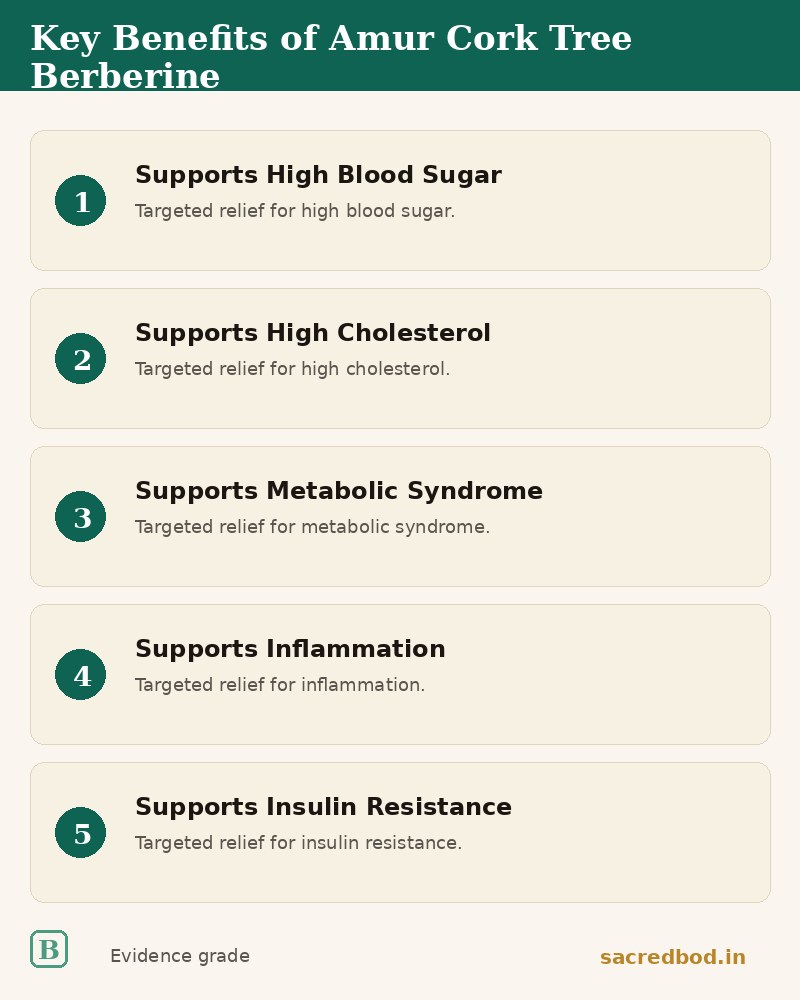
It sits in the Traditional Chinese Berberine Source category and is most relevant for people dealing with high blood sugar, high cholesterol, metabolic syndrome.
How does Amur Cork Tree Berberine work?
Berberine from Phellodendron activates AMPK, improving insulin sensitivity and reducing hepatic glucose output — the same mechanism as berberine from any source. However, the additional alkaloids contribute unique effects: palmatine has anti-inflammatory and neuroprotective properties; jatrorrhizine has antimicrobial and gastrointestinal benefits; magnoflorine has vasodilatory and hypotensive effects. The combined alkaloid spectrum may produce broader metabolic, anti-inflammatory, and cardiovascular benefits than isolated berberine.
It primarily acts on the liver, pancreas, intestines, blood vessels, and effects are dose-dependent rather than immediate.
Who should consider Amur Cork Tree Berberine?
Individuals seeking berberine with a broader alkaloid spectrum, those interested in TCM formulations, people with metabolic syndrome who want the combined benefits of multiple isoquinoline alkaloids, and individuals who have used Berberis aristata-derived berberine and want to explore alternative sources. Note: most Indian berberine supplements use Berberis aristata, not Phellodendron.
How much Amur Cork Tree Berberine should you take?
A typical dose is 500 mg, best taken with food, usually in the morning. Most people can expect noticeable effects within 2–4 weeks for glucose; 4–8 weeks for lipids. Consistency matters more than a single large dose.
Safety and who should avoid it
Pregnant or breastfeeding women (berberine may cause uterine contractions and kernicterus), people with low blood pressure (additional hypotensive alkaloids), those on multiple CYP3A4-metabolised medications, individuals with G6PD deficiency.
Side effects: Same as berberine from any source: mild stomach upset, constipation, or diarrhea at high doses. The broader alkaloid profile does not significantly change the safety profile. Rarely: headache or dizziness.
How to combine Amur Cork Tree Berberine
Amur Cork Tree Berberine is often layered into a broader protocol rather than taken alone. See the “Goes with” panel on its product page for evidence-aligned pairings, and introduce one new supplement at a time so you can attribute any change to the right product.
Frequently asked questions
Is Amur Cork Tree Berberine available in India? Yes — it is sold on Amazon.in. Prioritise standardised, third-party-tested products.
How long until it works? Around 2–4 weeks for glucose; 4–8 weeks for lipids.
Can vegetarians take it? Check the label for a vegetable-cellulose capsule rather than gelatin.
How to track whether it is working
The most objective approach is to measure before and after. Keep a simple weekly log of the specific outcome you care about, and where relevant test Fasting glucose, HbA1c, LDL cholesterol before starting Amur Cork Tree Berberine and again at 8-12 weeks. Interpreting a number against your own baseline — and against how you feel — is far more reliable than reacting to day-to-day fluctuations. The SacredBod analyzer can track blood marker changes across reports over time.
Choosing a quality Amur Cork Tree Berberine product in India
The Indian supplement market is large but lightly regulated, so quality varies widely between brands on Amazon.in. For Amur Cork Tree Berberine, look past marketing claims and check three things on the label: the standardised active content (not just the total extract weight), third-party testing such as NSF, USP or Informed Sport, and the exact capsules form. Generic ‘natural’ or ‘herbal’ labelling without standardisation data is a red flag. The price gap between a well-made and a poorly-made product is usually small; the gap in real-world results is not.
Common mistakes to avoid
The two most common mistakes with Amur Cork Tree Berberine are inconsistency and impatience. Skipping days resets progress, and judging results before 2–4 weeks for glucose; 4–8 weeks for lipids leads people to quit just before benefits appear. A third mistake is stacking several new products at once, which makes it impossible to know what is actually working. Start Amur Cork Tree Berberine on its own, at 500 mg, and add anything else only later.
Where to buy Amur Cork Tree Berberine in India
Amur Cork Tree Berberine is available on Amazon.in. When buying, prioritise products that state the standardised active percentage, third-party testing (NSF, USP or Informed Sport), and a clear vegetarian-capsule declaration if that matters to you. Use the buy button on the Amur Cork Tree Berberine page to see the current verified listing with the SacredBod tag.
This article is for informational purposes only. Consult a qualified healthcare provider before starting any supplement, especially if you take prescription medication or have a medical condition.
Supplements mentioned
People also ask
Is Amur Cork Tree Berberine available in India?
Yes, Amur Cork Tree Berberine is available on Amazon.in. Look for standardised, third-party-tested products with a clear label.
What is the typical Amur Cork Tree Berberine dose?
A typical dose is 500 mg, taken with food. Always follow the product label and your clinician's advice.
How long does Amur Cork Tree Berberine take to work?
About 2–4 weeks for glucose; 4–8 weeks for lipids.
Keep reading
- ZMA: complete India guide
Everything you need to know about ZMA — mechanism, dose, safety, buying guide for India, and what the research actually says.
- Zinc: complete India guide
Everything you need to know about Zinc — mechanism, dose, safety, buying guide for India, and what the research actually says.
- Yohimbine HCl: complete India guide
Everything you need to know about Yohimbine HCl — mechanism, dose, safety, buying guide for India, and what the research actually says.