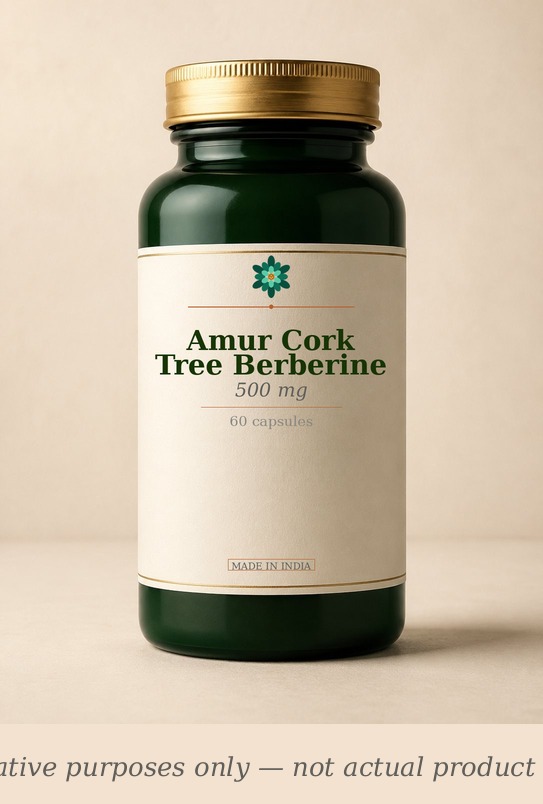
SacredBod's longer take on Amur Cork Tree Berberine — context the structured blocks above don't capture.
Phellodendron amurense — Huang Bai — is one of the 50 fundamental herbs of Traditional Chinese Medicine, and it happens to be one of the richest sources of berberine on Earth. While Indian supplements almost exclusively use Berberis aristata (Daruharidra), the Amur Cork Tree from East Asia provides not just berberine but a symphony of related isoquinoline alkaloids that may offer broader therapeutic benefits.
What the Research Shows
A 2019 clinical study (PMC6434235) evaluated berberine (from Coptis/Phellodendron sources) in metabolic syndrome patients and found significant improvements in fasting glucose, postprandial glucose, HbA1c, triglycerides, total cholesterol, and LDL cholesterol. Insulin resistance (HOMA-IR) decreased, and inflammatory markers (IL-6, TNF-α) were reduced. The researchers concluded berberine is effective for metabolic syndrome through multiple pathways.
A 2020 review (PMC7235753) on berberine bioavailability noted that while Phellodendron and Coptis are traditional Chinese sources, the pharmacological effects are driven primarily by berberine content regardless of plant source. However, the additional alkaloids in Phellodendron — palmatine (anti-inflammatory), jatrorrhizine (GI antimicrobial), and magnoflorine (vasodilatory) — contribute to the traditional TCM indications for Huang Bai that extend beyond berberine’s metabolic effects.
A 2022 pharmacokinetic review (PMC8538182) confirmed that berberine metabolism is similar regardless of plant source, with gut microbiota playing a major role in converting berberine to its active metabolite berberrubine. The source plant matters less than the dose, formulation, and individual microbiome composition.
India Context
- Availability: Standalone Phellodendron amurense supplements are NOT available on Amazon India. All berberine products use Berberis aristata (Indian Barberry/Daruharidra) as the source. The ASINs listed are for standard berberine products derived from Berberis aristata.
- Price: ₹400–₹1,000 for 60 capsules (500 mg standard berberine)
- TCM vs Ayurveda: While Phellodendron is not available in India, the comparison is relevant for consumers choosing between imported TCM formulations and domestic Ayurvedic products. Indian consumers should know that Daruharidra (Berberis aristata) provides equivalent berberine content with the added confidence of Ayurvedic traditional use.
- Ayurvedic heritage: Daruharidra is described in Charaka Samhita as tikta (bitter) and kashaya (astringent), used for prameha (diabetes), kustha (skin diseases), raktapitta (bleeding disorders), and jwara (fever). The root bark yields Rasanjana — the traditional Ayurvedic berberine preparation.
- Quality markers: Look for products standardised to 95% berberine HCl or verified extracts. Indian brands like NutriJa, Origins Nutra, and NutraMarck offer high-purity Berberis aristata extracts.
- Import option: Phellodendron-based products from TCM suppliers (e.g., Plum Flower, Mayway) can be imported but are not sold on Amazon India.
Dosage & Safety
- Standard dose: 500 mg twice daily with meals
- Best time: Morning and evening with food
- Caution: Same as all berberine sources — avoid in pregnancy, with statins, warfarin, and immunosuppressants. Monitor blood sugar if on diabetes medication. Those seeking Phellodendron specifically should import TCM products; Indian consumers will receive equivalent benefits from Berberis aristata-derived berberine.