
India’s wellness market is growing fast, but with hundreds of products on Amazon.in and little standardisation, knowing what to actually buy is harder than it should be. This guide covers Phosphatidylcholine from first principles — what it is, how it works, who it suits, and how to use it safely.
What is Phosphatidylcholine?
Phosphatidylcholine (PC) is a phospholipid and the primary structural component of cell membranes, particularly abundant in the liver and brain. It is the main active fraction of lecithin (typically 10–20% of soybean lecithin by weight). PC serves as a choline donor for acetylcholine synthesis and supports hepatic cell membrane integrity, bile composition and fat metabolism. Polyenylphosphatidylcholine (PPC) is a highly purified form used in European liver protocols.
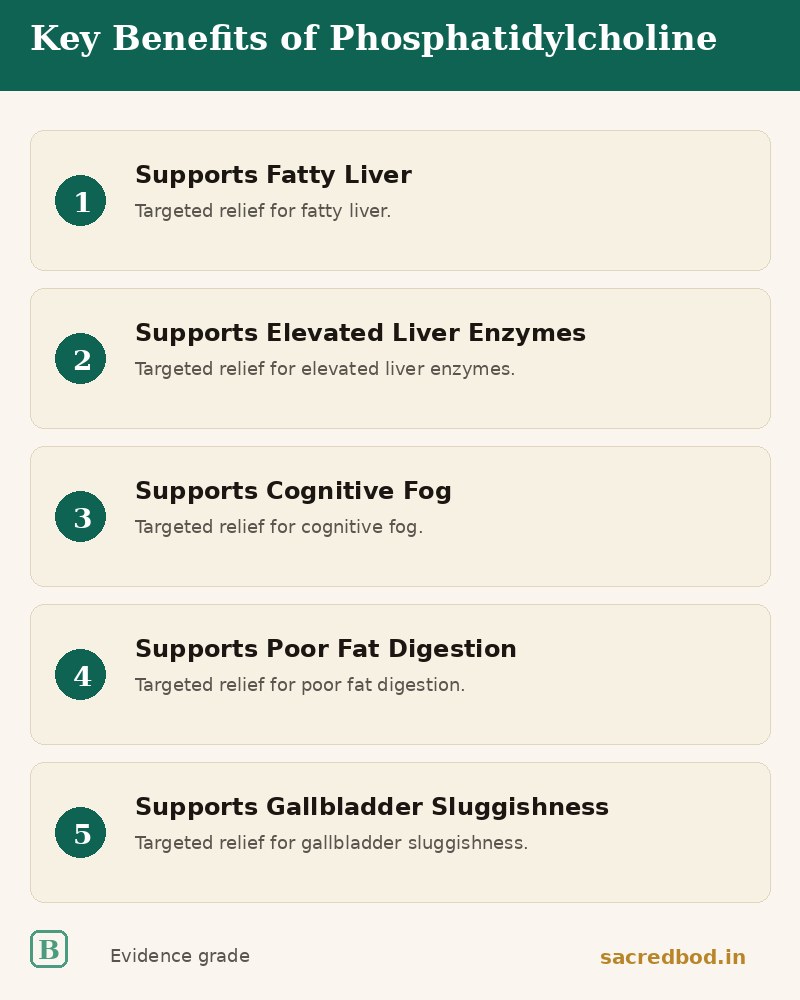
It sits in the Phospholipid category and is most relevant for people dealing with fatty liver, elevated liver enzymes, cognitive fog.
How does Phosphatidylcholine work?
PC provides choline for acetylcholine synthesis, supporting cholinergic neurotransmission and cognitive function. In the liver, PC is incorporated into hepatocyte membranes and is essential for very-low-density lipoprotein (VLDL) assembly and secretion — deficiency leads to hepatic fat accumulation. PPC has been shown to reduce hepatic fibrosis in animal models by inhibiting hepatic stellate cell activation. In primary biliary cirrhosis, hepatic PC synthesis genes (PEMT, BHMT) are upregulated as a compensatory response to biliary injury.
It primarily acts on the liver, brain, gallbladder, cell membranes, and effects are dose-dependent rather than immediate.
Who should consider Phosphatidylcholine?
Individuals seeking liver support, those with non-alcoholic fatty liver disease (NAFLD) or elevated liver enzymes, people wanting a gentler choline source than choline bitartrate or Alpha-GPC for cognitive support, and those with gallbladder concerns (PC supports bile fluidity).
How much Phosphatidylcholine should you take?
A typical dose is 420 mg, best taken with food, usually in the morning. Most people can expect noticeable effects within 2–4 weeks for liver support; 4–8 weeks for cognitive benefits. Consistency matters more than a single large dose.
Safety and who should avoid it
Individuals with trimethylaminuria (fish odour syndrome). Those with severe soy allergies (if soy-derived). Pregnant and breastfeeding women should stay within recommended choline intake limits (~550 mg/day total choline).
Side effects: Generally well-tolerated. High doses may cause mild diarrhoea, nausea or fishy body odour (from excessive choline metabolism to trimethylamine). Those with trimethylaminuria should avoid. Soy-derived PC may be allergenic for soy-sensitive individuals.
How to combine Phosphatidylcholine
Phosphatidylcholine is often layered into a broader protocol rather than taken alone. See the “Goes with” panel on its product page for evidence-aligned pairings, and introduce one new supplement at a time so you can attribute any change to the right product.
Frequently asked questions
Is Phosphatidylcholine available in India? Yes — it is sold on Amazon.in. Prioritise standardised, third-party-tested products.
How long until it works? Around 2–4 weeks for liver support; 4–8 weeks for cognitive benefits.
Can vegetarians take it? Check the label for a vegetable-cellulose capsule rather than gelatin.
Common mistakes to avoid
The two most common mistakes with Phosphatidylcholine are inconsistency and impatience. Skipping days resets progress, and judging results before 2–4 weeks for liver support; 4–8 weeks for cognitive benefits leads people to quit just before benefits appear. A third mistake is stacking several new products at once, which makes it impossible to know what is actually working. Start Phosphatidylcholine on its own, at 420 mg, and add anything else only later.
Fitting Phosphatidylcholine into a daily routine
Adherence is easier when a supplement is anchored to an existing habit. Most people take Phosphatidylcholine in the morning, with food — pairing it with a daily meal or your morning routine makes it hard to forget. Keep the bottle where you will see it. Remember that Phosphatidylcholine is one input among many: sleep, diet, movement and stress management all act on the same liver, brain, gallbladder, cell membranes and will amplify or blunt what any supplement can do.
What to realistically expect
Supplements rarely produce dramatic overnight change. With an evidence grade of B, Phosphatidylcholine is best understood as a steady, cumulative input rather than a quick fix. Expect gradual rather than sudden change over 2–4 weeks for liver support; 4–8 weeks for cognitive benefits, and measure against your own baseline. If after a fair trial at 420 mg you notice nothing — subjectively or on relevant lab markers — that is useful information, and it is reasonable to stop.
Where to buy Phosphatidylcholine in India
Phosphatidylcholine is available on Amazon.in. When buying, prioritise products that state the standardised active percentage, third-party testing (NSF, USP or Informed Sport), and a clear vegetarian-capsule declaration if that matters to you. Use the buy button on the Phosphatidylcholine page to see the current verified listing with the SacredBod tag.
This article is for informational purposes only. Consult a qualified healthcare provider before starting any supplement, especially if you take prescription medication or have a medical condition.
Supplements mentioned
People also ask
Is Phosphatidylcholine available in India?
Yes, Phosphatidylcholine is available on Amazon.in. Look for standardised, third-party-tested products with a clear label.
What is the typical Phosphatidylcholine dose?
A typical dose is 420 mg, taken with food. Always follow the product label and your clinician's advice.
How long does Phosphatidylcholine take to work?
About 2–4 weeks for liver support; 4–8 weeks for cognitive benefits.
Keep reading
- ZMA: complete India guide
Everything you need to know about ZMA — mechanism, dose, safety, buying guide for India, and what the research actually says.
- Zinc: complete India guide
Everything you need to know about Zinc — mechanism, dose, safety, buying guide for India, and what the research actually says.
- Yohimbine HCl: complete India guide
Everything you need to know about Yohimbine HCl — mechanism, dose, safety, buying guide for India, and what the research actually says.