
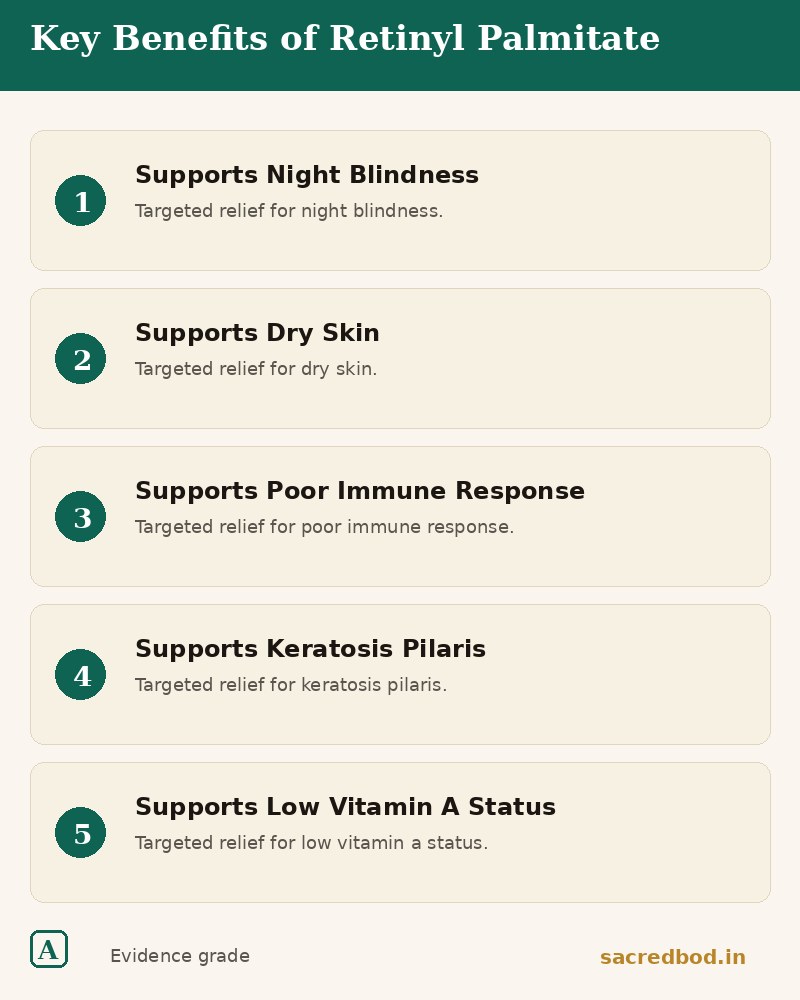
If you are specifically considering Retinyl Palmitate for night blindness, this article covers the rationale, the practical dosing for this goal, and how to measure whether it is actually working for you.
Why Retinyl Palmitate for night blindness?
Retinyl palmitate (vitamin A palmitate) is an ester of retinol (preformed vitamin A) and palmitic acid. It is the most stable and widely used form of vitamin A in supplements and fortified foods. Unlike beta-carotene (a provitamin A carotenoid that must be converted), retinyl palmitate provides active vitamin A directly. It is essential for vision (rhodopsin synthesis), immune function (mucosal barrier integrity), cellular differentiation, reproduction and embryonic development. It primarily acts on the eyes, skin, immune system, liver, reproductive system, which is why it is considered for night blindness.
Retinyl palmitate is hydrolysed in the intestine to retinol, which is absorbed, re-esterified and stored in the liver. When needed, retinol is oxidised to retinaldehyde and then retinoic acid, which binds to nuclear retinoic acid receptors (RARs) and retinoid X receptors (RXRs) to regulate gene transcription. This controls cellular differentiation, immune cell maturation, visual pigment regeneration and epithelial barrier function. Retinyl palmitate is more stable than retinol against oxidation, making it ideal for supplement formulation.
How to use Retinyl Palmitate for night blindness
Use 10,000 IU, taken with food in the morning. Allow 2–4 weeks for skin/vision; 4–8 weeks for immune support before judging results.
Tracking your progress
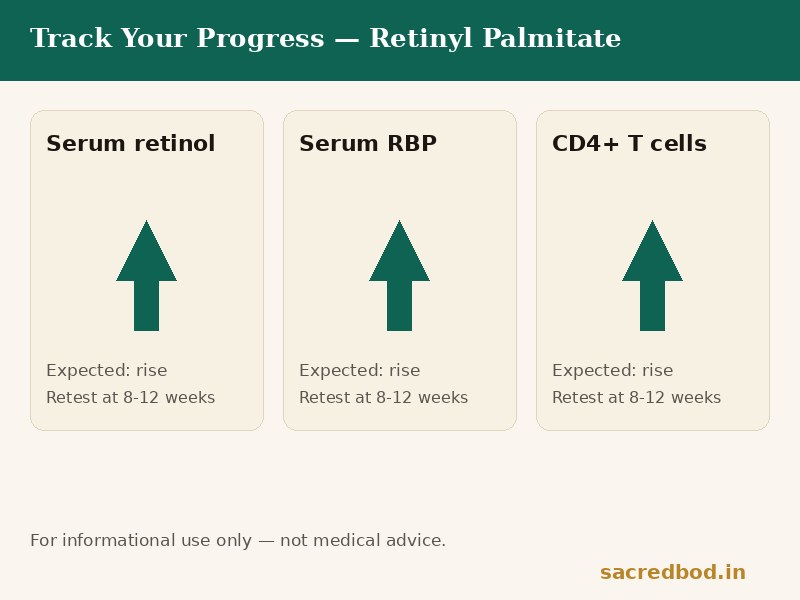
The most objective way to know if Retinyl Palmitate is helping your night blindness is to measure before and after. Keep a simple weekly log of the symptom itself, and where relevant retest the blood markers shown above at 8-12 weeks.
Who should be cautious
Pregnant women at doses >10,000 IU/day (teratogenic risk). Individuals with liver disease or hypervitaminosis A. Those with osteoporosis (high-dose retinol increases fracture risk). Smokers (high-dose beta-carotene increases lung cancer; retinyl palmitate does not share this risk but caution advised). Not for children except under paediatric guidance.
Side effects: Well-tolerated at 5,000–10,000 IU/day. Doses above 25,000 IU/day long-term risk hypervitaminosis A (headache, nausea, liver toxicity, bone pain, hair loss). Acute toxicity at >100,000 IU. Pregnant women must avoid >10,000 IU/day due to birth defect risk. Yellowing of skin (carotenoderma) is from beta-carotene, not retinyl palmitate.
Realistic expectations
Supplements rarely cause dramatic overnight change. For night blindness, Retinyl Palmitate is best seen as one consistent input alongside sleep, diet, movement and stress management — not a standalone fix.
What to realistically expect
Supplements rarely produce dramatic overnight change. With an evidence grade of A, Retinyl Palmitate is best understood as a steady, cumulative input rather than a quick fix. Expect gradual rather than sudden change over 2–4 weeks for skin/vision; 4–8 weeks for immune support, and measure against your own baseline. If after a fair trial at 10,000 IU you notice nothing — subjectively or on relevant lab markers — that is useful information, and it is reasonable to stop.
Storage and stability
Heat and humidity are real considerations across much of India. Store Retinyl Palmitate in a cool, dry place away from direct sunlight, keep the bottle tightly closed, and avoid leaving it in a hot car or on a sunny kitchen shelf. A softgels kept in stable conditions retains potency far better than one repeatedly exposed to monsoon humidity. If your product arrives with a desiccant sachet, leave it in the bottle.
How to track whether it is working
The most objective approach is to measure before and after. Keep a simple weekly log of the specific outcome you care about, and where relevant test Serum retinol, Serum RBP, CD4+ T cells before starting Retinyl Palmitate and again at 8-12 weeks. Interpreting a number against your own baseline — and against how you feel — is far more reliable than reacting to day-to-day fluctuations. The SacredBod analyzer can track blood marker changes across reports over time.
Choosing a quality Retinyl Palmitate product in India
The Indian supplement market is large but lightly regulated, so quality varies widely between brands on Amazon.in. For Retinyl Palmitate, look past marketing claims and check three things on the label: the standardised active content (not just the total extract weight), third-party testing such as NSF, USP or Informed Sport, and the exact softgels form. Generic ‘natural’ or ‘herbal’ labelling without standardisation data is a red flag. The price gap between a well-made and a poorly-made product is usually small; the gap in real-world results is not.
Where to buy Retinyl Palmitate in India
Retinyl Palmitate is available on Amazon.in. When buying, prioritise products that state the standardised active percentage, third-party testing (NSF, USP or Informed Sport), and a clear vegetarian-capsule declaration if that matters to you. Use the buy button on the Retinyl Palmitate page to see the current verified listing with the SacredBod tag.
This article is for informational purposes only. Consult a qualified healthcare provider before starting any supplement, especially if you take prescription medication or have a medical condition.
Supplements mentioned
People also ask
Does Retinyl Palmitate help with night blindness?
It is used for night blindness based on how it acts on the eyes, skin, immune system, liver, reproductive system. Evidence grade is A; track your own response over 8-12 weeks.
How should I take Retinyl Palmitate for night blindness?
10,000 IU, with food, in the morning.
Keep reading
- Vitamin A (Cod Liver Oil) for Night blindness: protocol, dose, and what to track
How to use Vitamin A (Cod Liver Oil) specifically for Night blindness — the right dose, timing, blood markers to track, and how to know if it is working.
- Vitamin A (Cod Liver Oil): complete India guide
Everything you need to know about Vitamin A (Cod Liver Oil) — mechanism, dose, safety, buying guide for India, and what the research actually says.
- Bilberry Extract for Night blindness: protocol, dose, and what to track
How to use Bilberry Extract specifically for Night blindness — the right dose, timing, blood markers to track, and how to know if it is working.