
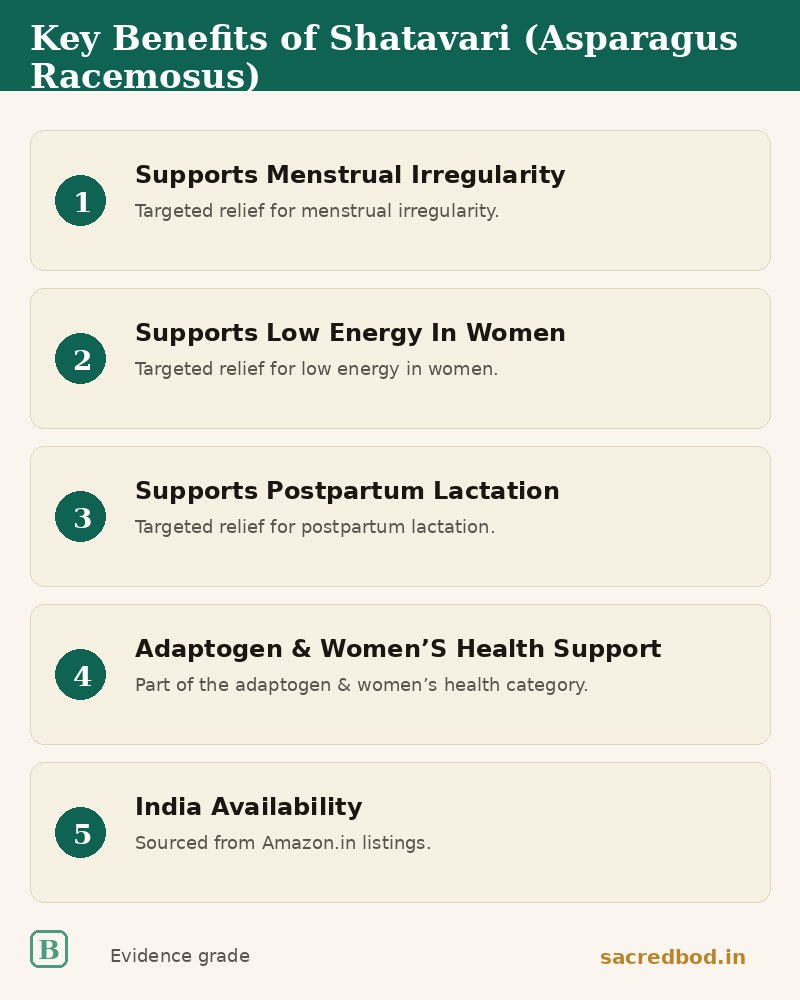
If you are specifically considering Shatavari (Asparagus Racemosus) for menstrual irregularity, this article covers the rationale, the practical dosing for this goal, and how to measure whether it is actually working for you.
Why Shatavari (Asparagus Racemosus) for menstrual irregularity?
Shatavari is the Indian asparagus root, the central women’s tonic of Ayurveda. Its saponins (shatavarins) modulate hormone-sensitive receptors gently. It primarily acts on the reproductive, adrenal, mammary, which is why it is considered for menstrual irregularity.
Shatavarin saponins act as selective estrogen receptor modulators (SERMs) — providing mild estrogenic support in peri-menopause while not driving estrogen-positive proliferation. Lactogenic prolactin support is folk-attested.
How to use Shatavari (Asparagus Racemosus) for menstrual irregularity
Use 500–1000 mg, taken with food in the morning. Allow 4–8 weeks for hormonal and energy markers before judging results.
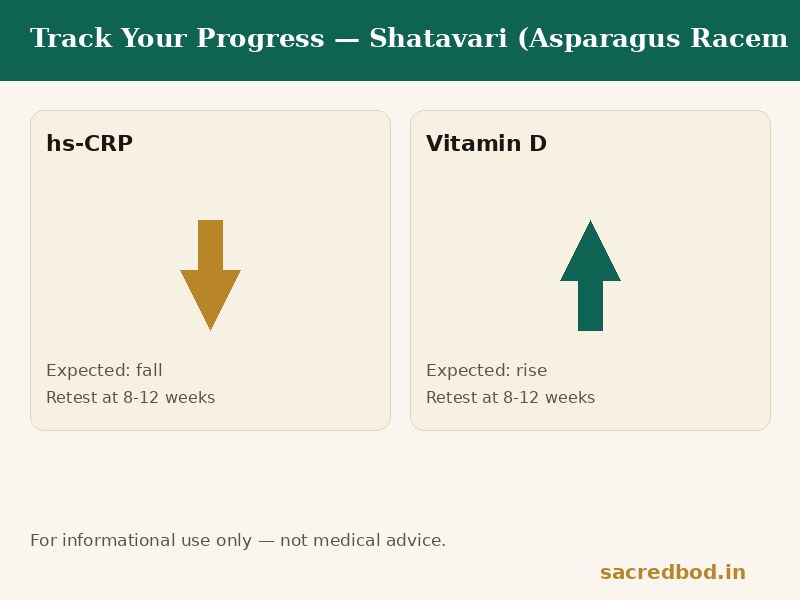
Tracking your progress
The most objective way to know if Shatavari (Asparagus Racemosus) is helping your menstrual irregularity is to measure before and after. Keep a simple weekly log of the symptom itself, and where relevant retest the blood markers shown above at 8-12 weeks.
Who should be cautious
Avoid in hormone-positive cancers. Coordinate with HRT and SERM medications.
Realistic expectations
Supplements rarely cause dramatic overnight change. For menstrual irregularity, Shatavari (Asparagus Racemosus) is best seen as one consistent input alongside sleep, diet, movement and stress management — not a standalone fix.
How to track whether it is working
The most objective approach is to measure before and after. Keep a simple weekly log of the specific outcome you care about, and where relevant test hs-CRP, Vitamin D before starting Shatavari (Asparagus Racemosus) and again at 8-12 weeks. Interpreting a number against your own baseline — and against how you feel — is far more reliable than reacting to day-to-day fluctuations. The SacredBod analyzer can track blood marker changes across reports over time.
Choosing a quality Shatavari (Asparagus Racemosus) product in India
The Indian supplement market is large but lightly regulated, so quality varies widely between brands on Amazon.in. For Shatavari (Asparagus Racemosus), look past marketing claims and check three things on the label: the standardised active content (not just the total extract weight), third-party testing such as NSF, USP or Informed Sport, and the exact capsule form. Generic ‘natural’ or ‘herbal’ labelling without standardisation data is a red flag. The price gap between a well-made and a poorly-made product is usually small; the gap in real-world results is not.
Common mistakes to avoid
The two most common mistakes with Shatavari (Asparagus Racemosus) are inconsistency and impatience. Skipping days resets progress, and judging results before 4–8 weeks for hormonal and energy markers leads people to quit just before benefits appear. A third mistake is stacking several new products at once, which makes it impossible to know what is actually working. Start Shatavari (Asparagus Racemosus) on its own, at 500–1000 mg, and add anything else only later.
Fitting Shatavari (Asparagus Racemosus) into a daily routine
Adherence is easier when a supplement is anchored to an existing habit. Most people take Shatavari (Asparagus Racemosus) in the morning, with food — pairing it with a daily meal or your morning routine makes it hard to forget. Keep the bottle where you will see it. Remember that Shatavari (Asparagus Racemosus) is one input among many: sleep, diet, movement and stress management all act on the same reproductive, adrenal, mammary and will amplify or blunt what any supplement can do.
What to realistically expect
Supplements rarely produce dramatic overnight change. With an evidence grade of B-, Shatavari (Asparagus Racemosus) is best understood as a steady, cumulative input rather than a quick fix. Expect gradual rather than sudden change over 4–8 weeks for hormonal and energy markers, and measure against your own baseline. If after a fair trial at 500–1000 mg you notice nothing — subjectively or on relevant lab markers — that is useful information, and it is reasonable to stop.
Storage and stability
Heat and humidity are real considerations across much of India. Store Shatavari (Asparagus Racemosus) in a cool, dry place away from direct sunlight, keep the bottle tightly closed, and avoid leaving it in a hot car or on a sunny kitchen shelf. A capsule kept in stable conditions retains potency far better than one repeatedly exposed to monsoon humidity. If your product arrives with a desiccant sachet, leave it in the bottle.
Where to buy Shatavari (Asparagus Racemosus) in India
Shatavari (Asparagus Racemosus) is available on Amazon.in. When buying, prioritise products that state the standardised active percentage, third-party testing (NSF, USP or Informed Sport), and a clear vegetarian-capsule declaration if that matters to you. Use the buy button on the Shatavari (Asparagus Racemosus) page to see the current verified listing with the SacredBod tag.
This article is for informational purposes only. Consult a qualified healthcare provider before starting any supplement, especially if you take prescription medication or have a medical condition.
Shop Shatavari (Asparagus Racemosus)
Supplements mentioned
People also ask
Does Shatavari (Asparagus Racemosus) help with menstrual irregularity?
It is used for menstrual irregularity based on how it acts on the reproductive, adrenal, mammary. Evidence grade is B-; track your own response over 8-12 weeks.
How should I take Shatavari (Asparagus Racemosus) for menstrual irregularity?
500–1000 mg, with food, in the morning.
Keep reading
- Shilajit for Low energy: protocol, dose, and what to track
How to use Shilajit specifically for Low energy — the right dose, timing, blood markers to track, and how to know if it is working.
- Schisandra Berry for Fatigue: protocol, dose, and what to track
How to use Schisandra Berry specifically for Fatigue — the right dose, timing, blood markers to track, and how to know if it is working.
- Shilajit: what the research actually shows
A clinical evidence review of Shilajit — RCT data, effect sizes, evidence grade, and what the numbers mean for your specific situation.