
Getting the dose right is the difference between a supplement that works and one that just costs money. Here is how to dose Vitamin K1 (Phytonadione) sensibly.
Standard Vitamin K1 (Phytonadione) dosage
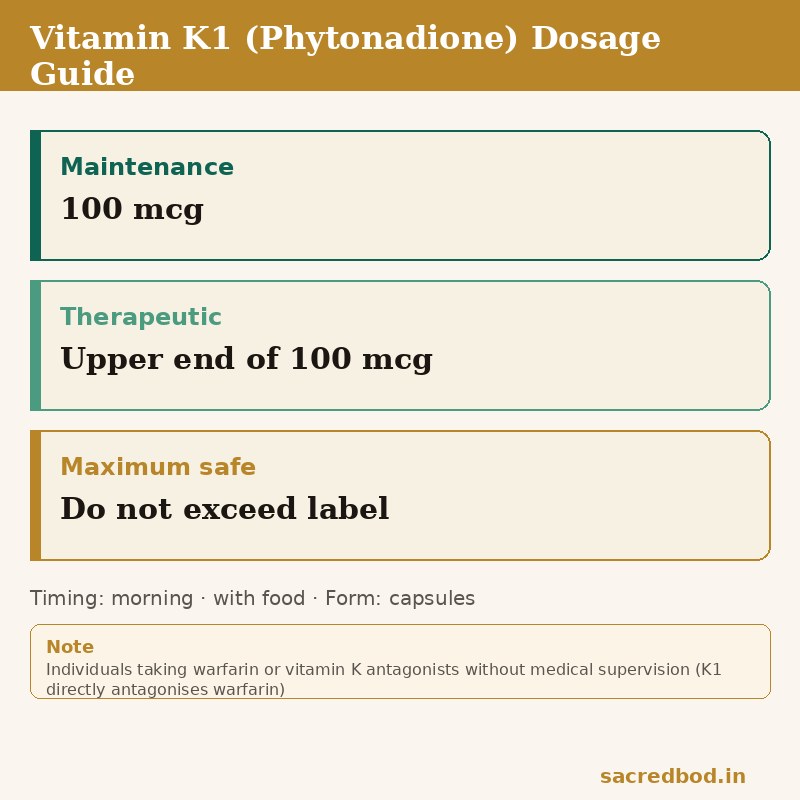
A typical dose is 100 mcg. Start at the lower end, assess tolerance, and only move up if needed. More is not automatically better — most supplements have a plateau beyond which extra doses add cost, not benefit.
When to take Vitamin K1 (Phytonadione)
Best taken with food, usually in the morning. Effects typically become noticeable within Immediate for coagulation; 4–8 weeks for vascular calcification markers.
Which form?
Vitamin K1 (Phytonadione) is commonly sold as a capsules. Whichever form you choose, the standardised active content on the label matters more than the raw milligram number.
Stacking Vitamin K1 (Phytonadione)
Vitamin K1 (Phytonadione) layers into a broader protocol; see its product page “Goes with” panel for evidence-aligned pairings. Add one new supplement at a time.
Safety and upper limits
Individuals taking warfarin or vitamin K antagonists without medical supervision (K1 directly antagonises warfarin). Those with thrombophilia or hypercoagulable disorders. Not for people on therapeutic anticoagulation unless directed by their physician.
Side effects: Generally well-tolerated at 100–500 mcg/day. Very high doses may interfere with warfarin anticoagulation. Rare allergic reactions to injectable forms. No toxicity from oral doses within recommended ranges. Do not exceed the label dose without clinician guidance.
Common mistakes to avoid
The two most common mistakes with Vitamin K1 (Phytonadione) are inconsistency and impatience. Skipping days resets progress, and judging results before Immediate for coagulation; 4–8 weeks for vascular calcification markers leads people to quit just before benefits appear. A third mistake is stacking several new products at once, which makes it impossible to know what is actually working. Start Vitamin K1 (Phytonadione) on its own, at 100 mcg, and add anything else only later.
Fitting Vitamin K1 (Phytonadione) into a daily routine
Adherence is easier when a supplement is anchored to an existing habit. Most people take Vitamin K1 (Phytonadione) in the morning, with food — pairing it with a daily meal or your morning routine makes it hard to forget. Keep the bottle where you will see it. Remember that Vitamin K1 (Phytonadione) is one input among many: sleep, diet, movement and stress management all act on the same blood, bones, blood vessels, heart valves and will amplify or blunt what any supplement can do.
What to realistically expect
Supplements rarely produce dramatic overnight change. With an evidence grade of B, Vitamin K1 (Phytonadione) is best understood as a steady, cumulative input rather than a quick fix. Expect gradual rather than sudden change over Immediate for coagulation; 4–8 weeks for vascular calcification markers, and measure against your own baseline. If after a fair trial at 100 mcg you notice nothing — subjectively or on relevant lab markers — that is useful information, and it is reasonable to stop.
Storage and stability
Heat and humidity are real considerations across much of India. Store Vitamin K1 (Phytonadione) in a cool, dry place away from direct sunlight, keep the bottle tightly closed, and avoid leaving it in a hot car or on a sunny kitchen shelf. A capsules kept in stable conditions retains potency far better than one repeatedly exposed to monsoon humidity. If your product arrives with a desiccant sachet, leave it in the bottle.
How to track whether it is working
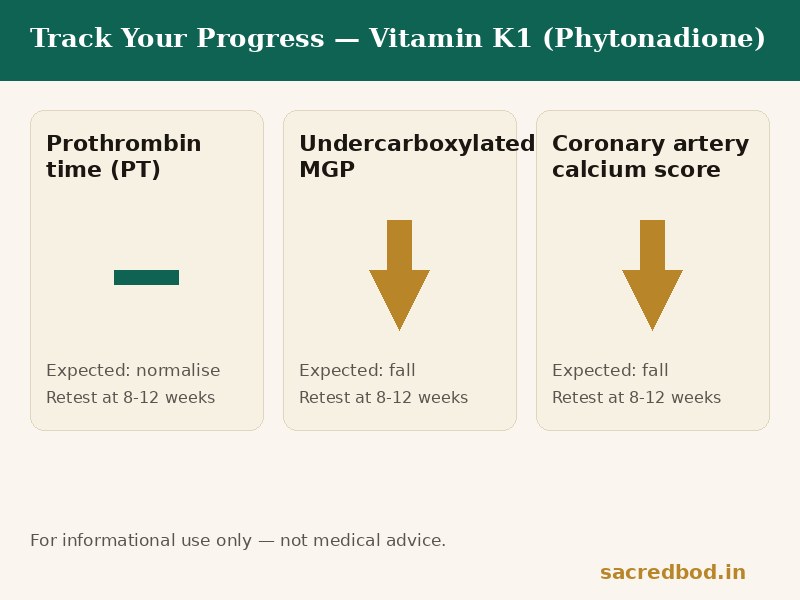
The most objective approach is to measure before and after. Keep a simple weekly log of the specific outcome you care about, and where relevant test Prothrombin time (PT), Undercarboxylated MGP, Coronary artery calcium score before starting Vitamin K1 (Phytonadione) and again at 8-12 weeks. Interpreting a number against your own baseline — and against how you feel — is far more reliable than reacting to day-to-day fluctuations. The SacredBod analyzer can track blood marker changes across reports over time.
Choosing a quality Vitamin K1 (Phytonadione) product in India
The Indian supplement market is large but lightly regulated, so quality varies widely between brands on Amazon.in. For Vitamin K1 (Phytonadione), look past marketing claims and check three things on the label: the standardised active content (not just the total extract weight), third-party testing such as NSF, USP or Informed Sport, and the exact capsules form. Generic ‘natural’ or ‘herbal’ labelling without standardisation data is a red flag. The price gap between a well-made and a poorly-made product is usually small; the gap in real-world results is not.
Where to buy Vitamin K1 (Phytonadione) in India
Vitamin K1 (Phytonadione) is available on Amazon.in. When buying, prioritise products that state the standardised active percentage, third-party testing (NSF, USP or Informed Sport), and a clear vegetarian-capsule declaration if that matters to you. Use the buy button on the Vitamin K1 (Phytonadione) page to see the current verified listing with the SacredBod tag.
This article is for informational purposes only. Consult a qualified healthcare provider before starting any supplement, especially if you take prescription medication or have a medical condition.
Shop Vitamin K1 (Phytonadione)
Supplements mentioned
People also ask
How much Vitamin K1 (Phytonadione) per day?
A typical dose is 100 mcg, taken with food. Follow the product label.
When should I take Vitamin K1 (Phytonadione)?
Usually in the morning, with food.
Keep reading
- Acetylcholine Dual Stack Dosage: How Much Should You Take?
How much Acetylcholine Dual Stack to take, when to take it, which form is best, and how to stack it safely.
- Agaricus blazei (ABM) Dosage: How Much Should You Take?
How much Agaricus blazei (ABM) to take, when to take it, which form is best, and how to stack it safely.
- Ajwain (Carom Seeds) Dosage: How Much Should You Take?
How much Ajwain (Carom Seeds) to take, when to take it, which form is best, and how to stack it safely.