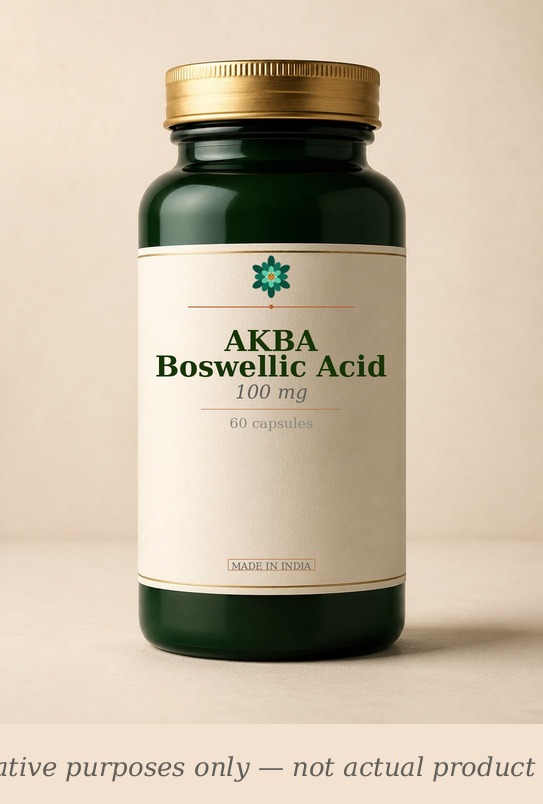
SacredBod's longer take on AKBA Boswellic Acid — context the structured blocks above don't capture.
What It Is
AKBA Boswellic Acid provides the most potent anti-inflammatory fraction of Boswellia serrata resin — acetyl-11-keto-β-boswellic acid. While crude boswellia extracts contain six major boswellic acids plus incensole and other terpenes, AKBA is the single compound most responsible for the clinical benefits documented in osteoarthritis, asthma and inflammatory bowel disease trials. Standardisation to AKBA content (typically 30 % in high-potency extracts, or 3 % in whole-resin extracts) ensures that each capsule delivers a meaningful dose of the active principle.
How It Works
- 5-LOX inhibition — AKBA is a direct, non-redox inhibitor of 5-lipoxygenase, the enzyme that generates leukotrienes from arachidonic acid. Unlike redox inhibitors (like zileuton), AKBA does not produce oxidative stress or hepatotoxicity.
- NF-κB suppression — AKBA prevents the phosphorylation and degradation of IκBα, blocking NF-κB nuclear translocation and downstream cytokine production.
- Complement system modulation — AKBA inhibits the classical complement pathway, reducing the inflammatory cascade triggered by immune complex deposition.
- Topoisomerase inhibition — At higher concentrations, AKBA inhibits topoisomerases I and II, contributing to its antiproliferative effects in cancer models.
Who Benefits Most
- Osteoarthritis patients — multiple RCTs show reduced pain, improved function and decreased knee-joint swelling.
- Asthma sufferers — leukotrienes are major mediators of bronchoconstriction; AKBA reduces their synthesis.
- IBD patients (Crohn’s, UC) — clinical trials demonstrate reduced disease activity scores and decreased need for steroids.
- Individuals who tried crude boswellia without success — AKBA-standardised extracts are more potent and consistent.
Dosage Guide
| Condition | AKBA Dose | Extract Equivalent | Duration |
|---|
| Osteoarthritis | 100 mg/day | ~300–500 mg of 30 % AKBA extract | Ongoing |
| Asthma | 100–200 mg/day | As above | 4–8 weeks |
| IBD | 200–400 mg/day | As above | 6–12 weeks |
Take with meals for optimal absorption. AKBA is lipophilic; a meal containing fat improves bioavailability. Dividing doses (morning and evening) may provide more stable blood levels than a single large dose.
Safety and Interactions
AKBA has an exceptional safety profile. Unlike NSAIDs, it does not cause gastric ulceration, renal impairment or cardiovascular events. The most common side effects are mild GI upset and nausea. Because it may have mild anticoagulant properties at very high doses, caution is warranted with warfarin. It may theoretically reduce the efficacy of immunosuppressive drugs by modulating immune function.
India-Specific Context
- Sanskrit/Hindi name: Shallaki (शल्लकी), Sallaki, Kunduru
- Ayurvedic classical texts: Shallaki is extensively documented in Charaka Samhita, Sushruta Samhita and Ashtanga Hridaya as a Shothahara (anti-inflammatory) and Vatahara (Vata-pacifying) herb. It is specifically indicated for Sandhigata Vata (osteoarthritis/joint disorders) and Vatavyadhi (neuromuscular disorders). It is a key ingredient in Yograj Guggulu and Mahayograj Guggulu.
- Indian brands: Widely available on Amazon.in from Teamex, HealthyHey Nutrition, STAY ALIVE, Generic brands and Baidyanath at ₹400–1,500 for 30–120 capsules. Look for products specifying AKBA content or total boswellic acid percentage.
- Regulatory status: Not a Schedule H drug; sold as a dietary supplement and Ayurvedic proprietary medicine. The AYUSH Ministry recognises Boswellia as a traditional medicine.
- Cultivation: Boswellia serrata is native to the dry deciduous forests of Madhya Pradesh, Rajasthan, Gujarat and Andhra Pradesh. Indian Shallaki is considered pharmacologically equivalent to African frankincense (Boswellia carterii).
Traditional Use in Indian Medicine
Shallaki holds a prestigious place in Ayurvedic Vata management. Charaka Samhita (Chikitsa Sthana 28) describes it for Sandhigata Vata — the classical Ayurvedic equivalent of osteoarthritis. The resin is Tikshna (penetrating), Laghu (light) and Snigdha (unctuous), with a bitter taste and warming post-digestive effect. Traditional practitioners apply Shallaki resin paste locally on swollen joints and prescribe it internally with ghee for Vata disorders. The modern isolation and standardisation of AKBA validates this empirical use, providing a molecular explanation for Shallaki’s efficacy in joint inflammation — 5-LOX inhibition reduces leukotriene-mediated synovial inflammation and cartilage degradation.