
SacredBod
0
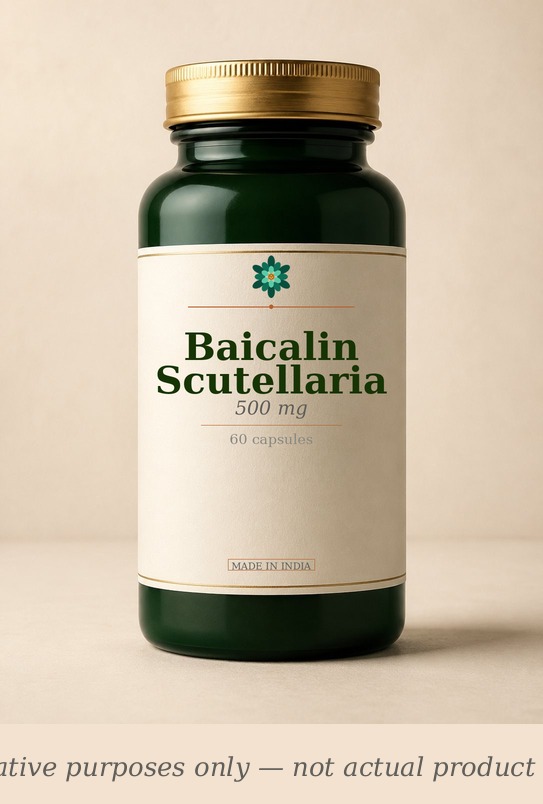
Baicalin Scutellaria — SacredBod supplement bottle (illustrative)
Supplement · Advanced Anti-Inflammatory

Baicalin Scutellaria

500 mg · vegan · gluten-free · 60 caps

Joint pain and stiffnessAllergic rhinitisAsthmaInflammatory skin conditionsChronic low-grade inflammation JointsLungsSkinLiver
BUY on Amazon →

Affiliate link · we earn from qualifying purchases. No paid placements.

What it is

Baicalin and baicalein are the principal flavonoids extracted from the root of Scutellaria baicalensis (Chinese skullcap / Huang Qin). Baicalin is the glycoside form; baicalein is its aglycone. Together they inhibit COX-2, 5-lipoxygenase (5-LOX) and NF-κB, providing broad-spectrum anti-inflammatory and anti-allergic activity.

How it works

Baicalein directly inhibits COX-2 and 5-LOX enzyme activity, reducing prostaglandin and leukotriene synthesis. It also blocks NF-κB nuclear translocation via stabilisation of IκBα and suppresses NLRP3 inflammasome activation. Baicalin, its more water-soluble glycoside form, is converted to baicalein in the gut by bacterial β-glucuronidase.

Who should take it

Individuals with osteoarthritis, allergic rhinitis, asthma, inflammatory skin conditions and those seeking a botanical alternative to NSAIDs with dual COX-LOX inhibition.

Avoid / careful

Avoid during pregnancy and breastfeeding. Use caution in those with liver disease, on sedatives or with known skullcap allergy. Side effects: Generally well tolerated; rare mild GI upset, drowsiness or headache. Very high doses may affect liver enzymes.

When to take it

Morning
Noon
Evening
Night

How to take it

With food
Empty stomach
Before food

FAQs

Frequently asked

How long before I see results?
Joint comfort improvements may appear within 2–4 weeks. Allergic symptom relief can be noticeable within 1–2 weeks. Benefits accumulate with consistent use.
Is it safe to take daily?
Yes. Baicalin has been safely used in Phase I clinical trials at doses up to 2,800 mg with no serious adverse events. The 500 mg daily dose is well within the safety window.
Can I take it with NSAIDs?
Use caution. Baicalin has COX-2 inhibitory activity that may be additive with NSAIDs. If combining, use the lowest effective dose of both and monitor for GI upset or bruising.

In plain English

A plain-English read of the literature behind this supplement. Not a clinical recommendation.

Key citations: PMID 28942223 (baicalin suppresses IL-1β-induced inflammatory cytokines via NF-κB blockade in human OA chondrocytes), PMID 25249339 (baicalin, baicalein and wogonin inhibit LPS-mediated vascular inflammation in vitro and in vivo), PMC5977217 (baicalein inhibits NO, cytokines and chemokines in dsRNA-induced macrophages), PMC10253382 (comprehensive review of baicalin anti-inflammatory mechanisms in chronic diseases), PMC12838963 (baicalein multi-target anti-inflammatory mechanisms in acute pancreatitis)

Editorial notes

SacredBod's longer take on Baicalin Scutellaria — context the structured blocks above don't capture.

What It Is

Baicalin Scutellaria provides the two principal flavonoids from Scutellaria baicalensis Georgi — a plant known as Chinese skullcap or Huang Qin (黄芩). While not native to India, skullcap extracts are increasingly available through Indian herbal brands and import channels. Baicalin (the glycoside) and baicalein (the aglycone) together form one of the most potent natural dual COX-2/5-LOX inhibitors known, with additional NF-κB and NLRP3 inflammasome suppression. This broad-spectrum activity makes it distinct from single-target anti-inflammatories like turmeric (primarily COX-2) or boswellia (primarily 5-LOX).

How It Works

  1. Dual eicosanoid inhibition — Baicalein directly inhibits both cyclooxygenase-2 (COX-2) and 5-lipoxygenase (5-LOX), reducing synthesis of prostaglandins (PGE2) and leukotrienes (LTB4) simultaneously. This is the same dual mechanism targeted by the pharmaceutical drug licofelone.
  2. NF-κB stabilisation — Baicalin stabilises IκBα, preventing its phosphorylation and degradation. This blocks NF-κB p65 nuclear translocation and shuts down transcription of TNF-α, IL-6, IL-1β, COX-2 and iNOS.
  3. NLRP3 inflammasome suppression — Baicalin negatively regulates the NLRP3/ASC/caspase-1 axis, reducing IL-1β maturation — a key driver of osteoarthritis cartilage destruction and gout flares.

Who Benefits Most

  • Osteoarthritis patients seeking cartilage-protective anti-inflammatory support beyond simple pain relief.
  • Allergic rhinitis and asthma sufferers — the dual COX-LOX inhibition reduces both prostaglandin-mediated vasodilation and leukotriene-mediated bronchoconstriction.
  • Individuals with inflammatory skin conditions — baicalin modulates Th17/Treg balance and reduces skin inflammatory cytokines.

Dosage Guide

GoalDoseTiming
General anti-inflammatory500 mg extract/day (85 % baicalin)With breakfast
Osteoarthritis support500–1,000 mg/dayDivided doses with meals
Allergic rhinitis500 mg/dayMorning with food

Baicalin relies on gut bacterial β-glucuronidase to convert to the more active baicalein. Probiotic supplementation or fermented foods may enhance this conversion. Avoid simultaneous use of antibiotics that disrupt gut flora.

Safety and Interactions

Baicalin is remarkably safe. Phase I trials in healthy volunteers showed no serious adverse events at doses up to 2,800 mg. Mild drowsiness may occur due to GABA-A receptor modulation — this is the same mechanism that makes skullcap a traditional nervine sedative. Use caution with warfarin and other anticoagulants.

India-Specific Context

  • Hindi/Sanskrit name: No classical Indian equivalent; Scutellaria baicalensis is a Chinese medicinal herb (Huang Qin in TCM). However, the pharmacological action aligns with Ayurvedic Shothahara (anti-inflammatory) herbs.
  • Local availability: Available on Amazon.in from Shree Herbal (tablets), Citokain (capsules) and other generic brands at ₹400–1,200 for 60–180 tablets/capsules. Most products are imported raw material formulated in India.
  • Regulatory status: Not a Schedule H drug; sold as a dietary supplement and herbal product.
  • Ayurvedic parallel: While not in classical texts, the dual COX-LOX action is conceptually similar to the polypharmacology of Yograj Guggulu and Mahayograj Guggulu — classical Ayurvedic anti-inflammatory formulations that target multiple inflammatory pathways.
  • Quality note: Look for extracts standardised to 80–90 % baicalin content. Raw skullcap powder is ineffective for anti-inflammatory purposes as baicalin is poorly absorbed without gut bacterial conversion.

Traditional Use in Indian Medicine

Scutellaria baicalensis does not appear in Charaka Samhita, Sushruta Samhita or other classical Ayurvedic texts — it is a Traditional Chinese Medicine (TCM) herb. However, the concept of using bitter, cooling herbs for inflammatory (Pitta) conditions is shared across both medical systems. In modern Indian integrative practice, baicalin is sometimes combined with classical Ayurvedic anti-inflammatories like Guduchi (Tinospora cordifolia) or Shallaki (Boswellia serrata) for enhanced polypharmacological effect. The AYUSH Ministry’s openness to cross-traditional medicine has facilitated the import and formulation of TCM herbs like skullcap in Indian supplement markets.

Added to your stack.