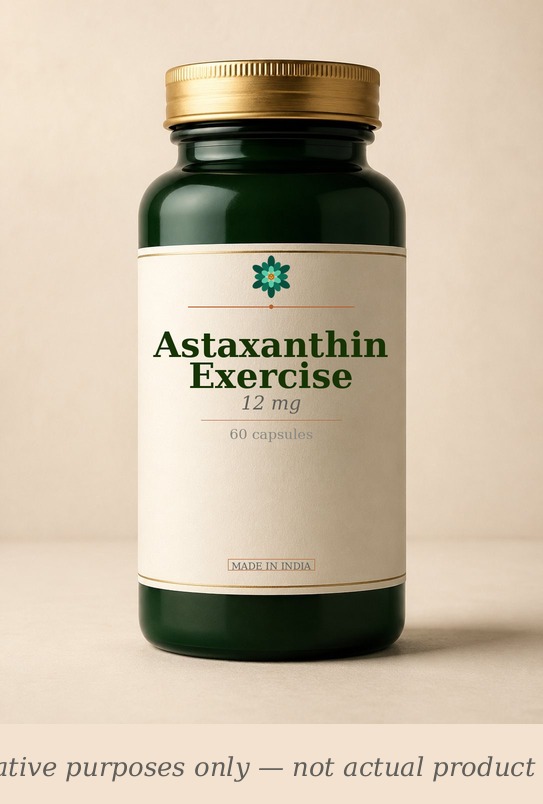
SacredBod's longer take on Astaxanthin Exercise — context the structured blocks above don't capture.
What It Is
Astaxanthin is a ketocarotenoid produced by the microalgae Haematococcus pluvialis and concentrated up the food chain in salmon, krill, shrimp and flamingos. It is 6,000 times more potent than vitamin C as a singlet oxygen quencher and 550 times more potent than vitamin E as a lipid peroxidation inhibitor. Unlike beta-carotene, astaxanthin never becomes pro-oxidant. Its unique molecular structure — with hydroxyl and keto groups at both ends of the conjugated polyene chain — allows it to span cell membranes and protect both the lipid interior and aqueous exterior. In India, it is sold as algae-derived capsules by Nutricost, Sports Research, NutriJa and domestic brands.
How It Works
During intense exercise, reactive oxygen species (ROS) production increases dramatically, damaging muscle cell membranes, proteins and DNA. Astaxanthin neutralises these ROS, reduces lipid peroxidation, and preserves mitochondrial function. A 2024 RCT in young adults found that 12 mg/day astaxanthin for 4 weeks attenuated post-exercise rises in creatine kinase (CK) and lactate dehydrogenase (LDH) during a cycling time trial. Another study in resistance-trained men showed that astaxanthin reduced subjective muscle soreness (DOMS) following eccentric exercise. It also increases glutathione concentrations — the body’s master antioxidant. However, not all studies are positive: Waldman et al. (2023) found no effect of 12 mg/day on muscle damage markers in resistance-trained men, suggesting benefits may be more pronounced in higher oxidative stress contexts (heat, altitude, ultra-endurance).
Who Benefits Most
Endurance athletes (runners, cyclists, swimmers) doing high weekly mileage; resistance athletes in high-volume hypertrophy blocks; and anyone training in hot, polluted or high-altitude environments where oxidative stress is amplified. Less critical for casual gym-goers in air-conditioned settings.
Dosage Guide
- Standard dose: 12 mg daily with a fat-containing meal
- Alternative protocol: 4 mg daily for 90 days (as used in soccer player studies)
- Timing: With breakfast or post-workout meal for optimal absorption
- Cycle: Continuous daily use is safe and recommended
Safety and Interactions
Extremely safe. GRAS status from FDA. No toxicity in doses up to 20 mg/day for 12 months. May cause mild skin reddening (harmless carotenodermia) at >20 mg/day. Theoretical interaction with immunosuppressants due to immune-modulating effects.
India-Specific Context
Astaxanthin is a growing but premium category on Amazon.in. Nutricost 12 mg softgels (₹3,099 for 60), Sports Research (₹4,279) and NutriJa (₹1,500–₹2,000) are the main options. Domestic algae-derived products are emerging. It is not a scheduled drug. There is no Ayurvedic equivalent for marine carotenoids, though turmeric (haridra) and amla provide antioxidant support through different mechanisms. Indian athletes training in Delhi/Mumbai pollution or summer heat may find astaxanthin particularly valuable for cellular protection.