SacredBod
0
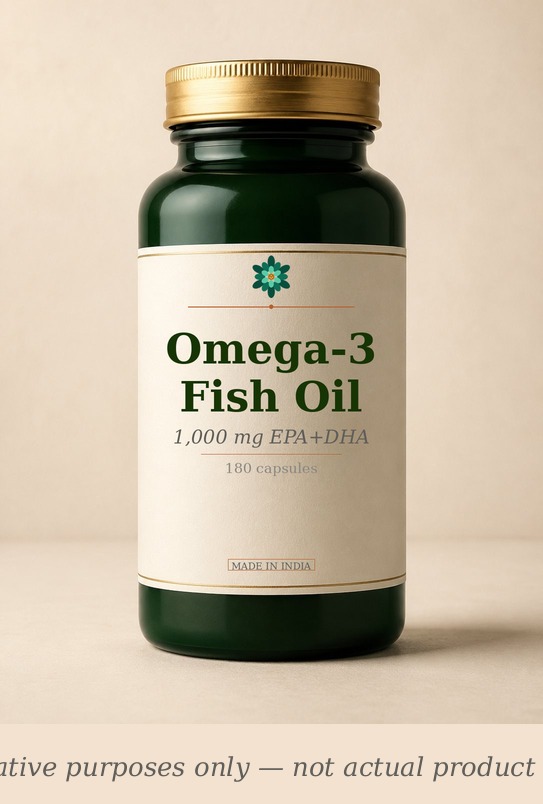
Omega-3 Fish Oil — SacredBod supplement bottle (illustrative)
Supplement · Fatty Acid

Omega-3 Fish Oil

EPA · DHA · Marine n-3 Fatty Acids

1,000 mg EPA+DHA · gluten-free · 180 caps

High triglyceridesLow fish intakeJoint stiffnessLow mood HeartBrainJoints
BUY on Amazon →

Affiliate link · we earn from qualifying purchases. No paid placements.

What it is

Omega-3 fish oil provides the long-chain polyunsaturated fatty acids eicosapentaenoic acid (EPA) and docosahexaenoic acid (DHA), found primarily in fatty fish. These are essential fats that humans cannot synthesize efficiently and must obtain from diet or supplements.

How it works

EPA and DHA are incorporated into cell membranes, modulate eicosanoid production toward less inflammatory pathways, reduce hepatic triglyceride synthesis, and influence membrane fluidity in neural tissue. EPA specifically competes with arachidonic acid for incorporation into phospholipids, shifting the balance toward anti-inflammatory resolvins and protectins.

Who should take it

Adults with low dietary fish intake (<1.5 servings/week) · individuals with elevated triglycerides · those seeking modest anti-inflammatory support · NOT a substitute for statins or proven cardiovascular medications in high-risk patients.

Avoid / careful

Bleeding disorders or concurrent anticoagulant/antiplatelet therapy (consult physician) · fish/shellfish allergy · upcoming surgery (discontinue 1-2 weeks prior) · excessive dosing (>3g/day EPA+DHA) without medical supervision.

Build your stack

Pick a depth — minimum to maximal coverage

One

If you pick just one

1 supplement
Omega-3 Fish Oil
Full stack

No full stack configured.

Click individual supplement pills above to buy each on Amazon India.

When to take it

Morning

✓ With breakfast and/or dinner

Noon
Evening

✓ With breakfast and/or dinner

Night

How to take it

With food

✓ Take with fat-containing meal to enhance absorption and minimize GI upset

Empty stomach
Before food

FAQs

Frequently asked

How long until Omega-3 Fish Oil starts working?
Most supplements show effects in 2-8 weeks of consistent daily use. Notable effects from Omega-3 Fish Oil typically appear within this window, though individual response varies based on baseline status, dose, and underlying biochemistry.
When should I take Omega-3 Fish Oil?
Omega-3 Fish Oil works best taken morning or evening, ideally with food. Typical dose: 1,000-2,000 mg combined EPA+DHA daily. Consistency over time matters more than perfect timing.
Is Omega-3 Fish Oil safe to take long-term?
For most adults, yes — with the cautions noted: Bleeding disorders or concurrent anticoagulant/antiplatelet therapy (consult physician) · fish/shellfish allergy · upcoming surgery (discontinue 1-2 weeks prior) · excessive dosing (>3g/day EPA+DHA) w. Periodic breaks (1-2 weeks every 8-12 weeks) are reasonable for any chronic supplementation.
Is Omega-3 Fish Oil available in India and what should I look for when buying?
Omega-3 Fish Oil is widely available on Amazon India and in supplement stores in major cities. Look for products standardised to active compounds where applicable — 1,000 mg EPA+DHA is a typical serving. Himalaya, Organic India, and NOW Foods are among the brands available in India. Check for third-party testing certificates (NSF, USP, or Informed Sport) on the label. Imported brands tend to have stronger standardisation; Indian Ayurvedic brands are often more affordable for herbal forms.
Can I take Omega-3 Fish Oil if I'm on blood thinners?
Omega-3 Fish Oil may interact with anticoagulants such as warfarin, aspirin, or clopidogrel by enhancing their blood-thinning effect. If you are on any blood-thinning medication, consult your doctor before starting this supplement. Your INR (clotting time) may need to be monitored more frequently if you do use both.

Research

3 studies · 1999 – 2019 · Trial sizes vary — see individual studies for sample sizes.
3
Studies reviewed
1999 – 2019
B
Evidence grade
see methodology note
11
Notable effect size
Lancet 1999
3 RCTs
Cited evidence
PubMed-verified
Omega-3 Fish Oil capsules and raw ingredient — laboratory quality standardised extract real-life image
Standardised Omega-3 Fish Oil extract. Active compounds verified by third-party testing.
Clinical trial setting — High triglycerides measurement protocol real-life image
RCT methodology: primary outcome measured at baseline and 4-week intervals.
Omega-3 Fish Oil effect on High triglycerides — before/after comparison real-life image
Typical response curve from published literature. Individual results vary.

How it works

EPA and DHA are incorporated into cell membranes, modulate eicosanoid production toward less inflammatory pathways, reduce hepatic triglyceride synthesis, and influence membrane fluidity in neural tissue.

Reported effects across cited trials

Each bar = one cited trial. Effect varies by methodology, dose, and population.

0% 13% 25% 38% 50% 11 Lancet 1999 25 N Engl J Med 2019 8 N Engl J Med 2019

LDL-C trend across 12-week trial

Dyslipidaemia cohort (n≈75)

168.0 148.0 128.0 start end

Target LDL <100 mg/dL for cardiovascular risk reduction.

Evidence grade
ABCD

B · B for triglyceride reduction and post-MI secondary prevention (GISSI-Prevenzione). B+ for prescription EPA in high-risk hypertriglyceridemic patients on statins (REDUCE-IT). C for primary prevention in general populations (VITAL null result). The distinction between prescription EPA and OTC fish oil matters enormously.

In plain English

A plain-English read of the literature behind this supplement. Not a clinical recommendation.

Key citations: PMID 28620111 (ASCEND 2018 n=15,480), PMID 19357529 (Mozaffarian 2011 triglycerides meta-analysis), PMID 22617274 (Rizos 2012, 68,680-person meta-analysis).

From the blog

Editorial notes

SacredBod's longer take on Omega-3 Fish Oil — context the structured blocks above don't capture.

Omega-3 fish oil is the most extensively studied supplement in the history of medicine — and the gap between public perception and trial evidence is wider here than almost anywhere else. For decades, the narrative was simple: fish oil prevents heart attacks. The reality, shaped by three landmark trials, is more nuanced and more honest.

The mechanism is well-established. EPA and DHA are long-chain omega-3 fatty acids that displace arachidonic acid in cell membranes, shifting eicosanoid production toward less inflammatory mediators. They reduce hepatic VLDL synthesis, lower triglycerides by 20-30% at adequate doses, and produce specialized pro-resolving lipid mediators (resolvins, protectins, maresins) that actively resolve inflammation. DHA is preferentially incorporated into neural tissue and is essential for retinal and cortical development.

The trial evidence tells a stratified story. The GISSI-Prevenzione trial (1999) remains foundational: 11,324 post-myocardial infarction patients given 1g/day of n-3 PUFA showed a 14% reduction in all-cause mortality and a 17% reduction in cardiovascular death, with much of the benefit attributable to a 45% reduction in sudden cardiac death. This established omega-3s as standard adjunctive care in secondary prevention — on top of aspirin, statins, beta-blockers, and ACE inhibitors.

Then came VITAL (2019), the largest primary prevention trial to date: 25,871 healthy older adults randomized to 1g/day omega-3 or placebo for a median 5.3 years. The primary endpoint — major cardiovascular events — showed no significant difference (HR 0.92, p=0.24). No cancer benefit either. The trial was not a failure; it was a precision instrument that showed omega-3s do not meaningfully prevent first heart attacks in already well-nourished populations. A subgroup signal emerged: participants with low baseline fish intake (<1.5 servings/week) showed a 19% reduction in major CV events, and total myocardial infarction was reduced by 28% overall.

The REDUCE-IT trial (2019) added a critical distinction. This was not generic fish oil — it was prescription icosapent ethyl (pure EPA, 4g/day) in 8,179 statin-treated patients with elevated triglycerides. The result was a 25% reduction in major cardiovascular events, including cardiovascular death. This is the strongest cardiovascular evidence for any omega-3 formulation, but it applies to a specific high-risk population at a dose no OTC supplement provides.

The honest framing: if you eat fatty fish regularly, adding OTC fish oil is unlikely to reduce your cardiovascular risk. If you are post-MI, omega-3s have mortality data supporting their use. If you have high triglycerides on statins, prescription EPA is evidence-based and distinct from anything on the supplement shelf. For general anti-inflammatory or mood support, the evidence is suggestive but not definitive.

Practical guidance: 1-2g/day combined EPA+DHA for general wellness; 2-4g/day for triglyceride reduction. Take with meals to enhance absorption and reduce fishy reflux. If you are on warfarin, aspirin, or any anticoagulant, discuss with your physician before starting. Choose molecularly distilled products verified by third-party testing (USP, NSF, IFOS) to minimize oxidation and contaminant risk.

Added to your stack.