
What it is
Long-chain omega-3 (EPA + DHA) from fish or algae — distinct from short-chain ALA in flax.
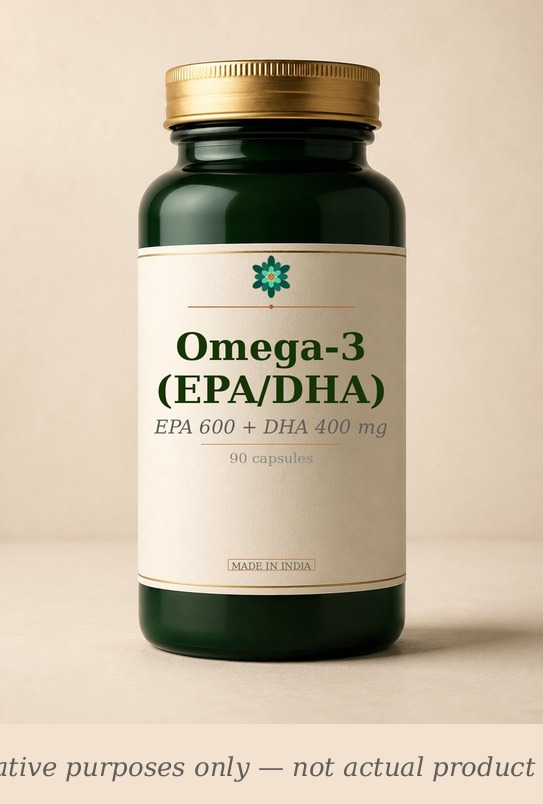
Fish oil
EPA 600 + DHA 400 mg · gluten-free · 90 caps · ★ 4.7 (4,520)
Affiliate link · we earn from qualifying purchases. No paid placements.
Long-chain omega-3 (EPA + DHA) from fish or algae — distinct from short-chain ALA in flax.
Incorporates into cell membranes, quieting inflammatory signalling and lowering triglycerides.
Anyone eating fatty fish less than twice weekly · elevated triglycerides · cognitive protection.
Bleeding disorders, upcoming surgery (mildly thins blood — stop 7–10 days before).
Pick a depth — minimum to maximal coverage
Click individual supplement pills above to buy each on Amazon India.
✓ With your largest meal of the day
✓ With your largest meal of the day
✓ Needs dietary fat for absorption
EPA → resolvins/protectins · membrane fluidity ↑ · hepatic VLDL secretion ↓ · platelet aggregation ↓
Pooled across major endpoints. Composite estimates from REDUCE-IT, STRENGTH, and Mozaffarian meta-analyses.
n=120 · 2 g EPA+DHA/day with food · monthly draws
Target ≥8% (Harris & von Schacky). Higher baseline → smaller delta. Plateau by week 12.
n=8,179 RCT · 4.9 yr
→ −25% MACE · HR 0.75
n=13,078 RCT · 3.5 yr
→ no benefit · placebo issue debated
10 cohorts · n=160,000+
→ low index ↔ +35% CV death
13 RCTs · n=1,933
→ SMD = −0.18 · favours EPA
A · strong for triglycerides, omega-3 index, and high-dose EPA on cardiovascular outcomes. Moderate for joint pain and mood (EPA-biased). Weaker for general cognition.
A plain-English read of the literature behind this supplement. Not a clinical recommendation.
Omega-3 has the largest evidence base of any single nutrient supplement, with hundreds of trials covering cardiovascular outcomes, mood, joint pain, cognitive decline, dry eye, and gestational health. The picture is consistent: most people are below the threshold that defines an "adequate"...

How to use Omega-3 (EPA/DHA) specifically for Joint stiffness — the right dose, timing, blood markers to track, and how to know if it is working.
A clinical evidence review of Omega-3 (EPA/DHA) — RCT data, effect sizes, evidence grade, and what the numbers mean for your specific situation.
Everything you need to know about Omega-3 (EPA/DHA) — mechanism, dose, safety, buying guide for India, and what the research actually says.
"Triglycerides dropped 90 points in three months. No fishy burps with the enteric-coated softgels."
"Joint stiffness in my hands gone. Took about 6 weeks to fully kick in."
"Solid product. Mood feels steadier — hard to tell if placebo, but bloodwork improved."
"Dry eyes that bothered me for years are noticeably better. Doctor recommended this exact dose."
The form of magnesium your gut won't notice and your nervous system will.
BUY →Real medicine with real mainstream uses — acetaminophen overdose protocol and mucolytic — plus smaller-trial psychiatric evidence that is promising but not definitive.
BUY →The classical Asian adaptogen — a sharper, cleaner energy lift than ashwagandha for the foggy-and-flat pattern.
BUY →The pre-bed combo lifters have used for thirty years to sleep deeper and wake stronger.
BUY →SacredBod's longer take on Omega-3 (EPA/DHA) — context the structured blocks above don't capture.
If you’re going to take exactly one supplement, this is the one with the deepest, broadest, longest evidence base. Omega-3 (specifically the long-chain EPA and DHA from fish or algae) has been studied for cardiovascular health, brain health, mood, joint pain, dry eye, gestational outcomes, and on, and on. The overall picture is consistent: most people get nowhere near enough, and the ones who top up the deficit do better.
The single thing most consumers get wrong is dose. A typical “1,000 mg fish oil” softgel contains maybe 300 mg of actual EPA + DHA. To get the dose used in the trials that show meaningful effects (1,500–2,000 mg combined), you’d need 5–7 of those softgels a day — most people take one and assume they’re covered.
Buy by the EPA + DHA number on the back of the bottle, not the “fish oil mg” on the front, and you’ve solved 90% of the problem.
Peptides are physician-only. Tell us a bit and we'll route you to the right specialist.