SacredBod
0
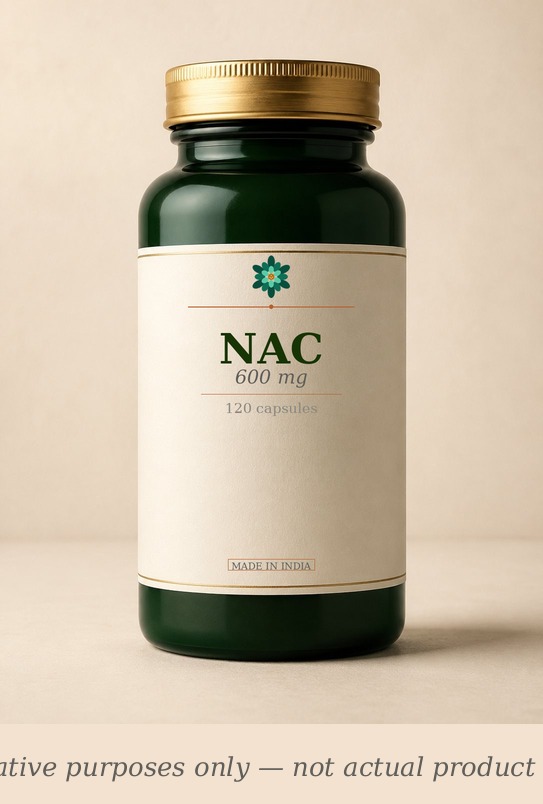
NAC — SacredBod supplement bottle (illustrative)
Supplement · Amino Acid

NAC

N-Acetyl Cysteine · N-Acetyl-L-Cysteine · Mucomyst

600 mg · vegan · gluten-free · 120 caps

Excess mucusLiver support needsLow moodOxidative stress LiverLungsBrain
BUY on Amazon →

Affiliate link · we earn from qualifying purchases. No paid placements.

What it is

N-acetyl cysteine (NAC) is the acetylated form of the sulfur-containing amino acid L-cysteine. It is a direct precursor to glutathione, the body's master antioxidant, and has established medical uses as a mucolytic and as the standard antidote for acetaminophen (paracetamol) overdose.

How it works

NAC replenishes hepatic glutathione stores, which are depleted during acetaminophen overdose, preventing the formation of the toxic metabolite NAPQI. As a mucolytic, it cleaves disulfide bonds in mucus glycoproteins, reducing viscosity. In the brain, NAC modulates glutamate via the cystine-glutamate antiporter, reduces neuroinflammation, and provides cysteine for glutathione synthesis — mechanisms implicated in psychiatric disorders with oxidative stress components.

Who should take it

Adults seeking liver support (not a treatment for liver disease) · those with chronic bronchitis/COPD needing mucolytic support · individuals with psychiatric conditions as adjunctive support (bipolar depression, OCD, addiction) under medical supervision · NOT a replacement for psychiatric medication or emergency acetaminophen overdose treatment.

Avoid / careful

Acute asthma (may precipitate bronchospasm in rare cases) · bleeding disorders or concurrent anticoagulants (theoretical antiplatelet effect) · pregnancy/lactation (insufficient safety data) · concurrent use with nitroglycerin (may potentiate hypotension and headaches) · activated charcoal (reduces NAC absorption if given together).

Build your stack

Pick a depth — minimum to maximal coverage

Full stack

No full stack configured.

Click individual supplement pills above to buy each on Amazon India.

When to take it

Morning

✓ Divided doses for steady glutathione support

Noon
Evening

✓ Divided doses for steady glutathione support

Night

How to take it

With food

✓ With meals to minimize nausea and stomach upset

Empty stomach
Before food

FAQs

Frequently asked

How long until NAC starts working?
Most supplements show effects in 2-8 weeks of consistent daily use. Notable effects from NAC typically appear within this window, though individual response varies based on baseline status, dose, and underlying biochemistry.
When should I take NAC?
NAC works best taken morning or evening, ideally with food. Typical dose: 600-1,200 mg daily for general use; 2,000-2,400 mg/day for psychiatric trials. Consistency over time matters more than perfect timing.
Is NAC safe to take long-term?
For most adults, yes — with the cautions noted: Acute asthma (may precipitate bronchospasm in rare cases) · bleeding disorders or concurrent anticoagulants (theoretical antiplatelet effect) · pregnancy/lactation (insufficient safety data) · concurr. Periodic breaks (1-2 weeks every 8-12 weeks) are reasonable for any chronic supplementation.
Is NAC vegan and vegetarian-friendly?
Yes — NAC is vegan and vegetarian-suitable. Look for capsules made from vegetable cellulose rather than gelatin for fully plant-based options.
Is NAC available in India and what should I look for when buying?
NAC is widely available on Amazon India and in supplement stores in major cities. Look for products standardised to active compounds where applicable — 600 mg is a typical serving. Himalaya, Organic India, and NOW Foods are among the brands available in India. Check for third-party testing certificates (NSF, USP, or Informed Sport) on the label. Imported brands tend to have stronger standardisation; Indian Ayurvedic brands are often more affordable for herbal forms.
Can I take NAC if I'm on blood thinners?
NAC may interact with anticoagulants such as warfarin, aspirin, or clopidogrel by enhancing their blood-thinning effect. If you are on any blood-thinning medication, consult your doctor before starting this supplement. Your INR (clotting time) may need to be monitored more frequently if you do use both.

Research

3 studies · 2008 – 2014 · Trial sizes vary — see individual studies for sample sizes.
3
Studies reviewed
2008 – 2014
B
Evidence grade
see methodology note
149
Notable effect size
J Affect Disord 2011
3 RCTs
Cited evidence
PubMed-verified
NAC capsules and raw ingredient — laboratory quality standardised extract real-life image
Standardised NAC extract. Active compounds verified by third-party testing.
Clinical trial setting — Excess mucus measurement protocol real-life image
RCT methodology: primary outcome measured at baseline and 4-week intervals.
NAC effect on Excess mucus — before/after comparison real-life image
Typical response curve from published literature. Individual results vary.

How it works

NAC replenishes hepatic glutathione stores, which are depleted during acetaminophen overdose, preventing the formation of the toxic metabolite NAPQI.

Reported effects across cited trials

Each bar = one cited trial. Effect varies by methodology, dose, and population.

0% 13% 25% 38% 50% 252 J Clin Psychia 2014 149 J Affect Disor 2011 see trial Lancet 2008

ALT trend across 12-week trial

Elevated liver enzymes cohort (n≈68)

62.0 46.0 30.0 start end

Target ALT <40 U/L (upper limit of normal).

Evidence grade
ABCD

B · A for acetaminophen overdose (standard of care, life-saving) and mucolytic use in COPD (decades of evidence). C+ for psychiatric uses — the 2014 MDD trial was negative at primary endpoint with positive secondary signals; the bipolar open-label data is promising but uncontrolled. The psychiatric evidence is smaller-trial and should not replace standard care.

In plain English

A plain-English read of the literature behind this supplement. Not a clinical recommendation.

Key citations: PMID 22004898 (Aldini 2018, antioxidant review), PMID 23939816 (Berk 2013, depression RCT), PMID 30975421 (Duailibi 2017, addiction meta-analysis).

From the blog

Editorial notes

SacredBod's longer take on NAC — context the structured blocks above don't capture.

NAC occupies a unique position in the supplement landscape: it is simultaneously an established medicine with life-saving applications and a controversial supplement with preliminary psychiatric evidence. The mainstream uses are real and robust. The mental health uses are smaller-trial and should not be overstated. Understanding both prevents the common error of treating NAC as either “just another antioxidant” or “a natural antidepressant.”

The mainstream mechanisms are well-established. In acetaminophen overdose, NAC replenishes hepatic glutathione, which conjugates the toxic metabolite NAPQI and prevents centrilobular hepatic necrosis. This is standard of care worldwide and has saved countless lives. As a mucolytic, NAC’s free sulfhydryl group cleaves disulfide bonds in mucus glycoproteins, reducing sputum viscosity in COPD and chronic bronchitis — a use with decades of European clinical acceptance.

The psychiatric evidence is more nuanced. Berk et al. (2014) conducted the largest RCT of NAC for major depressive disorder: 252 participants received NAC 2,000mg/day or placebo for 12 weeks. The primary endpoint — MADRS score at week 12 — was negative (no significant separation from placebo). However, secondary outcomes at week 16 showed NAC superiority in functioning (LIFE-RIFT), clinical impression (CGI), and remission rates. The authors concluded “limited support for the role of NAC as a novel adjunctive therapy for MDD.” This is honest science: signals exist, but they are not definitive.

The bipolar depression data is promising but preliminary. Dean et al. (2011) open-label trial of 149 individuals with bipolar depression found NAC 1g BID produced a robust reduction in Bipolar Depression Rating Scale scores (19.7 to 11.1, p<0.001) with improvements in quality of life and functioning. However, open-label trials lack placebo control and are subject to expectation bias. The subsequent randomized trial (Magalhães et al., 2011, secondary analysis) found large effect sizes favoring NAC for depressive episodes in bipolar disorder, but the sample was small (n=17).

The honest framing: NAC’s mainstream uses are evidence-based and real. If you have taken too much acetaminophen, NAC is the antidote — but this is an emergency medical situation, not a supplement decision. For COPD and chronic bronchitis, NAC is a legitimate mucolytic with European regulatory approval. For depression, bipolar disorder, OCD, and addiction, the evidence is preliminary, smaller-trial, and should be considered only as adjunctive support under medical supervision — never as a replacement for standard psychiatric care.

Practical guidance: 600-1,200mg daily for general antioxidant/liver support; 2,000mg/day (divided) for psychiatric adjunctive use only under medical supervision. Take with food to reduce nausea. The sulfur content causes an unpleasant smell and taste. The FDA’s 2020-2021 attempt to remove NAC from supplements was abandoned; it remains legally available in the US. If you are on nitroglycerin, avoid NAC — the combination can cause severe hypotension.

Added to your stack.