
What it is
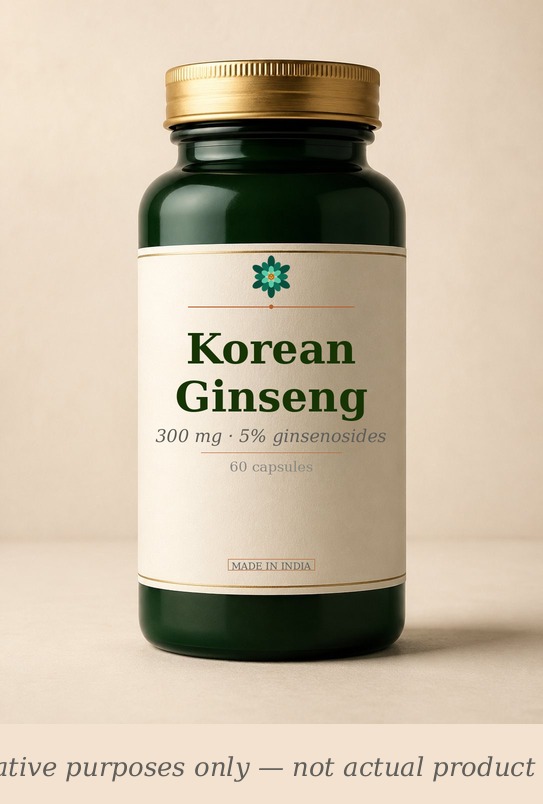
Standardised root extract of Panax ginseng — the active ginsenosides drive its effects.
Panax ginseng · Asian ginseng
300 mg · 5% ginsenosides · vegan · gluten-free · 60 caps · ★ 4.5 (980)
Affiliate link · we earn from qualifying purchases. No paid placements.
Standardised root extract of Panax ginseng — the active ginsenosides drive its effects.
Acts on HPA axis, dopamine, and acetylcholine — mildly activating without caffeine's jitter.
Mental fatigue · jet lag · long workdays · adults too sedated by ashwagandha · mild ED.
High blood pressure · insomnia (don't take after 2 p.m.) · pregnancy · warfarin.
Pick a depth — minimum to maximal coverage
Click individual supplement pills above to buy each on Amazon India.
✓ Morning — too stimulating later in the day
Flexible — works in any of the above.
Chronic stress cohort (n≈64)
Morning cortisol normal range 6–23 μg/dL. Elevated = chronic stress.
n=30 crossover · 200 mg
→ +9% accuracy under load
n=438 RCT · 8 wk
→ VAS fatigue −14%
n=119 RCT · 8 wk
→ IIEF +5 pts vs placebo
n=323 RCT · 12 wk
→ −18% URI duration
B · moderate for cognitive performance under fatigue and ED-related endpoints. Modest for cold/flu duration. Effect sizes are real but small; expect a useful nudge, not a transformation.
A plain-English read of the literature behind this supplement. Not a clinical recommendation.
Modern research on Panax ginseng has clustered around three main areas: cognitive performance under fatigue, sexual function in middle-aged men, and immune function during respiratory infections. The cognitive-stamina trials (notably Reay et al. 2005, 2010) consistently show modest effects at ...
How to use Korean Ginseng specifically for Brain fog — the right dose, timing, blood markers to track, and how to know if it is working.
A clinical evidence review of Korean Ginseng — RCT data, effect sizes, evidence grade, and what the numbers mean for your specific situation.
Everything you need to know about Korean Ginseng — mechanism, dose, safety, buying guide for India, and what the research actually says.
"Afternoon energy slump gone. Cleaner than coffee — no jitters, no crash."
"Worked for fatigue but I had to stop after 6 weeks — was getting too activated. Cycling helps."
"Mental clarity for long workdays is real. Dose timing matters — never after lunch."
"Modest effect on energy. Bigger effect on resilience to stressful weeks."
The single supplement with the strongest evidence base for a healthy human — if you actually take enough.
BUY →Real medicine with real mainstream uses — acetaminophen overdose protocol and mucolytic — plus smaller-trial psychiatric evidence that is promising but not definitive.
BUY →The form of magnesium your gut won't notice and your nervous system will.
BUY →The pre-bed combo lifters have used for thirty years to sleep deeper and wake stronger.
BUY →SacredBod's longer take on Korean Ginseng — context the structured blocks above don't capture.
Korean ginseng is older as a medicinal plant than written records — Chinese pharmacopeia mentions it 2,000 years ago. The modern science is patchier than ashwagandha’s, but in some ways more interesting: ginsenosides have unusual mixed effects, both stimulating and calming depending on which receptor they hit and what your nervous system was doing first.
The practical translation: Korean ginseng tends to even people out. If you’re flat and foggy, it lifts you. If you’re frazzled, it doesn’t make you more frazzled — but it’s emphatically not the right choice for that pattern. For “I’m tired in a way coffee isn’t fixing”, it’s one of the better options on the shelf.
Like every herbal extract, the bottle matters more than the herb. A “1,000 mg ginseng capsule” with no standardisation tells you nothing — you could be getting 4 mg of useful ginsenosides or 40. Spend the extra few rupees on a standardised, ideally Korean-grown red ginseng extract, and you’ve sidestepped the main reason most people try ginseng and conclude it does nothing.
Peptides are physician-only. Tell us a bit and we'll route you to the right specialist.