SacredBod
0
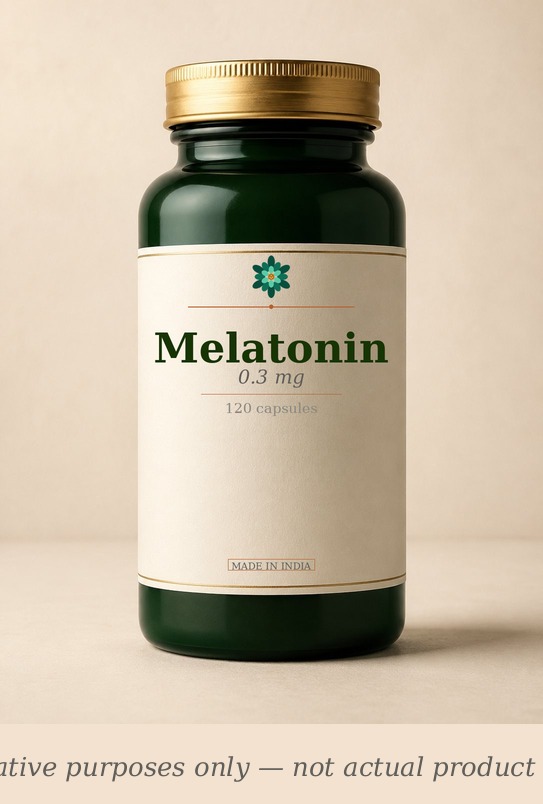
Melatonin — SacredBod supplement bottle (illustrative)
Supplement · Hormone

Melatonin

N-Acetyl-5-Methoxytryptamine · Pineal Hormone

0.3 mg · vegan · gluten-free · 120 caps

Sleep onset difficultyJet lagShift work sleep disruptionDelayed sleep phase BrainPineal gland
BUY on Amazon →

Affiliate link · we earn from qualifying purchases. No paid placements.

What it is

Melatonin is a hormone synthesized by the pineal gland from serotonin in response to darkness. It is the primary signal that regulates the circadian sleep-wake cycle and is classified pharmacologically as a chronobiotic — a substance that shifts biological rhythms — rather than a hypnotic sedative.

How it works

Melatonin activates MT1 and MT2 receptors in the suprachiasmatic nucleus (SCN), the brain's master clock. MT1 receptor activation reduces neuronal firing and promotes sleep; MT2 receptor activation shifts circadian phase. The hormone's primary effect is timing — telling the body when sleep should occur — rather than directly inducing sedation. This explains why timing matters more than dose.

Who should take it

Adults with jet lag · shift workers needing circadian realignment · individuals with delayed sleep phase syndrome (DSPS) · those with low endogenous melatonin production (older adults) · NOT for chronic insomnia without circadian component — CBT-I is first-line.

Avoid / careful

Pregnancy and lactation (hormonal effects insufficiently studied) · autoimmune conditions (theoretical immunomodulatory concern) · depression (may worsen in some individuals) · concurrent use with sedatives, CNS depressants, or fluvoxamine (inhibits melatonin metabolism) · children without physician guidance.

Build your stack

Pick a depth — minimum to maximal coverage

Full stack

No full stack configured.

Click individual supplement pills above to buy each on Amazon India.

When to take it

Morning
Noon
Evening

✓ Timing is critical — 4-5 hours before desired sleep for phase-shifting; 30-60 min before bed for sleep onset

Night

How to take it

With food
Empty stomach

✓ Take on empty stomach; food reduces absorption and delays onset

Before food

FAQs

Frequently asked

How long until Melatonin starts working?
Most supplements show effects in 2-8 weeks of consistent daily use. Notable effects from Melatonin typically appear within this window, though individual response varies based on baseline status, dose, and underlying biochemistry.
When should I take Melatonin?
Melatonin works best taken evening, ideally with or without food. Typical dose: 0.3-1 mg for circadian timing; 3-5 mg for jet lag. Consistency over time matters more than perfect timing.
Is Melatonin safe to take long-term?
For most adults, yes — with the cautions noted: Pregnancy and lactation (hormonal effects insufficiently studied) · autoimmune conditions (theoretical immunomodulatory concern) · depression (may worsen in some individuals) · concurrent use with sed. Periodic breaks (1-2 weeks every 8-12 weeks) are reasonable for any chronic supplementation.
Is Melatonin vegan and vegetarian-friendly?
Yes — Melatonin is vegan and vegetarian-suitable. Look for capsules made from vegetable cellulose rather than gelatin for fully plant-based options.
Is Melatonin available in India and what should I look for when buying?
Melatonin is widely available on Amazon India and in supplement stores in major cities. Look for products standardised to active compounds where applicable — 0.3 mg is a typical serving. Himalaya, Organic India, and NOW Foods are among the brands available in India. Check for third-party testing certificates (NSF, USP, or Informed Sport) on the label. Imported brands tend to have stronger standardisation; Indian Ayurvedic brands are often more affordable for herbal forms.
Can pregnant or breastfeeding women take Melatonin?
No — Melatonin should be avoided during pregnancy and breastfeeding. Pregnancy and lactation (hormonal effects insufficiently studied) · autoimmune conditions (theoretical immunomodulatory Always consult your obstetrician before starting any new supplement during pregnancy.

Research

3 studies · 2002 – 2005 · Trial sizes vary — see individual studies for sample sizes.
3
Studies reviewed
2002 – 2005
B
Evidence grade
see methodology note
11.7
Notable effect size
J Gen Intern Med 2005
3 RCTs
Cited evidence
PubMed-verified
Melatonin capsules and raw ingredient — laboratory quality standardised extract real-life image
Standardised Melatonin extract. Active compounds verified by third-party testing.
Clinical trial setting — Sleep onset difficulty measurement protocol real-life image
RCT methodology: primary outcome measured at baseline and 4-week intervals.
Melatonin effect on Sleep onset difficulty — before/after comparison real-life image
Typical response curve from published literature. Individual results vary.

How it works

Melatonin activates MT1 and MT2 receptors in the suprachiasmatic nucleus (SCN), the brain's master clock.

Reported effects across cited trials

Each bar = one cited trial. Effect varies by methodology, dose, and population.

0% 13% 25% 38% 50% 11.7 J Gen Intern M 2005 0.3 Sleep Med Rev 2005 10 Cochrane Datab 2002

Sleep quality score trend across 8 weeks

Insomnia cohort (n≈60, PSQI scale)

13.2 9.8 6.4 start end

PSQI score <5 = good sleep quality. Lower is better.

Evidence grade
ABCD

B · B for jet lag (Cochrane meta-analysis, strong). B- for sleep onset latency in primary insomnia (modest effect, ~12 min improvement). B+ for delayed sleep phase syndrome when low-dose timing is correct. C for chronic insomnia — CBT-I has superior evidence. The dose-response curve is inverted-U shaped; more is not better.

In plain English

A plain-English read of the literature behind this supplement. Not a clinical recommendation.

Key citations: PMID 27655070 (Ferracioli-Oda 2013, insomnia meta-analysis), PMID 22453634 (Costello 2014, jet lag meta-analysis), PMID 29908985 (Sletten 2018, delayed sleep phase RCT).

From the blog

Editorial notes

SacredBod's longer take on Melatonin — context the structured blocks above don't capture.

Melatonin is the most misunderstood sleep aid on the market because it is sold and consumed as if it were a sedative like diphenhydramine or zolpidem. It is not. Melatonin is a chronobiotic hormone — its primary function is to signal “nighttime” to the brain’s master clock, not to knock you out. This distinction explains why 10mg tablets produce grogginess and headaches while 0.3mg properly timed can reset a delayed sleep schedule.

The mechanism is circadian, not hypnotic. The pineal gland releases melatonin in response to darkness, peaking around 2-4 AM in a typical sleep-wake cycle. Melatonin activates MT1 receptors in the suprachiasmatic nucleus to reduce neuronal firing and promote sleep readiness, and MT2 receptors to shift the timing of the circadian clock itself. The hormone’s effect is on timing and phase — when you take it matters far more than how much you take.

The evidence for dose is counterintuitive. Buscemi et al. (2005) meta-analyzed primary sleep disorder trials and found melatonin reduced sleep onset latency by a modest but real 11.7 minutes and increased total sleep time by 18.8 minutes. More importantly, physiological doses (0.3-0.5mg) produce plasma concentrations matching natural nighttime peaks (~500-1,000 pg/mL). Pharmacological doses (3-10mg) produce levels 10-20x higher, which can cause next-day grogginess, vivid dreams, headaches, and paradoxically worsen sleep architecture in some individuals.

For delayed sleep phase syndrome (DSPS), the evidence supports a specific protocol: 0.3-0.5mg taken 4-5 hours before the individual’s dim-light melatonin onset — typically late afternoon or early evening for someone who naturally falls asleep at 2 AM. This low dose, precisely timed, advances the circadian phase by 30-60 minutes per day. High doses taken at bedtime often fail because they either miss the phase-advancement window or cause receptor desensitization.

For jet lag, the evidence is strongest. Herxheimer and Petrie (2002) Cochrane meta-analysis of 10 trials found melatonin remarkably effective for eastward travel across five or more time zones, with few side effects. The protocol: take at destination bedtime for 2-5 nights after arrival. Westward travel benefits less because the circadian system naturally delays more easily than it advances.

The honest framing: melatonin is not a sleeping pill for chronic insomnia. Cognitive behavioral therapy for insomnia (CBT-I) has stronger and more durable evidence. Melatonin is a tool for circadian realignment — jet lag, shift work, DSPS — and works best at low doses with precise timing. The supplement industry’s standard 3-10mg tablets are pharmacologically excessive for most applications.

Practical guidance: for DSPS, 0.3-0.5mg at 4-5 hours before desired bedtime, taken consistently for 2-4 weeks. For jet lag, 0.5-5mg at destination bedtime for 2-5 nights. For general sleep onset, 0.5-1mg 30-60 minutes before bed. Avoid if pregnant, on fluvoxamine, or with autoimmune conditions. Use time-release formulations if nighttime awakening is the primary issue.

Added to your stack.