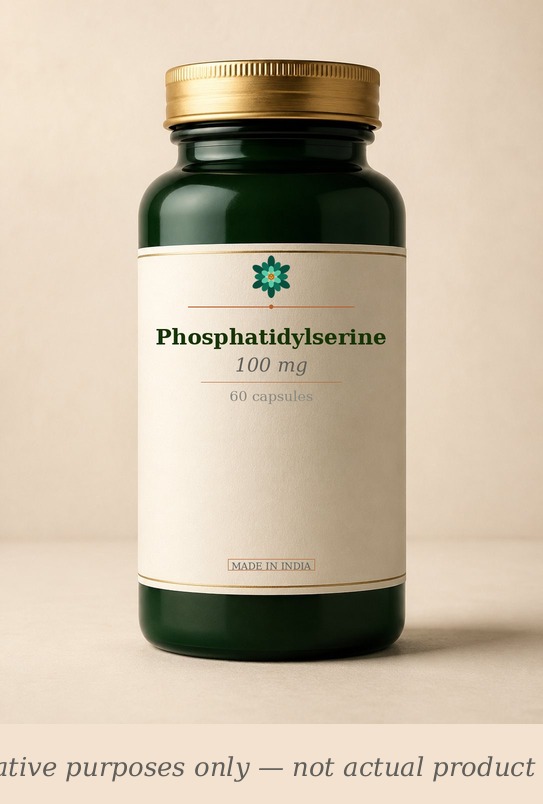
SacredBod's longer take on Phosphatidylserine — context the structured blocks above don't capture.
Phosphatidylserine occupies a unique position among brain supplements: it is not merely a precursor or cofactor, but a structural component of neuronal membranes themselves. This phospholipid makes up roughly 10% of the brain’s lipid content and concentrates in the inner leaflet of cell membranes where it regulates receptor function, signal transduction, and the controlled cell death (apoptosis) that shapes neural development. The logic of supplementation rests on the premise that exogenous PS can integrate into these membranes and restore fluidity that declines with age.
The cortisol-modulating dimension of PS has generated substantial interest among athletes and stressed professionals. Multiple studies demonstrate that 400–800 mg of PS taken before exercise or acute stress can attenuate the cortisol spike that normally follows these challenges. This is not merely a laboratory curiosity: chronically elevated cortisol correlates with hippocampal atrophy and memory impairment. By blunting this stress hormone response, PS may offer indirect neuroprotection. However, the effect is acute and dose-dependent; it does not “lower cortisol” in a basal sense but rather modulates the stress response.
The cognitive evidence is more nuanced than marketing suggests. Vakhapova and colleagues (2010, Dementia and Geriatric Cognitive Disorders, PMID 20523044) conducted a double-blind placebo-controlled trial in 157 non-demented elderly participants with memory complaints, testing a novel formulation of phosphatidylserine enriched with omega-3 fatty acids. After 15 weeks, the PS-omega-3 group showed statistically significant improvements in immediate recall and learning ability compared to placebo. This is one of the better-designed trials in the PS literature, though the combination with omega-3 complicates attribution of effects to PS alone. In contrast, Jorissen and colleagues (2001, Nutritional Neuroscience, PMID 11842880) tested soy-derived PS in 120 elderly adults with age-associated memory impairment and found no significant differences in any cognitive outcome between 300 mg, 600 mg, and placebo groups after 12 weeks. This null result is important: it suggests that the form and composition of PS matter significantly.
The ADHD data adds another dimension. Manor and colleagues (2012, European Psychiatry, PMID 21807480) conducted a 30-week study in 200 children with ADHD, testing PS enriched with omega-3 fatty acids. While the primary analysis showed only modest effects, a prespecified subgroup analysis of children with pronounced hyperactive-impulsive and emotionally dysregulated behavior revealed significant reductions in ADHD-Index and hyperactive components. This is not a broad indication for PS in ADHD—the effect was confined to a specific phenotype—but it does suggest that PS-omega-3 may have a niche role in behavioral regulation. The honest framing: PS has genuine but modest effects on stress-induced cortisol and may improve memory when combined with omega-3, but soy-derived PS alone appears ineffective for cognitive enhancement.