
What it is
Citicoline (CDP-choline) is an endogenous compound and precursor to phosphatidylcholine and acetylcholine. It provides both choline and cytidine, the latter of which converts to uridine to support neuronal membrane synthesis.
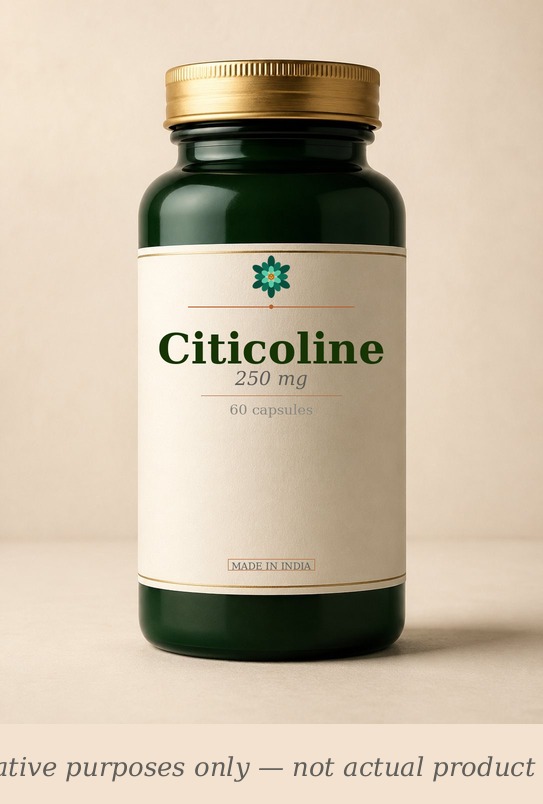
CDP-Choline · cytidine diphosphate choline · Cognizin
250 mg · vegan · gluten-free · 60 caps
Affiliate link · we earn from qualifying purchases. No paid placements.
Citicoline (CDP-choline) is an endogenous compound and precursor to phosphatidylcholine and acetylcholine. It provides both choline and cytidine, the latter of which converts to uridine to support neuronal membrane synthesis.
Citicoline donates choline for acetylcholine synthesis and cytidine for phospholipid production. It may also stabilize neuronal membranes, reduce free fatty acid release during ischemia, and support mitochondrial ATPase activity.
Adults seeking cognitive support, individuals recovering from stroke (adjunctive), older adults with mild vascular cognitive impairment.
People with bipolar disorder (rare reports of mood elevation), those taking levodopa without medical supervision (may increase dopamine), individuals with severe kidney disease.
Pick a depth — minimum to maximal coverage
No full stack configured.
Click individual supplement pills above to buy each on Amazon India.
✓ Morning for cognitive clarity; split dose for sustained effect
Flexible — works in any of the above.
Citicoline donates choline for acetylcholine synthesis and cytidine for phospholipid production.
Each bar = one cited trial. Effect varies by methodology, dose, and population.
Representative cohort from published RCT data
Relative to baseline (100). Data from published clinical literature.
see study
→ NULL: No significant difference in stroke recovery vs placebo (N=2,298, 6 weeks)
see study
→ Review: observational data shows lower cognitive impairment at 2 years; open-label limitations
see study
→ Open-label: MMSE scores stable vs decline in untreated controls (N=265, 9 months)
B · Largest RCT was NULL; smaller trials and open-label studies show promise; evidence quality rated LOW by 2023 meta-analysis
A plain-English read of the literature behind this supplement. Not a clinical recommendation.
Key citations: PMID 23924853 (Secades 2016, Cochrane brain injury), PMID 19686290 (Alvarez-Sabín 2013, memory RCT), PMID 27911244 (Grieb 2014, neuroprotection review).

How to use Citicoline specifically for brain fog — the right dose, timing, blood markers to track, and how to know if it is working.
A clinical evidence review of Citicoline — RCT data, effect sizes, evidence grade, and what the numbers mean for your specific situation.
Everything you need to know about Citicoline — mechanism, dose, safety, buying guide for India, and what the research actually says.
SacredBod's longer take on Citicoline — context the structured blocks above don't capture.
Citicoline occupies a complex position in the nootropic landscape: it is one of the most extensively studied brain supplements, yet its largest and most rigorous trial returned a null result. This tension between mechanistic promise and clinical evidence demands honest examination. Citicoline (CDP-choline) provides both choline and cytidine—the former for acetylcholine synthesis, the latter converting to uridine to support neuronal membrane phospholipid production through the Kennedy pathway. The dual-donor mechanism is elegant and biologically plausible.
The elephant in the room is the ICTUS trial. Dávalos and colleagues (2012, The Lancet, PMID 22691567) conducted an international randomized placebo-controlled study in 2,298 patients with moderate-to-large acute ischemic stroke, testing whether 2,000 mg daily of citicoline for six weeks improved functional recovery. The result: no significant difference between citicoline and placebo on the primary endpoint (modified Rankin Scale). This null result from a well-powered, methodologically rigorous trial stands in contrast to smaller, earlier studies that had suggested benefit. The discrepancy likely reflects differences in stroke severity, timing of intervention, and statistical power—smaller trials are more prone to false positives.
Does the ICTUS null result invalidate citicoline? Not necessarily, but it substantially narrows the evidentiary basis. The IDEALE study (Cotroneo et al., 2013, Clinical Interventions in Aging, PMID 23403474) offers a different window: 265 elderly patients with mild vascular cognitive impairment took 1,000 mg citicoline daily for nine months in an open-label design. Their MMSE scores remained stable while untreated controls declined by 1.9 points. This is promising but methodologically weaker—open-label, no placebo, and the “significant difference” emerged from comparing treatment to no-treatment controls rather than placebo. The 2023 meta-analysis by Gareri and colleagues (PMC9866349) pooled these and similar studies, finding a small positive effect on MMSE scores, but explicitly noted “intermediate/high risk of bias” and “low quality of evidence.”
The post-stroke cognitive protection narrative requires careful parsing. Alvarez-Sabín and Román (2013, Brain Sciences, PMID 24961534) reviewed evidence suggesting citicoline may reduce cognitive decline after stroke when started early and continued long-term. Observational data from the VITA study showed lower cognitive impairment prevalence at two years in citicoline-treated patients (27.9% vs. 39% in controls). These are real signals, but they come from observational and open-label designs where placebo effects and selection bias cannot be excluded. The honest framing: citicoline has biological plausibility, promising smaller trials, and concerning null results from the largest RCT. It may stabilize cognition in mild vascular impairment, but claims of robust stroke recovery or dementia prevention outrun the evidence.
Peptides are physician-only. Tell us a bit and we'll route you to the right specialist.