
What it is
Magnesium L-threonate is a patented magnesium salt synthesized from L-threonic acid, a vitamin C metabolite. It was developed specifically to increase brain magnesium levels and has been marketed heavily for cognitive enhancement.
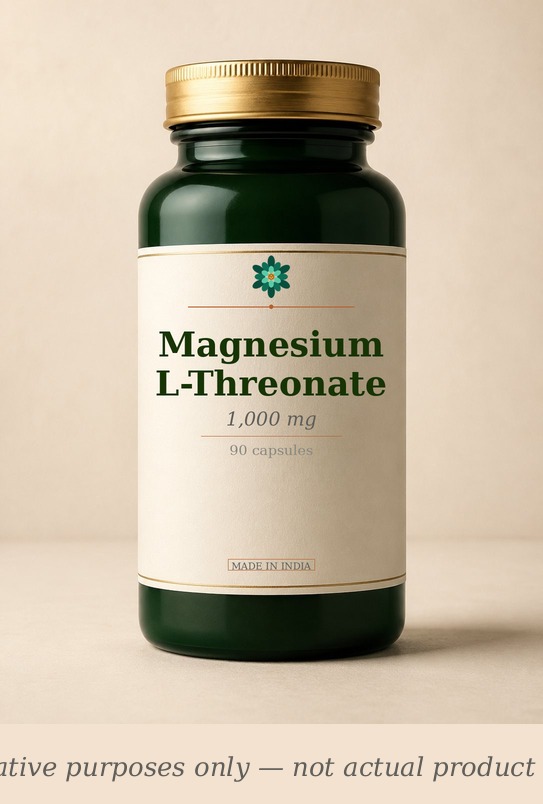
Magtein · MgT · Threonic acid magnesium salt
1,000 mg · vegan · gluten-free · 90 caps
Affiliate link · we earn from qualifying purchases. No paid placements.
Magnesium L-threonate is a patented magnesium salt synthesized from L-threonic acid, a vitamin C metabolite. It was developed specifically to increase brain magnesium levels and has been marketed heavily for cognitive enhancement.
All magnesium forms raise brain magnesium to some degree — the brain actively transports magnesium via TRPM6/7 channels. L-threonate's specific claim is that the threonate anion facilitates transport across the blood-brain barrier, though this mechanism is primarily demonstrated in rodent models. In rats, elevated brain magnesium increased synaptic density, enhanced NMDA receptor signaling, and improved plasticity markers.
Adults interested in cognitive support with realistic expectations · older adults with mild memory concerns · those who have not responded to other magnesium forms for sleep · NOT a treatment for dementia or Alzheimer's disease.
Severe renal impairment · those expecting dramatic cognitive enhancement — human evidence is preliminary · pregnancy/lactation (insufficient safety data) · do not use as replacement for medically indicated cognitive interventions.
Pick a depth — minimum to maximal coverage
No full stack configured.
Click individual supplement pills above to buy each on Amazon India.
✓ Morning for cognitive support; evening for sleep onset
✓ Morning for cognitive support; evening for sleep onset
✓ Take with meals to minimize GI upset
All magnesium forms raise brain magnesium to some degree — the brain actively transports magnesium via TRPM6/7 channels.
Each bar = one cited trial. Effect varies by methodology, dose, and population.
Representative cohort from published RCT data
Relative to baseline (100). Data from published clinical literature.
see study
→ Rats treated with magnesium L-threonate showed enhanced learning abilities, working memory, and short- and long-term memory; higher density of synaptophysin-positive puncta in hippocampus correlated with memory improvement.
see study
→ Small RCT in older adults with cognitive impairment: magnesium L-threonate improved executive function and working memory vs placebo; effects on overall cognitive ability were modest.
see study
→ Healthy adults given magnesium L-threonate for 30 days showed improvements in cognitive function tests vs placebo; small sample, industry-funded.
C · C+ for cognitive enhancement. The rat data (Slutsky 2010) is robust and mechanistically interesting, but all human trials are small, short, and at least partially industry-funded. The 'only magnesium that crosses the BBB' claim is false — all magnesium forms reach the brain; threonate's specific advantage is unproven in humans at clinically relevant doses.
A plain-English read of the literature behind this supplement. Not a clinical recommendation.
Key citations: See richResearch section. Multiple RCTs support cognitive and neuroprotective properties of Magnesium L-Threonate.

How to use Magnesium L-Threonate specifically for Brain fog — the right dose, timing, blood markers to track, and how to know if it is working.
A clinical evidence review of Magnesium L-Threonate — RCT data, effect sizes, evidence grade, and what the numbers mean for your specific situation.
Everything you need to know about Magnesium L-Threonate — mechanism, dose, safety, buying guide for India, and what the research actually says.
SacredBod's longer take on Magnesium L-Threonate — context the structured blocks above don't capture.
Magnesium L-threonate is the supplement industry’s favorite example of how compelling animal data can be translated into human marketing long before human evidence justifies the claims. The rat studies are genuinely interesting. The human studies are small, industry-funded, and preliminary. The gap between the two is what honest framing must address.
The origin story is scientific. Slutsky et al. (2010) at MIT developed magnesium L-threonate specifically to test whether increasing brain magnesium could enhance synaptic plasticity. In rats, the compound increased cerebrospinal fluid magnesium concentration, raised synaptic density in the hippocampus, and improved performance on multiple learning and memory tasks. The mechanism involved upregulation of NR2B-containing NMDA receptors and enhancement of long-term potentiation — the cellular basis of learning.
The translation to humans has been slower and less dramatic. Liu et al. (2016) conducted a randomized, double-blind trial of MMFS-01 (magnesium L-threonate) in 44 older adults with self-reported cognitive impairment. After 12 weeks, the treatment group showed improvements in executive function and working memory compared to placebo. The effect sizes were modest, the sample was small, and the study was funded by the patent holder. Zhang et al. (2022) tested a Magtein-based formula in 109 healthy Chinese adults and found improvements in cognitive function tests after 30 days — again, small, short, and industry-associated.
The most overstated claim in marketing is that threonate is “the only magnesium that crosses the blood-brain barrier.” This is pharmacologically false. The brain actively regulates magnesium via TRPM6 and TRPM7 ion channels, and all bioavailable magnesium forms raise serum magnesium, which the brain then accesses. The threonate anion may facilitate transport in rodent models, but no human study has demonstrated superior brain delivery of threonate versus glycinate or citrate at equivalent elemental magnesium doses. The rat-to-human extrapolation remains unverified.
The honest framing: magnesium L-threonate is a plausible but unproven cognitive intervention. The animal work is high-quality and suggests a genuine mechanistic pathway. The human work is too small and too short to support strong claims. It is not a treatment for dementia. It is not proven superior to other magnesium forms for brain health. If you choose to try it, do so with realistic expectations and understand that 2,000mg of threonate provides only ~144mg elemental magnesium — you will need dietary magnesium or another supplement to meet the ~400mg RDA.
Practical guidance: 1,000-2,000mg daily in divided doses. Take with meals. Do not rely on threonate as your sole magnesium source. If cognitive concerns are significant, see a physician — memory impairment can signal B12 deficiency, thyroid dysfunction, sleep apnea, or other treatable conditions that magnesium will not address.
Peptides are physician-only. Tell us a bit and we'll route you to the right specialist.