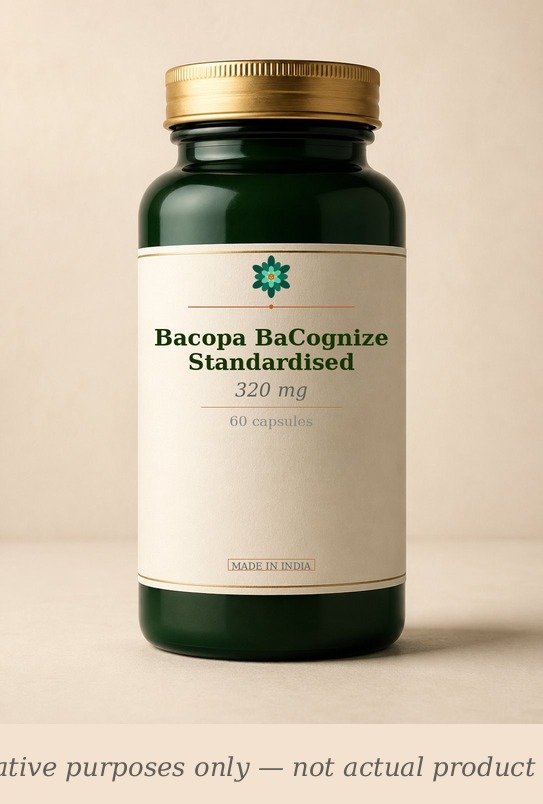
SacredBod's longer take on Bacopa BaCognize Standardised — context the structured blocks above don't capture.
What Bacopa BaCognize Is
Bacopa monnieri, known in Sanskrit as Brahmi (ब्राह्मी), is one of the most revered Medhya Rasayanas (cognitive tonics) in Ayurvedic classical texts including the Charaka Samhita and Sushruta Samhita. For millennia, it has been prescribed for enhancing memory (Smriti), intellect (Buddhi), and longevity. Modern extraction technology has allowed standardisation of its active bacosides, culminating in BaCognize — a patented extract manufactured by Pharmanza Herbal Pvt. Ltd. in Gujarat, India — standardised to ≥12% total bacosaponins.
Unlike generic bacopa powders, BaCognize delivers a reproducible bacoside profile (bacoside A3, bacopaside II, bacopaside X, bacopasaponin C) that has been directly evaluated in Indian clinical populations.
How It Works
Bacosides A and B are lipophilic saponins that cross the blood-brain barrier and exert three primary mechanisms:
- Cholinergic modulation — Bacosides influence acetylcholine levels and protect cholinergic neurons, the same pathway targeted by Alzheimer’s medications like donepezil.
- Synaptic repair — Animal studies demonstrate that bacosides regenerate synapses and repair damaged neurons in the hippocampus, the brain’s memory centre.
- Antioxidant neuroprotection — Bacopa upregulates superoxide dismutase, catalase, and glutathione peroxidase in the prefrontal cortex, striatum, and hippocampus, shielding neurons from age-related oxidative stress.
Who Benefits Most
- Healthy older adults experiencing subjective memory complaints — the 12-week RCT in adults >55 years showed significant improvements in verbal learning and delayed recall.
- Medical students and professionals — The Nagpur trial demonstrated that even individuals with already-high baseline cognition showed working-memory and attention improvements after 6 weeks.
- Anyone seeking an Ayurvedic nootropic with modern clinical validation — BaCognize bridges classical Indian medicine and evidence-based supplementation.
Dosage Guide
| Goal | Dose | Duration |
|---|
| General cognitive support | 300–320 mg/day standardised extract | 12+ weeks |
| Working-memory enhancement | 300 mg/day (as studied in medical students) | 6–12 weeks |
| Age-related memory support | 300 mg/day (as studied in elderly) | 12–16 weeks |
Take with food to minimise gastrointestinal side effects. Do not expect acute same-day effects — bacopa is a chronic adaptogen, not a stimulant.
Safety & Interactions
- Thyroid interaction: Bacopa may increase T4; monitor if on thyroid replacement.
- Sedatives: Additive CNS depression possible; avoid combining with benzodiazepines.
- GI effects: Mild nausea, cramps, or loose stools in ~10–15% of users — usually resolves within 1–2 weeks.
India-Specific Context
- Ayurvedic lineage: Brahmi is classified as a Medhya Rasayana in Charaka Samhita (Sutrasthana 4) and is used in classical formulations like Brahmi Ghrita and Saraswatarishta.
- Local availability: Himalaya, Dabur, Baidyanath, and Organic India all sell Brahmi tablets/capsules through Indian pharmacies and e-commerce. However, standalone BaCognize-standardised 320mg capsules are not currently available on Amazon.in — most products are generic bacopa blends or combination formulas with Ginkgo.
- Regulatory status: Bacopa is classified as a dietary supplement in India, not a Schedule H drug. It is widely available without prescription.
- Traditional use: In Kerala and Tamil Nadu, fresh Brahmi leaves are used in Thambuli (a yoghurt-based side dish) for daily cognitive nourishment.