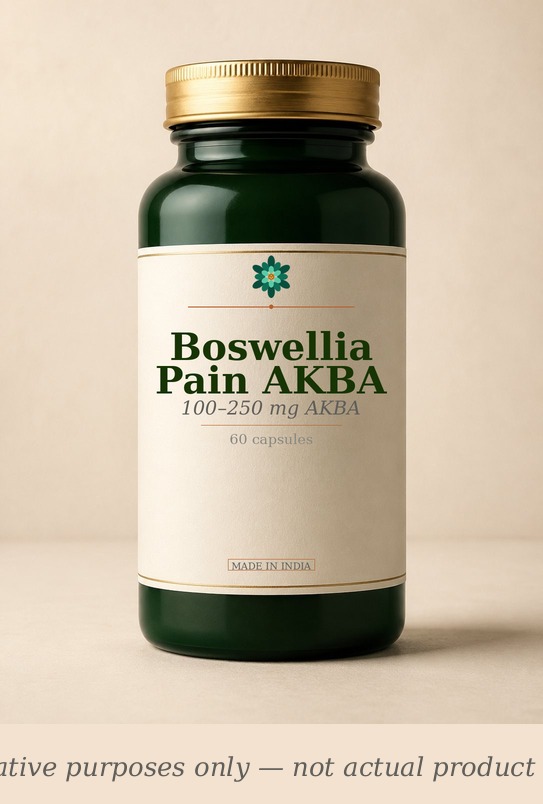
SacredBod's longer take on Boswellia Pain AKBA — context the structured blocks above don't capture.
What Is AKBA-Enriched Boswellia?
Boswellia serrata — known in India as Shallaki or Salai Guggul — is a tree that grows in the dry hills of Rajasthan, Gujarat and Madhya Pradesh. When the bark is cut, it exudes a fragrant resin that has been used in Ayurvedic medicine for over 3,000 years for joint pain, inflammation and respiratory conditions.
The resin contains a family of compounds called boswellic acids. There are over a dozen types, but AKBA (3-O-acetyl-11-keto-β-boswellic acid) is the most potent. Standard boswellia extracts contain 1–3% AKBA. AKBA-enriched extracts concentrate this to 20–30% — a 10-fold increase in the most active compound.
This matters because AKBA is the primary 5-LOX inhibitor. Standard extracts contain mostly inactive or weakly active boswellic acids that do not significantly inhibit inflammation. AKBA enrichment transforms boswellia from a mild herbal remedy into a targeted anti-inflammatory agent.
How Does It Work?
AKBA’s mechanism is distinct from NSAIDs and complementary to them:
- 5-LOX inhibition: AKBA directly blocks 5-lipoxygenase, the enzyme that produces leukotrienes — potent inflammatory mediators that drive joint swelling, bronchoconstriction and intestinal inflammation.
- NF-kappaB suppression: Reduces TNF-alpha, IL-1β and IL-6 production.
- Human leukocyte elastase inhibition: Protects cartilage and connective tissue from enzymatic degradation.
- Complement system modulation: Reduces complement-mediated inflammation in autoimmune conditions.
The 2001 Crohn’s disease RCT (n=102) was groundbreaking: 70% of patients receiving Boswellia serrata extract achieved remission, compared to 0% in the placebo group. This established boswellia as a serious contender in inflammatory bowel disease.
Who Benefits Most?
- Crohn’s disease and ulcerative colitis: The Crohn’s trial showed 70% remission — comparable to mesalazine.
- Osteoarthritis: Reduces pain, stiffness and improves joint function.
- Rheumatoid arthritis: Complements DMARDs by addressing the leukotriene pathway.
- Spinal stenosis: Improves walking distance and reduces neurogenic claudication.
- Asthma: Leukotriene reduction improves bronchial tone.
- NSAID-intolerant patients: Those who cannot tolerate gastric or cardiovascular NSAID side effects.
Dosage Guide
- Standard dose: 300–500 mg of AKBA-enriched extract (providing 100–250 mg AKBA) daily.
- Therapeutic / IBD: 1,200 mg three times daily (as used in the Crohn’s trial).
- Timing: With meals for optimal absorption.
- Form: Capsules or tablets. Powder is bitter and poorly soluble.
- Duration: Minimum 4–8 weeks for joints; 6–12 weeks for IBD.
Safety & Interactions
Boswellia is extremely safe. The main cautions:
- Warfarin: May affect clotting; monitor INR.
- Immunosuppressants: May theoretically reduce efficacy; discuss with rheumatologist.
- NSAIDs: Redundant — choose one approach.
- Pregnancy: Avoid at high doses.
India-Specific Context
Sanskrit/Hindi name: Shallaki (शल्लकी), Salai Guggul, Sallaki. The resin is known as Kunduru.
Ayurvedic classical texts: Shallaki is extensively documented in Charaka Samhita and Sushruta Samhita as a “Sandhigata Vata” remedy — the classical Ayurvedic diagnosis for osteoarthritis. It is described as “Shoolahara” (pain-relieving), “Shothahara” (anti-inflammatory) and “Vatahara” (Vata-pacifying). It is a key ingredient in “Yogaraj Guggulu” and “Kaishore Guggulu” — the two most important Ayurvedic joint pain formulations.
Availability: Boswellia is widely available on Amazon.in:
- Stay Alive Boswellia 1000 mg with AKBA (ASIN B0DJ5HJM4S) — ₹600–800.
- Unifarma Herbals Shallaki 250 mg (ASIN B0GGQR1NQT) — ₹250.
- HealthyHey Boswellia 250 mg, 120 capsules (ASIN B07B7GSWY8) — ₹709.
- Forest Harvest Boswellia 500 mg 85% (ASIN B0DZXLNJKH) — ₹800–1,000.
- INLIFE Boswellia 400 mg (ASIN B07BGDFMML) — ₹500–600.
- Pure Nutrition Boswellia 450 mg (ASIN B0DX2BDS7C) — ₹400–500.
It is not a Schedule H drug.
Traditional use: Shallaki resin has been collected in the Aravalli hills of Rajasthan for over 3,000 years. In Ayurveda, it is used for joint pain, inflammation, wounds, respiratory conditions and as a fragrance in incense (loban). The tree is considered sacred in some tribal communities. Modern AKBA-enriched extracts represent the convergence of this ancient tradition with 21st-century phytochemistry.