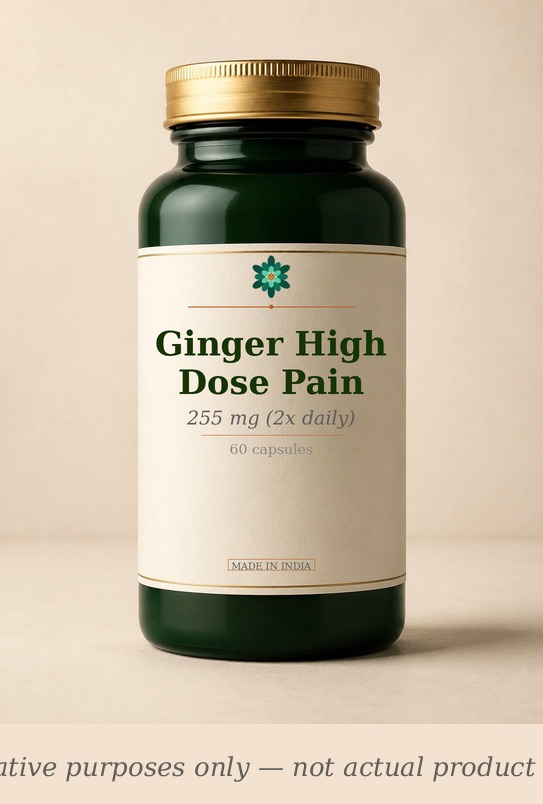
SacredBod's longer take on Ginger High Dose Pain — context the structured blocks above don't capture.
Ginger (adrak) is already in every Indian kitchen. But the pinch of grated ginger in your chai or the slice in your dal is not enough for therapeutic pain relief. High-dose standardised ginger extract delivers concentrated gingerols — the bioactive polyphenols — at doses that match those used in clinical trials for osteoarthritis and muscle pain.
The “255 mg twice daily” protocol comes from the landmark trials that demonstrated ginger’s efficacy for knee osteoarthritis. At this dose, ginger provides approximately 25–50 mg of gingerols — enough to measurably inhibit COX enzymes and reduce inflammatory cytokines. Standard culinary ginger contains gingerols too, but you would need to eat 20–40 grams of fresh ginger daily to match the clinical dose.
In India, dried ginger is known as Sunthi (Sanskrit: शुण्ठी) and is one of the most important herbs in Ayurvedic medicine.
How Does It Work?
Ginger’s anti-inflammatory mechanism is remarkably comprehensive:
- Dual COX inhibition: Gingerols inhibit both COX-1 and COX-2, reducing prostaglandin synthesis — the same mechanism as ibuprofen and diclofenac.
- 5-LOX blockade: Unlike NSAIDs, ginger also inhibits 5-lipoxygenase, reducing leukotriene production. This dual COX+LOX inhibition is unique among natural anti-inflammatories.
- NF-kappaB suppression: Reduces TNF-alpha, IL-1β and IL-6 at the transcriptional level.
- TRPV1 modulation: Directly reduces pain signal transmission.
- Gastroprotection: Increases gastric mucus and bicarbonate production — the opposite of NSAIDs.
The 2013 Indian RCT (n=60) showed that 750 mg ginger powder three times daily produced WOMAC score improvements comparable to diclofenac 50 mg — with no gastric side effects.
Who Benefits Most?
- Knee osteoarthritis: The primary indication with the strongest evidence.
- Exercise-induced muscle soreness: Reduces DOMS and speeds recovery.
- Menstrual cramps: As effective as ibuprofen for dysmenorrhoea in some trials.
- General inflammatory pain: For anyone seeking a natural NSAID alternative.
- Digestive pain: Ginger’s gastroprotective effect addresses pain from gastritis and indigestion.
Dosage Guide
- Standard pain dose: 255 mg twice daily of 5% gingerol extract.
- High-dose / therapeutic: 500–750 mg twice daily.
- Powder equivalent: 2–4 g of dried ginger powder daily.
- Timing: With meals to reduce heartburn.
- Form: Capsules, tablets or powder. Fresh ginger juice is less precisely dosed.
- Duration: Minimum 4–8 weeks for OA; acute pain may respond within days.
Safety & Interactions
Ginger is extremely safe. The main cautions:
- Blood thinners: Mild antiplatelet effect — monitor INR with warfarin.
- Pregnancy: High doses may stimulate uterine contractions; limit to culinary amounts.
- Gallstones: Stimulates bile flow — avoid with active gallstones.
- Diabetes: May lower blood sugar — monitor if on hypoglycaemic medications.
India-Specific Context
Sanskrit/Hindi name: Ardraka (fresh ginger, अर्द्रक), Sunthi (dried ginger, शुण्ठी). Also known as Vishwa Bheshaja (“universal medicine”) in Ayurveda.
Ayurvedic classical texts: Sunthi is one of the “Trikatu” (three pungents) in Charaka Samhita — along with Pippali (long pepper) and Maricha (black pepper). It is used in over 100 Ayurvedic formulations including “Yogaraj Guggulu” (joint pain), “Trikatu Churna” (digestion and metabolism) and “Sunthi Kwath” (fever and pain). It is classified as “Deepana” (digestive fire enhancer) and “Shoolahara” (pain reliever).
Availability: Ginger supplements are widely available on Amazon.in:
- Trexgenics Ginger 5% Gingerol 550 mg (ASIN B08DM22PC6) — ₹350–400.
- Adorreal Ginger 600 mg (ASIN B0DRSTQ3RW) — ₹500–600.
- Zandu Sunthi Capsules (ASIN B07V5QTHHR) — ₹200–250.
- Morsan Healthcare Sonth Extract (ASIN B0F6K4FSBS) — ₹300–400.
- Genius Herbs Dried Ginger 500 mg (ASIN B09Y9JMVKM) — ₹400–500.
It is not a Schedule H drug.
Traditional use: Ginger has been used in India for over 3,000 years. In Ayurveda, it is considered “Vishwa Bheshaja” — the universal medicine effective for almost all diseases. It is used for pain, fever, digestion, respiratory conditions and as a carrier substance (anupana) to enhance the absorption of other herbs. Every Indian household has a ginger-garlic-turmeric paste for joint pain and inflammation.