
What it is
Agropyron repens, commonly called Couch Grass or Dog Grass, is a widespread perennial whose rhizomes have been used in European herbal medicine for inflammatory conditions of the urinary tract and for kidney stone prevention.
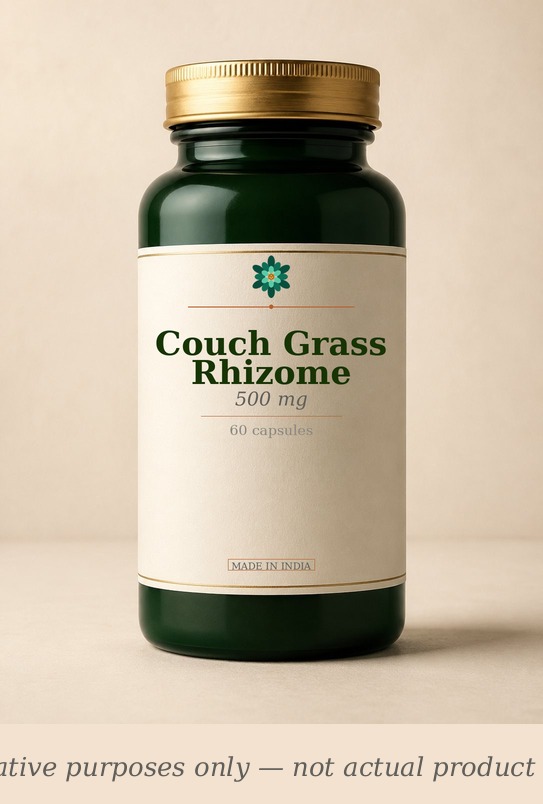
500 mg · vegan · gluten-free · 60 caps
Affiliate link · we earn from qualifying purchases. No paid placements.
Agropyron repens, commonly called Couch Grass or Dog Grass, is a widespread perennial whose rhizomes have been used in European herbal medicine for inflammatory conditions of the urinary tract and for kidney stone prevention.
Couch grass contains polysaccharides, triticin and agropyrene that soothe irritated urinary mucosa, reduce inflammation in the bladder wall, and increase urine volume to flush pathogens. It may also reduce uric acid excretion when combined with potassium citrate.
Adults with chronic cystitis, urethritis, irritable bladder, or nephrolithiasis seeking mucosal soothing and stone-preventive support.
Pregnant or breastfeeding women; people with severe kidney disease; those with known grass/pollen allergies. Side effects: Very rare; occasional mild GI upset or allergic reaction in grass-sensitive individuals.
A plain-English read of the literature behind this supplement. Not a clinical recommendation.
Key citations: PMID 22908773 (prospective RCT with potassium citrate, stone reduction), Barson 1981 / Hautmann & Scheithe 2000 (observational studies on urinary symptoms, cited in EMA assessment reports)
SacredBod's longer take on Couch Grass Rhizome — context the structured blocks above don't capture.
Couch Grass (Agropyron repens L. P. Beauv., also called Dog Grass or Twitch Grass) is a tenacious perennial grass whose creeping rhizomes have been harvested for medicine since ancient Greece and Rome. In European phytotherapy, the rhizome is approved by German Commission E and the European Medicines Agency for “irrigation therapy in inflammatory diseases of the urinary tract and for prevention of kidney gravel.” In India, couch grass is not an Ayurvedic herb and is not widely cultivated; it appears on Amazon.in only as imported powder from DoctorKC Herbal.
The rhizome contains polysaccharides (including triticin), agropyrene, mucilage and small amounts of essential oil. These constituents coat and soothe irritated bladder mucosa, while the mild diuretic effect increases urine flow to mechanically flush bacteria and crystals. A 2012 Italian RCT in 50 nephrolithiasis patients demonstrated that the combination of potassium citrate + couch grass dry extract (100 mg twice daily) significantly reduced total stone number (−1.0 vs 0.0 stones) and largest stone diameter (−3.6 mm vs 0.0 mm) compared to potassium citrate alone over 5 months. Urinary uric acid excretion also dropped significantly (−164.7 mg/24h). Observational data in 313 patients with cystitis and irritable bladder showed 32–53% symptom-free rates after 12 days of fluid extract use.
Adults with chronic cystitis, urethritis, irritable bladder syndrome, or calcium/uric acid stone formers seeking a mucosal-soothing adjunct. Not for acute pyelonephritis or obstructing stones.
Extremely well tolerated with no reported side effects in large observational studies. Rare grass-allergy reactions possible. Theoretical caution with potassium-sparing diuretics due to electrolyte shifts.
Couch grass has no Ayurvedic equivalent and does not appear in Charaka or Sushruta Samhitas. On Amazon.in, it is available only as powder (DoctorKC Herbal, ₹800–₹1,200 for 500 g) or occasionally in European-import kidney teas. Standalone capsules or standardised extracts are not currently available on the Indian market. It is not a scheduled drug. Consumers may need to purchase powder and encapsulate it independently or brew as tea. Given its scarcity, Indian stone-formers may find Chanca Piedra (Bhumi Amla) a more accessible domestic alternative, though couch grass offers unique mucosal-soothing properties.
Peptides are physician-only. Tell us a bit and we'll route you to the right specialist.