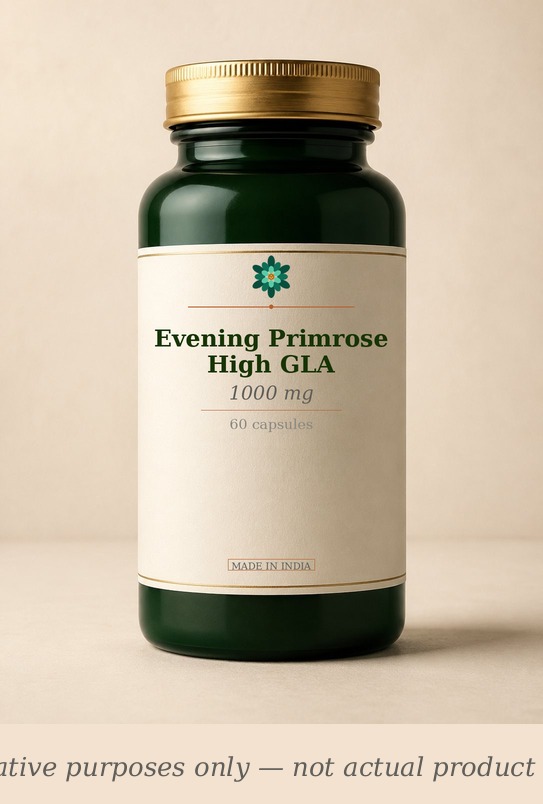
SacredBod's longer take on Evening Primrose High GLA — context the structured blocks above don't capture.
Evening primrose oil has been a staple of natural medicine since the 1980s — a seed oil rich in gamma-linolenic acid (GLA), one of the rare fatty acids that directly produces anti-inflammatory prostaglandin E1. For Indian women dealing with PMS, mastalgia, eczema, or dry skin, standardised EPO offers a well-researched, gentle alternative to hormonal and steroid treatments.
What the Research Shows
A 1990 Lancet study (PMID 1969047) evaluated evening primrose oil in atopic eczema and found significant improvements in itching, scaling, and overall severity compared to placebo. While later meta-analyses have shown mixed results for eczema specifically, the anti-inflammatory mechanism through PGE1 is well-established.
A 2021 meta-analysis (PMC8296106) pooled 13 RCTs with 1752 women and evaluated EPO for mastalgia (breast pain). The analysis found that EPO was as safe as placebo and other treatments (topical NSAIDs, danazol, vitamin E) with no increased adverse events. While pain reduction was modest compared to danazol, EPO’s safety profile makes it the preferred first-line natural treatment.
A 2019 review (PMC6718646) on EPO in female health cataloged benefits for PMS, mastalgia, hot flashes, and gestational diabetes. The 8–10% GLA content was identified as the active component, with PGE1-mediated anti-inflammatory effects being the primary mechanism.
A 2021 systematic review (PMC8105655) on EPO for eczema concluded that while individual trial results vary, the overall safety profile is excellent and some patients respond very well, particularly those with GLA deficiency or delta-6-desaturase impairment.
India Context
- Availability: EPOMUST, MARC REAL GOLD, Carbamide Forte, AMBROSIAL, Fytika, Weheal, and PRIVEL all offer evening primrose oil capsules on Amazon India. Most products are 1000–1250 mg softgels.
- Price: ₹300–₹800 for 30–60 softgels
- Women’s health relevance: Indian women commonly experience PMS, mastalgia, and menopausal symptoms but often lack access to hormonal treatments. EPO offers an affordable, safe alternative that has been used by millions of women worldwide.
- Eczema relevance: Atopic dermatitis is rising in Indian children and adults, particularly in urban areas with pollution. EPO’s barrier-supporting and anti-inflammatory effects are relevant for this growing patient group.
- Ayurvedic parallel: EPO’s hormonal balancing effects align with Shatavari (Asparagus racemosus) and Ashoka (Saraca asoca) — the classical Ayurvedic duo for female reproductive health. For skin, Kumari (Aloe vera) provides similar anti-inflammatory benefits.
- Standardisation note: Look for products standardised to 9% GLA or higher. Some Indian products do not disclose GLA content — choose brands that specify the percentage.
Dosage & Safety
- Standard dose: 1000 mg twice daily with meals (provides ~180 mg GLA)
- Eczema protocol: 1000 mg three times daily
- PMS/mastalgia: 1000 mg twice daily, starting 1 week before expected symptoms
- Best time: Morning and evening with food
- Caution: Avoid if you have epilepsy or are on blood thinners. Rare nausea at high doses. Not for pregnancy. Choose standardised 9% GLA products for consistent dosing.