
SacredBod
0
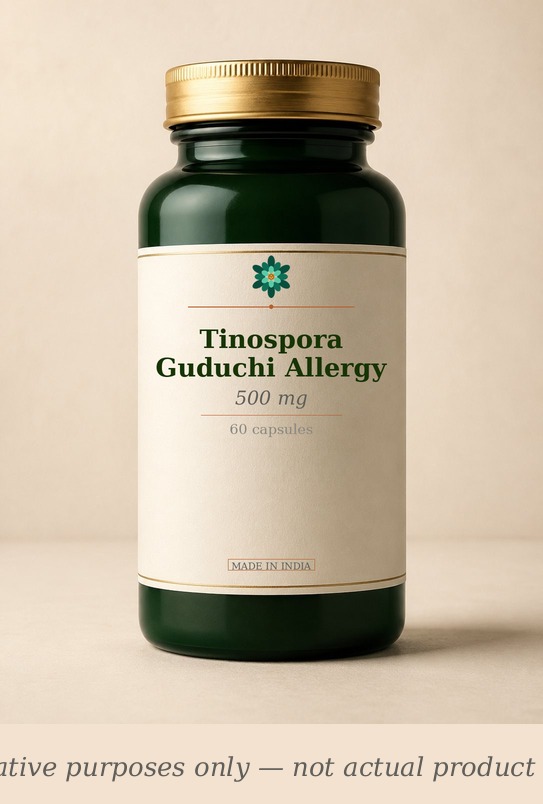
Tinospora Guduchi Allergy — SacredBod supplement bottle (illustrative)
Supplement · Allergy & Histamine Control

Tinospora Guduchi Allergy

500 mg · vegan · gluten-free · 60 caps

Allergic rhinitisSneezingNasal dischargeNasal obstructionNasal pruritus (itching)Recurrent respiratory infections Nasal mucosaImmune systemRespiratory tract
BUY on Amazon →

Affiliate link · we earn from qualifying purchases. No paid placements.

What it is

Tinospora cordifolia, known as Guduchi (गुडूची) or Giloy (गिलोय), is a climbing shrub native to India. Its stem extract has been evaluated in a randomised double-blind placebo-controlled trial for allergic rhinitis, showing 100% relief from sneezing in 83% of patients, significant reduction in eosinophil and neutrophil counts, and absence of goblet cells in nasal smear. It is one of the most important Rasayanas (rejuvenative tonics) in Ayurveda.

How it works

Tinospora cordifolia modulates both innate and adaptive immunity. It increases macrophage phagocytic activity, stimulates B-lymphocytes, and enhances polymorphonuclear leukocyte function. In allergic rhinitis, it reduces eosinophil infiltration in nasal mucosa, stabilises mast cells, and downregulates Th2 cytokines (IL-4, IL-5) that drive IgE production. The diterpenoid lactones (tinocordiside, cordifolioside) are the primary immunomodulatory compounds.

Who should take it

Adults with allergic rhinitis, recurrent upper respiratory infections, or seasonal allergies; individuals seeking an Ayurvedic immunomodulator with modern clinical validation; and those with low immunity who experience frequent colds and allergies.

Avoid / careful

Pregnant or breastfeeding women (insufficient safety data); individuals with autoimmune diseases (theoretical immunostimulatory concern); those on immunosuppressants (may counteract drug effects). Side effects: Very well tolerated. Mild stomach upset or loose stools in rare cases. No serious adverse events reported in clinical trials at doses up to 900 mg/day.

When to take it

Morning
Noon
Evening
Night

How to take it

With food
Empty stomach
Before food

FAQs

Frequently asked

How long before I see results?
The Badar trial showed significant symptom relief after 8 weeks of 500mg twice daily. 83% of patients had complete relief from sneezing, 69% from nasal discharge, 61% from nasal obstruction, and 71% from nasal itching. Eosinophil and neutrophil counts in nasal smear decreased significantly. For general immune support, benefits may appear within 2–4 weeks.
Is it safe for daily long-term use?
Yes. Guduchi is classified as a Rasayana (rejuvenative tonic) in Ayurveda and is considered safe for long-term use. Clinical trials have used it for 6 months at 900 mg/day without adverse effects. It is one of the safest immunomodulators available.
Can I take it with my allergy medications?
Yes. Guduchi is complementary to antihistamines and leukotriene antagonists. It addresses the immune dysregulation underlying allergies, while medications address acute symptoms. However, if you are on immunosuppressants (e.g., post-transplant), consult your physician as Guduchi may stimulate immune function.

In plain English

A plain-English read of the literature behind this supplement. Not a clinical recommendation.

Key citations: PMID 15619563 (Efficacy of Tinospora cordifolia in allergic rhinitis — Badar et al. 2005), PMC2792597 (Immunomodulatory effect in HIV patients — mentions TC in allergic rhinitis), PMC11133831 (Comprehensive review of Tinospora pharmacology)

Editorial notes

SacredBod's longer take on Tinospora Guduchi Allergy — context the structured blocks above don't capture.

What Tinospora Guduchi Allergy Is

Tinospora cordifolia, revered in Ayurveda as Guduchi (गुडूची), Giloy (गिलोय), or Amrita (अमृता — “nectar of immortality”), is a climbing shrub native to the tropical forests of India. It is one of the most celebrated Rasayanas (rejuvenative tonics) in classical Ayurvedic texts, mentioned in the Charaka Samhita and Sushruta Samhita for its ability to enhance immunity, longevity, and vitality.

Modern clinical research has validated its traditional use, with a randomised double-blind placebo-controlled trial (Badar et al., 2005) demonstrating significant efficacy in allergic rhinitis — a condition that affects an estimated 20–30% of India’s urban population.

How It Works

  1. Immunomodulation — Guduchi stimulates macrophage phagocytosis, B-lymphocyte proliferation, and polymorphonuclear leukocyte function. This enhances the body’s ability to clear allergens and pathogens.
  2. Mast cell stabilisation — The diterpenoid lactones (tinocordiside, cordifolioside, tinosporaside) inhibit mast cell degranulation, reducing histamine release.
  3. Th2 downregulation — Guduchi shifts the Th1/Th2 balance toward Th1, reducing IL-4 and IL-5 production — the cytokines that drive IgE synthesis and eosinophil recruitment.
  4. Eosinophil reduction — The Badar trial showed decreased eosinophil and neutrophil counts in nasal smear, correlating with clinical symptom improvement.
  5. Anti-inflammatory — Inhibits NF-κB and reduces TNF-α, IL-1β, and IL-6 in mucosal tissues.

Who Benefits Most

  • Allergic rhinitis sufferers — The Badar RCT showed 83% complete sneezing relief, 69% nasal discharge relief, and 61% obstruction relief after 8 weeks.
  • Recurrent infection prone individuals — Guduchi’s immunostimulatory effect increases total leukocyte count and enhances neutrophil function.
  • Students and professionals — India’s high pollution and dust levels create year-round allergy triggers. Guduchi provides sustained immune support.
  • Post-COVID immune recovery — Guduchi is widely used in Indian post-COVID protocols to restore immune balance.

Dosage Guide

GoalDoseDuration
Allergic rhinitis500 mg 2× daily8–12 weeks
General immune support500 mg/dayOngoing
Post-illness recovery500 mg 2× daily4–6 weeks

Take with meals. The stem extract is preferred over leaf extract for immunomodulatory effects.

Safety & Interactions

  • Autoimmune diseases: Theoretical concern due to immunostimulatory effects; consult rheumatologist.
  • Immunosuppressants: May counteract effects of transplant medications, cyclosporine, etc.
  • Diabetes: May lower blood sugar; monitor if on hypoglycaemic drugs.
  • Pregnancy: Not recommended due to insufficient safety data.

India-Specific Context

  • Availability: Guduchi is abundantly available on Amazon.in. AYURVEDASHREE (B0CYYH6Q8P), Satya Naturals (B0DBXHCNR7), Morpheme (B07C1DVG48), Morsan Nutraveda (B0CHP2V2QW), and INLIFE (B089F7HHSV) all sell 500mg capsules. Prices range from ₹300–₹700 for 60 capsules.
  • Regulatory status: Guduchi is sold as both an Ayurvedic medicine and dietary supplement in India. It is not a Schedule H drug.
  • Ayurvedic classical status: Guduchi is one of the most important herbs in Ayurveda. Charaka Samhita describes it as Vayasthapana (age-stabilising), Dahaprashamana (heat-pacifying), and Tridoshaghna (balancing all three doshas). For allergies, it is specifically indicated for Kapha and Pitta imbalances affecting the respiratory system.
  • Cultural significance: During the COVID-19 pandemic, the Indian government actively promoted Giloy consumption for immune support. It is now a household name across India.
  • Traditional preparation: Fresh Giloy stem juice (Swaras) is a popular home remedy in rural India for fever, allergies, and immune weakness. The standardised capsule form provides consistent dosing.
Added to your stack.