
SacredBod
0
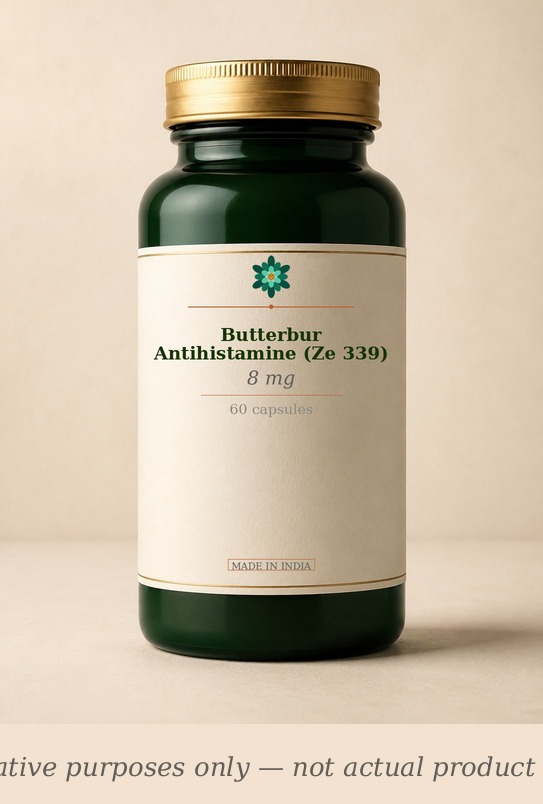
Butterbur Antihistamine (Ze 339) — SacredBod supplement bottle (illustrative)
Supplement · Allergy & Histamine Control

Butterbur Antihistamine (Ze 339)

8 mg · vegan · gluten-free · 60 caps

SneezingRunny noseNasal congestionItchy eyesWatery eyesItchy throat Nasal mucosaEyesRespiratory tract
BUY on Amazon →

Affiliate link · we earn from qualifying purchases. No paid placements.

What it is

Ze 339 is a standardised carbon dioxide extract of Petasites hybridus (butterbur) leaves, standardised for petasin and isopetasin content. It is a licensed herbal medicine in Germany and Switzerland for allergic rhinitis, with multiple RCTs demonstrating efficacy equivalent to cetirizine and desloratadine — but without the sedative side effects.

How it works

Petasins inhibit leukotriene biosynthesis (5-lipoxygenase pathway) and reduce histamine and IL-8 release from mast cells and basophils. Ze 339 also modulates the JAK/STAT signalling pathway in nasal epithelial cells, reducing pro-inflammatory cytokine production in response to allergens. Unlike antihistamines, it does not block H1 receptors centrally and therefore causes no drowsiness.

Who should take it

Adults and children over 12 with seasonal or perennial allergic rhinitis (hay fever); individuals who experience sedation, fatigue, or impaired driving from conventional antihistamines; and those seeking a natural alternative to cetirizine, loratadine, or fexofenadine.

Avoid / careful

Pregnant or breastfeeding women; children under 12 years; individuals with liver disease (despite PA-free status, caution warranted); those allergic to Asteraceae family plants (ragweed, daisy, sunflower). Side effects: Very well tolerated. Mild gastrointestinal upset (nausea, burping, stomach pain) in ~5–10% of users. Rare allergic skin reactions. Ze 339 is certified pyrrolizidine alkaloid (PA)-free, eliminating the liver toxicity risk associated with raw butterbur.

When to take it

Morning
Noon
Evening
Night

How to take it

With food
Empty stomach
Before food

FAQs

Frequently asked

How long before I see results?
Symptom relief typically begins within 3–5 days. The landmark RCT showed that after 2 weeks, butterbur was equivalent to cetirizine in SF-36 scores and global improvement. For seasonal allergies, start 1–2 weeks before pollen season for preventive benefit.
Is it really non-sedating?
Yes. In the cetirizine head-to-head trial, two-thirds of adverse events in the cetirizine group were drowsiness and fatigue. The butterbur group had zero sedative adverse events. This is because butterbur works peripherally (leukotriene inhibition + mast cell stabilisation) rather than crossing the blood-brain barrier to block central H1 receptors.
Is butterbur safe for the liver?
Raw butterbur contains pyrrolizidine alkaloids (PAs) that can cause liver damage. Ze 339 and pharmaceutical-grade extracts like Petadolex are certified PA-free through rigorous manufacturing processes. Only use PA-certified products. The SAI HERBS powders on Amazon.in do not declare PA content — use with caution.

In plain English

A plain-English read of the literature behind this supplement. Not a clinical recommendation.

Key citations: PMID 11799030 (Butterbur vs cetirizine for seasonal allergic rhinitis — Schapowal 2002), PMID 15133458 (Dose-dependent efficacy of Ze 339 — Schapowal 2004), PMID 21536486 (Ze 339 vs desloratadine for nasal obstruction — Dumitru 2011), PMC12189244 (2024 comprehensive review of Ze 339 safety and efficacy)

Editorial notes

SacredBod's longer take on Butterbur Antihistamine (Ze 339) — context the structured blocks above don't capture.

What Butterbur Ze 339 Is

Petasites hybridus, commonly known as butterbur, is a perennial herb native to Europe, northern Africa, and southwestern Asia. Its large rhubarb-like leaves were historically used to wrap butter (hence the name). Modern pharmaceutical extraction has isolated the active petasins — sesquiterpene compounds that inhibit leukotriene synthesis and stabilise mast cells.

Ze 339 is a patented, carbon dioxide-extracted, pyrrolizidine alkaloid (PA)-free leaf extract manufactured by Zeller AG in Switzerland. It is standardised for petasin and isopetasin content and has been a licensed medicine for allergic rhinitis in Germany since 2003. The extract is now authorised in ten European countries.

How It Works

  1. Leukotriene inhibition — Petasins block 5-lipoxygenase, the enzyme that produces leukotrienes (LTB4, LTC4, LTD4). Leukotrienes are potent inflammatory mediators that cause nasal congestion, mucus production, and bronchospasm.
  2. Mast cell stabilisation — Ze 339 reduces histamine and IL-8 release from mast cells and basophils during allergen exposure.
  3. JAK/STAT pathway modulation — In nasal epithelial cells, Ze 339 inhibits the JAK/STAT signalling cascade, reducing IL-6 and other pro-inflammatory cytokines in the late-phase allergic response.
  4. Non-sedating — Unlike H1 antihistamines, butterbur does not cross the blood-brain barrier, preserving alertness and driving ability.

Who Benefits Most

  • Hay fever sufferers — Four RCTs with 659+ patients confirm efficacy equivalent to cetirizine and desloratadine.
  • Professionals who drive or operate machinery — The absence of sedation is a major advantage over first- and second-generation antihistamines.
  • Students during exam season — No cognitive impairment or drowsiness.
  • Antihistamine non-responders — The leukotriene pathway addresses nasal congestion that antihistamines often fail to relieve.

Dosage Guide

FormulationDoseDuration
Ze 339 tablets1 tablet (8 mg petasins) 3–4× dailyDuring allergy season
Petadolex (migraine formula)50–75 mg 2× dailyOff-label for allergy

Take with food to minimise burping or stomach upset. Start 1–2 weeks before pollen season for preventive effect.

Safety & Interactions

  • Pyrrolizidine alkaloids: Only use PA-free certified products. Raw butterbur powders (like SAI HERBS) may contain PAs.
  • Pregnancy/breastfeeding: Not recommended.
  • Children: Approved for ages 12+ in Europe.
  • Asteraceae allergy: Cross-reactivity possible with ragweed, daisy, sunflower.

India-Specific Context

  • Availability: Ze 339 is not available on Amazon.in. The only butterbur products are raw powders (SAI HERBS) and imported Petadolex softgels (B0013OQCWW). Raw powders lack standardisation and PA certification.
  • Regulatory status: Butterbur is not a Schedule H drug in India but is not widely marketed as an allergy supplement.
  • Ayurvedic parallel: While not in classical Ayurvedic texts, butterbur’s mechanism aligns with the concept of Kapha reduction and Pranavaha Srotas cleansing. It is functionally similar to combining Tulsi (antihistamine-like) with Vasa (anti-leukotriene).
  • Import option: Ze 339 can be imported from German/Swiss pharmacies. A 60-tablet pack costs approximately €15–20 (₹1,300–1,800) plus shipping.
  • Allergy burden in India: India has a high prevalence of allergic rhinitis (estimated 20–30% of urban populations), driven by dust, pollution, and pollen. A non-sedating, effective natural alternative is particularly valuable for India’s workforce and student population.
Added to your stack.