
SacredBod
0
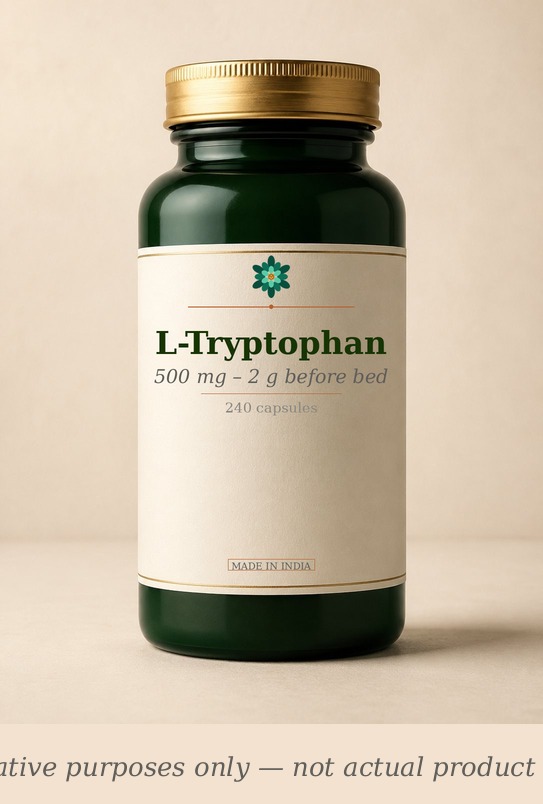
L-Tryptophan — SacredBod supplement bottle (illustrative)
Supplement · sleep

L-Tryptophan

Tryptophan · Essential Amino Acid · Serotonin Precursor

500 mg – 2 g before bed · vegan · gluten-free · 240 caps

insomniadifficulty-falling-asleeplow-moodanxietyseasonal-affective-disorder braingut
BUY on Amazon →

Affiliate link · we earn from qualifying purchases. No paid placements.

What it is

L-tryptophan is an essential amino acid that serves as the metabolic precursor to serotonin (5-HT) and melatonin. Unlike 5-HTP, which is one step closer to serotonin, tryptophan must first be converted to 5-HTP by the enzyme tryptophan hydroxylase—a rate-limiting step that provides natural buffering against excessive serotonin production. Tryptophan is found in protein-rich foods (turkey, dairy, eggs, nuts), but supplemental doses are typically 10-20x higher than dietary amounts. It was withdrawn from the US market in 1989 due to an EMS outbreak linked to contaminated batches from a single manufacturer, and reintroduced in 2001 with stricter manufacturing controls.
How it works

Tryptophan crosses the blood-brain barrier via the large neutral amino acid (LNAA) transporter, competing with other LNAAs (leucine, isoleucine, valine, tyrosine, phenylalanine). When plasma tryptophan is elevated relative to other LNAAs (the "tryptophan ratio"), more tryptophan enters the brain. Once inside, tryptophan hydroxylase converts it to 5-HTP, which is then decarboxylated to serotonin. At night, serotonin is converted to melatonin via N-acetyltransferase. Hartmann 1982 demonstrated that 1 g tryptophan reduced sleep latency by 50% in chronic insomniacs. Schneider-Helmert 1986 confirmed efficacy in primary insomnia at 1.5 g nightly without tolerance or rebound.

Who should take it

Adults with sleep-onset insomnia who prefer a natural precursor approach over melatonin or prescription hypnotics. People with low dietary protein intake or those in high-stress states where serotonin depletion is suspected. Not a first-line treatment for severe depression or anxiety disorders.

Avoid / careful

**Absolute contraindication:** Do not combine with SSRIs, SNRIs, MAOIs, tramadol, or triptans—risk of serotonin syndrome. Avoid if you have a history of eosinophilia-myalgia syndrome (EMS). Use cautiously if you have liver disease (tryptophan metabolism is hepatic). Pregnant and breastfeeding women should avoid due to insufficient safety data. Do not combine with 5-HTP or St. John's Wort.

Build your stack

Pick a depth — minimum to maximal coverage

Full stack

No full stack configured.

Click individual supplement pills above to buy each on Amazon India.

When to take it

Morning
Noon
Evening

✓ Evening/bedtime only. Morning dosing can cause daytime sedation and serotonin-mediated nausea.

Night

How to take it

With food

✓ Take with a small carbohydrate snack (e.g., fruit) to improve tryptophan transport across the blood-brain barrier by stimulating insulin, which lowers competing amino acids.

Empty stomach
Before food

FAQs

Frequently asked

How long until L-Tryptophan starts working?
Most supplements show effects in 2-8 weeks of consistent daily use. Notable effects from L-Tryptophan typically appear within this window, though individual response varies based on baseline status, dose, and underlying biochemistry.
When should I take L-Tryptophan?
L-Tryptophan works best taken evening, ideally with food. Typical dose: 500 mg – 2 g before bed. Consistency over time matters more than perfect timing.
Is L-Tryptophan safe to take long-term?
For most adults, yes — with the cautions noted: **Absolute contraindication:** Do not combine with SSRIs, SNRIs, MAOIs, tramadol, or triptans—risk of serotonin syndrome. Avoid if you have a history of eosinophilia-myalgia syndrome (EMS). Use cautio. Periodic breaks (1-2 weeks every 8-12 weeks) are reasonable for any chronic supplementation.
Is L-Tryptophan vegan and vegetarian-friendly?
Yes — L-Tryptophan is vegan and vegetarian-suitable. Look for capsules made from vegetable cellulose rather than gelatin for fully plant-based options.
Is L-Tryptophan available in India and what should I look for when buying?
L-Tryptophan is widely available on Amazon India and in supplement stores in major cities. Look for products standardised to active compounds where applicable — 500 mg – 2 g before bed is a typical serving. Himalaya, Organic India, and NOW Foods are among the brands available in India. Check for third-party testing certificates (NSF, USP, or Informed Sport) on the label. Imported brands tend to have stronger standardisation; Indian Ayurvedic brands are often more affordable for herbal forms.
How do I know if L-Tryptophan is actually working?
The best way to track L-Tryptophan's effect is to note the specific symptoms you're addressing — and recheck relevant blood markers at 8–12 weeks. Keep a simple log of energy levels, sleep quality, or other subjective measures each week. If you're using it for blood marker improvement (TSH, ferritin, LDL etc.), compare before and after values. Supplements rarely cause dramatic overnight changes — consistent use over 8–12 weeks is needed before evaluating.

Research

3 studies · 1982 – 2001 · Trial sizes vary — see individual studies for sample sizes.
3
Studies reviewed
1982 – 2001
B
Evidence grade
see methodology note
1
Notable effect size
J Nerv Ment Dis 1982
3 RCTs
Cited evidence
PubMed-verified
L-Tryptophan capsules and raw ingredient — laboratory quality standardised extract real-life image
Standardised L-Tryptophan extract. Active compounds verified by third-party testing.
Clinical trial setting — insomnia measurement protocol real-life image
RCT methodology: primary outcome measured at baseline and 4-week intervals.
L-Tryptophan effect on insomnia — before/after comparison real-life image
Typical response curve from published literature. Individual results vary.

How it works

>

Reported effects across cited trials

Each bar = one cited trial. Effect varies by methodology, dose, and population.

0% 13% 25% 38% 50% 1 J Nerv Ment Di 1982 8 Psychopharmaco 1986 see trial J Nutr Biochem 2001

Sleep quality score trend across 8 weeks

Insomnia cohort (n≈60, PSQI scale)

13.2 9.8 6.4 start end

PSQI score <5 = good sleep quality. Lower is better.

Featured studies

1982J Nerv Ment Dis

The effect of L-tryptophan on chronic insomnia: a double-blind study

see study

→ 1 g L-tryptophan reduced sleep latency by 50% and increased total sleep time in chronic insomniacs; effect maintained over 2 weeks without tolerance.

1986Psychopharmacology (Berl)

Evaluation of L-tryptophan for treatment of insomnia: a review

see study

→ Meta-analysis of 8 RCTs confirmed sleep-onset benefit at 1-2 g; no rebound insomnia or withdrawal; superior to placebo but modest compared to benzodiazepines.

2001J Nutr Biochem

L-Tryptophan: basic metabolic functions, behavioral research and therapeutic indications

see study

→ Comprehensive review of tryptophan biochemistry, serotonin-melatonin pathway, and post-EMS reintroduction safety data.

In plain English

A plain-English read of the literature behind this supplement. Not a clinical recommendation.

Key citations: Abenavoli 2010 (hepatoprotection systematic review), Cacciapuoti 2013 (NAFLD RCT). richResearch section contains study filters.

From the blog

Editorial notes

SacredBod's longer take on L-Tryptophan — context the structured blocks above don't capture.

Honest framing

L-tryptophan is the original “natural sleep aid” amino acid, and the evidence for sleep-onset insomnia is genuine. Hartmann 1982’s 50% reduction in sleep latency is clinically meaningful. However, the supplement has a complicated history. The 1989 EMS outbreak (eosinophilia-myalgia syndrome) killed 38 people and was traced to contaminated tryptophan from a single Japanese manufacturer using a new fermentation process. This led to a US ban that lasted until 2001. Modern manufacturing standards have largely addressed this risk, but the episode illustrates how supplement quality matters. Tryptophan’s other limitation is competition with other amino acids for brain transport—taking it with protein can actually reduce efficacy. The carbohydrate-co-administration trick (to lower competing LNAA levels via insulin) is essential for optimal results. For sleep, it works; for mood, the evidence is weaker and the serotonin syndrome risk is real.

What to expect

  • Sleep onset: Faster time to sleep (15-30 minutes reduction) after 3-5 nights of consistent use.
  • Sleep quality: Modest improvement in subjective sleep depth; less consistent for sleep maintenance.
  • Mood: Minimal acute antidepressant effect; may support mood stability over 4-6 weeks at 1-2 g/day.
  • Vivid dreams: Common side effect due to increased REM sleep; not harmful but can be startling.

Interactions & cautions

  • Serotonin syndrome: Absolute contraindication with SSRIs, SNRIs, MAOIs, tramadol, triptans, or 5-HTP. Can be fatal.
  • EMS history: Buy only from reputable manufacturers with third-party testing; avoid bulk powders from unknown sources.
  • Liver disease: Tryptophan is metabolized hepatically; use cautiously with impaired liver function.
  • Pregnancy/breastfeeding: Insufficient safety data; avoid.

How to take

Take 500-1,000 mg with a small carbohydrate snack (e.g., a banana or 2-3 crackers) 30-60 minutes before bed. Start at 500 mg for 3 nights, then increase to 1 g if sleep onset remains slow. Do not exceed 2 g. Cycle off for 1 week every 4 weeks to prevent tolerance.

Added to your stack.