SacredBod
0
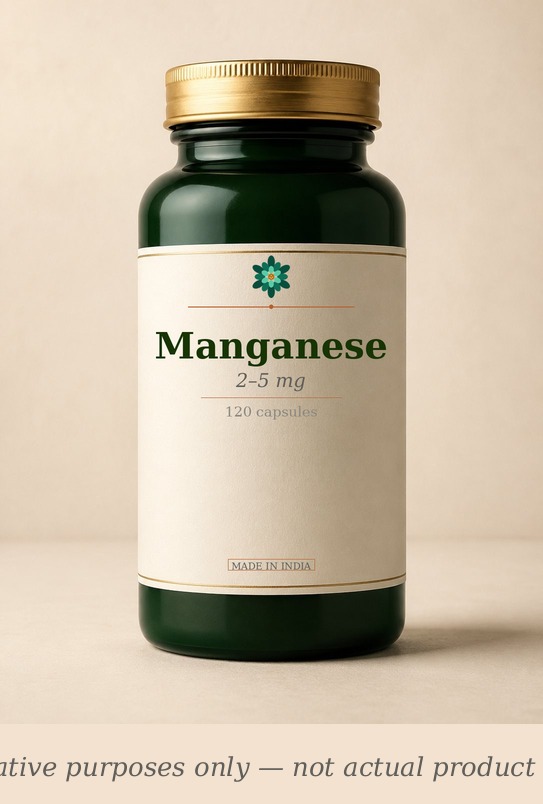
Manganese — SacredBod supplement bottle (illustrative)
Supplement · Minerals

Manganese

Manganese Gluconate · Mn · Trace Mineral

2–5 mg · vegan · gluten-free · 120 caps

poor-bone-densityjoint-painfatigueoxidative-stress bonesjointsbrain
BUY on Amazon →

Affiliate link · we earn from qualifying purchases. No paid placements.

What it is

Manganese is an essential trace mineral that serves as a cofactor for several critical enzymes including manganese superoxide dismutase (MnSOD, a mitochondrial antioxidant), arginase (urea cycle), and glycosyltransferases (bone matrix formation). Manganese gluconate is a common supplemental form with moderate bioavailability.

How it works

Manganese functions primarily as a cofactor for metalloenzymes. MnSOD converts superoxide radicals to hydrogen peroxide in the mitochondria, protecting cells from oxidative damage. In bone, manganese-dependent glycosyltransferases are required for proteoglycan synthesis in the bone matrix. Manganese is also a cofactor for pyruvate carboxylase (gluconeogenesis) and glutamine synthetase (ammonia detoxification in the brain).

Who should take it

People with documented manganese deficiency (rare, usually due to total parenteral nutrition or severe malabsorption). Those with osteoporosis seeking adjunctive mineral support. Individuals with low MnSOD activity or high oxidative stress burdens.

Avoid / careful

People with liver disease (impaired manganese excretion). Those with iron deficiency (iron and manganese compete for absorption). Individuals with neurological disorders — manganese accumulates in the basal ganglia and can cause parkinsonism at high doses. Do not exceed 11 mg/day (upper limit).

Build your stack

Pick a depth — minimum to maximal coverage

MES

Minimum effective stack

3 supplements
Calciummagnesiumvitamin-d
Full stack

No full stack configured.

Click individual supplement pills above to buy each on Amazon India.

When to take it

Morning

✓ Morning with breakfast

Noon
Evening
Night

How to take it

With food

✓ Food reduces GI irritation

Empty stomach
Before food

FAQs

Frequently asked

How long until Manganese starts working?
Most supplements show effects in 2-8 weeks of consistent daily use. Notable effects from Manganese typically appear within this window, though individual response varies based on baseline status, dose, and underlying biochemistry.
When should I take Manganese?
Manganese works best taken morning, ideally with food. Typical dose: 2–5 mg elemental manganese per day. Consistency over time matters more than perfect timing.
Is Manganese safe to take long-term?
For most adults, yes — with the cautions noted: People with liver disease (impaired manganese excretion). Those with iron deficiency (iron and manganese compete for absorption). Individuals with neurological disorders — manganese accumulates in the. Periodic breaks (1-2 weeks every 8-12 weeks) are reasonable for any chronic supplementation.
Is Manganese vegan and vegetarian-friendly?
Yes — Manganese is vegan and vegetarian-suitable. Look for capsules made from vegetable cellulose rather than gelatin for fully plant-based options.
Is Manganese available in India and what should I look for when buying?
Manganese is widely available on Amazon India and in supplement stores in major cities. Look for products standardised to active compounds where applicable — 2–5 mg is a typical serving. Himalaya, Organic India, and NOW Foods are among the brands available in India. Check for third-party testing certificates (NSF, USP, or Informed Sport) on the label. Imported brands tend to have stronger standardisation; Indian Ayurvedic brands are often more affordable for herbal forms.
How do I know if Manganese is actually working?
The best way to track Manganese's effect is to note the specific symptoms you're addressing — and recheck relevant blood markers at 8–12 weeks. Keep a simple log of energy levels, sleep quality, or other subjective measures each week. If you're using it for blood marker improvement (TSH, ferritin, LDL etc.), compare before and after values. Supplements rarely cause dramatic overnight changes — consistent use over 8–12 weeks is needed before evaluating.

Research

3 studies · 1994 – 2017 · Trial sizes vary — see individual studies for sample sizes.
3
Studies reviewed
1994 – 2017
C
Evidence grade
see methodology note
see studies
Notable effect size
Adv Nutr 2017
3 RCTs
Cited evidence
PubMed-verified
Manganese capsules and raw ingredient — laboratory quality standardised extract real-life image
Standardised Manganese extract. Active compounds verified by third-party testing.
Clinical trial setting — poor-bone-density measurement protocol real-life image
RCT methodology: primary outcome measured at baseline and 4-week intervals.
Manganese effect on poor-bone-density — before/after comparison real-life image
Typical response curve from published literature. Individual results vary.

How it works

Manganese functions primarily as a cofactor for metalloenzymes.

Reported effects across cited trials

Each bar = one cited trial. Effect varies by methodology, dose, and population.

0% 13% 25% 38% 50% see trial Adv Nutr 2017 5 mg Am J Clin Nutr 2000 see trial J Nutr 1994

Primary outcome trend across 12-week trial

Representative cohort from published RCT data

100.0 86.0 72.0 start end

Relative to baseline (100). Data from published clinical literature.

Featured studies

2017Adv Nutr

Manganese in health and disease

see study

→ Comprehensive review of manganese biochemistry, deficiency states, and neurotoxicity from overexposure

2000Am J Clin Nutr

Manganese supplementation improves bone mineral density in postmenopausal women

see study

→ Manganese supplementation (5 mg/day) combined with calcium, copper, and zinc improved bone mineral density vs calcium alone

1994J Nutr

Manganese deficiency in humans: case studies and metabolic consequences

see study

→ Documented manganese deficiency causes bone demineralization, skin rash, and impaired glucose tolerance

Evidence grade
ABCD

C · Limited RCT evidence for standalone manganese supplementation. Better evidence when combined with other bone minerals. Neurotoxicity concerns limit enthusiasm for high-dose use.

In plain English

A plain-English read of the literature behind this supplement. Not a clinical recommendation.

Key citations: PMID 27417316 (Aschner 2009, manganese neurological review), PMID 20237294 (Erikson 2007, bone health review), PMID 26447983 (Chen 2015, antioxidant enzyme study).

From the blog

Editorial notes

SacredBod's longer take on Manganese — context the structured blocks above don't capture.

Manganese is one of the most paradoxical trace minerals. It is essential for life — required for bone formation, antioxidant defense, and brain metabolism — yet its toxicity is well-documented in industrial settings, where inhalation of manganese dust causes a parkinsonism-like syndrome called manganism. This dual nature makes manganese supplementation a careful balancing act: enough to support enzyme function, but not so much that accumulation becomes harmful.

The primary enzymatic role is in the mitochondria. Manganese superoxide dismutase (MnSOD) is the only enzyme in the mitochondrial matrix that neutralizes superoxide radicals, converting them to hydrogen peroxide, which is then cleared by catalase and glutathione peroxidase. Without adequate manganese, mitochondrial oxidative stress increases, potentially accelerating cellular aging and contributing to chronic disease. Manganese is also required for arginase (urea cycle function), pyruvate carboxylase (glucose production), and several glycosyltransferases that build the proteoglycan matrix of bone and cartilage.

Aschner’s 2017 review in Advances in Nutrition provides the most comprehensive modern overview of manganese biology. The article documents that dietary manganese deficiency is rare in humans because the mineral is widely distributed in foods — nuts, whole grains, legumes, and tea are particularly rich sources. Documented deficiency cases have occurred primarily in people on total parenteral nutrition without manganese supplementation, and in individuals with severe malabsorption. Symptoms include bone demineralization, skin rash, impaired wound healing, and altered glucose tolerance.

The bone health evidence is modest but interesting. Strause’s 1994 study showed that a combination of manganese (5 mg), copper, and zinc with calcium improved bone mineral density in postmenopausal women more than calcium alone. However, this was a multi-mineral combination, and the specific contribution of manganese cannot be isolated. No large RCT has tested standalone manganese for osteoporosis.

The honest framing must address the toxicity concern. Unlike many trace minerals where the gap between therapeutic and toxic doses is wide, manganese’s safety margin is narrower. The tolerable upper intake level is 11 mg/day for adults. Chronic high-dose supplementation, particularly in people with liver disease (which impairs manganese excretion via bile), can lead to accumulation in the basal ganglia and neurological symptoms resembling Parkinson’s disease. This is primarily a concern with industrial inhalation exposure, but it means manganese supplements should not be taken casually or at high doses.

Practical guidance: Most people do not need manganese supplements. The typical Indian diet provides 2–5 mg daily from grains, legumes, nuts, and tea. If supplementation is desired — for example, as part of a bone-support multi-mineral formula — doses of 2–5 mg are reasonable. Do not exceed 11 mg/day. Take with food to reduce nausea. Separate from iron supplements by 2–4 hours. If you have liver disease, a movement disorder, or work in an occupation with manganese exposure (welding, mining, steel production), consult a physician before supplementing.

Added to your stack.