SacredBod
0
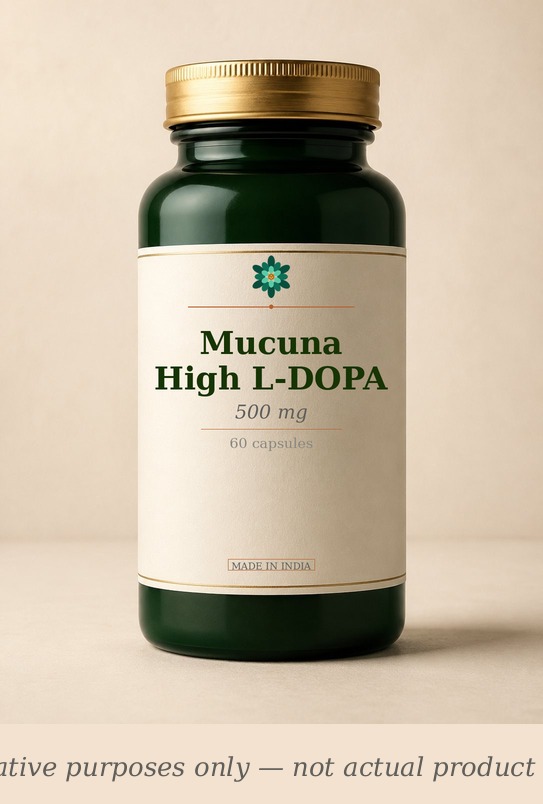
Mucuna High L-DOPA — SacredBod supplement bottle (illustrative)
Supplement · Dopamine & Testosterone

Mucuna High L-DOPA

500 mg · vegan · gluten-free · 60 caps

Low motivationBrain fogLow testosteroneElevated prolactinDepressed mood BrainTestesPituitary glandMuscles
BUY on Amazon →

Affiliate link · we earn from qualifying purchases. No paid placements.

What it is

Mucuna pruriens (Kapikacchu / Kaunch Beej / Velvet Bean) is a tropical legume native to India and Africa. It is the richest natural source of L-DOPA (levodopa) — the direct precursor to dopamine. Standardized extracts containing 15–20% L-DOPA provide consistent dosing for dopamine support, prolactin reduction, testosterone enhancement, and growth hormone stimulation. This is distinct from standard mucuna powder which contains variable (and often low) L-DOPA levels.

How it works

L-DOPA crosses the blood-brain barrier and is converted to dopamine by dopa decarboxylase. Increased dopamine suppresses prolactin secretion from the pituitary — and since prolactin inhibits testosterone production, lowering prolactin indirectly raises testosterone. Dopamine also stimulates growth hormone release via hypothalamic GHRH neurons. The seed's antioxidant content (phenolics, tannins) protects testicular tissue from oxidative damage, directly supporting spermatogenesis.

Who should take it

Men with low dopamine symptoms (low motivation, brain fog, depression), individuals with elevated prolactin, those seeking natural testosterone support, people with Parkinson's symptoms (under medical supervision), and anyone wanting mood and cognitive enhancement. Highly relevant for Indian men facing stress-related dopamine depletion.

Avoid / careful

People with psychotic disorders (dopamine may worsen symptoms), those on MAO inhibitors, individuals with melanoma (L-DOPA is a melanin precursor), pregnant or breastfeeding women. Side effects: Generally safe at standard doses. May cause nausea, headache, or insomnia at higher doses. The 'levodopa' content means it can cause dyskinesias at very high doses. Rarely: hypotension or arrhythmias.

When to take it

Morning
Noon
Evening
Night

How to take it

With food
Empty stomach
Before food

FAQs

Frequently asked

How long before I see results?
Mood and motivation improvements may appear within 1–2 weeks. Prolactin reduction and testosterone changes require 4–8 weeks. Growth hormone stimulation is acute (within 1 hour of dosing) but chronic benefits require consistent use.
Is it safe to take daily?
Yes at 500 mg/day (15–20% L-DOPA). This provides 75–100 mg L-DOPA — far below the 500+ mg doses used in Parkinson's therapy. Daily use is safe for healthy adults. Those with bipolar disorder or psychosis should avoid.
Can I take it with antidepressants?
Caution with SSRIs and SNRIs. Mucuna increases dopamine, which may counteract serotonergic antidepressant mechanisms or cause serotonin-dopamine imbalance. Consult your psychiatrist before combining.

In plain English

A plain-English read of the literature behind this supplement. Not a clinical recommendation.

Key citations: PMID 24252425 (Mucuna on testosterone, LH, and prolactin in infertile men, 2014), PMID 20657580 (Mucuna improves fertility & sperm quality in 120 infertile men, 2010)

Editorial notes

SacredBod's longer take on Mucuna High L-DOPA — context the structured blocks above don't capture.

Mucuna pruriens — Kapikacchu in Sanskrit, Kaunch Beej in Hindi — is one of the most important herbs in Ayurvedic neuroendocrine medicine. This climbing legume is the richest natural source of L-DOPA, the direct precursor to dopamine, and has been used for millennia to treat Parkinson’s symptoms, male infertility, and depression in Indian traditional medicine.

What the Research Shows

A 2014 study (PMID 24252425) evaluated Mucuna pruriens in 120 infertile men. The Mucuna group showed significant increases in serum testosterone (+27.3%), luteinizing hormone (+23.5%), and sperm count while prolactin decreased by 32.6%. The mechanism involves both dopaminergic prolactin suppression and direct antioxidant protection of testicular tissue.

A 2010 study (PMID 20657580) confirmed these findings in a larger cohort, showing that Mucuna improved sperm quality, reduced oxidative stress markers, and enhanced dopamine metabolite levels. The L-DOPA content (typically 4–7% in raw seeds, 15–20% in standardized extracts) is the key driver of these effects.

Standardized extracts (15–20% L-DOPA) are critical because raw Mucuna powder contains highly variable L-DOPA levels depending on growing conditions, processing, and storage. A 500 mg capsule of 20% standardized extract delivers 100 mg L-DOPA — a consistent, therapeutic dose.

India Context

  • Availability: Mucuna is widely available on Amazon India. Trexgenics offers a premium 20% L-DOPA + P5P formulation. NOW Foods, Bixa Botanical, Merlion Naturals, and multiple generic brands also sell Mucuna capsules and tablets.
  • Price: ₹300–₹800 for 60–120 capsules depending on standardization level
  • Ayurvedic heritage: Kapikacchu is described in Charaka Samhita as a medhya rasayana (brain tonic), vajikarana (aphrodisiac), and balya (strength promoter). It is a key ingredient in classical formulations like Mamsagni Rasayana and Ashwagandhadi Lehya.
  • Traditional use: In rural India, roasted Kaunch Beej seeds are consumed as a snack and tonic. The hairs on the pod cause intense itching (hence ‘velvet bean’ — the hairs are like velvet but irritating), so only processed extracts are safe for consumption.
  • P5P synergy: The Trexgenics product adds P5P (pyridoxal-5-phosphate, the active form of vitamin B6) because P5P is the essential cofactor for dopa decarboxylase — the enzyme that converts L-DOPA to dopamine. Without adequate B6, L-DOPA conversion is inefficient.

Dosage & Safety

  • Standard dose: 500 mg daily (15–20% L-DOPA = 75–100 mg L-DOPA)
  • Best time: Morning with breakfast
  • Caution: Avoid with MAO inhibitors, antipsychotics, and levodopa medications. Not for melanoma patients (L-DOPA is melanin precursor). May cause nausea in sensitive individuals — take with food. Not for pregnancy.

Added to your stack.