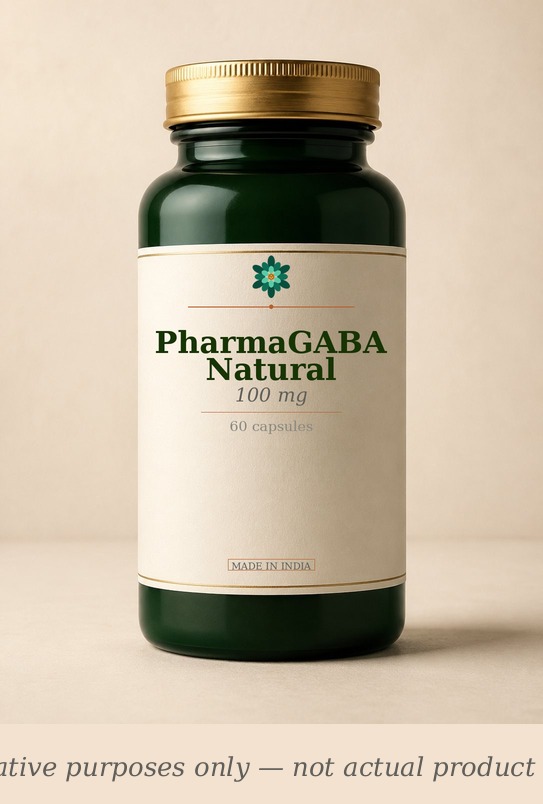
SacredBod's longer take on PharmaGABA Natural — context the structured blocks above don't capture.
What It Is
PharmaGABA Natural delivers gamma-aminobutyric acid produced through natural fermentation with Lactobacillus hilgardii — the same lactic acid bacteria used in traditional Korean kimchi. While all GABA supplements contain the same molecule (C4H9NO2), PharmaGABA is distinguished by its clinical validation: published EEG studies showing brain wave changes, cortisol suppression during stress tasks and objective sleep architecture improvements. In India, true PharmaGABA-branded products are not yet available; buyers must import or use generic GABA supplements that lack the same clinical evidence base.
How It Works
- Enteric nervous system activation — PharmaGABA is recognised by GABA receptors in the gut’s enteric nervous system (the “second brain” containing 500 million neurons). This activates the gut-brain axis, signalling the CNS via the vagus nerve to reduce sympathetic arousal.
- Alpha wave enhancement — EEG studies show that 100 mg PharmaGABA increases alpha brain wave power (8–13 Hz, associated with relaxed alertness) by approximately 50 % within 60 minutes, while decreasing stress-related beta waves (13+ Hz) by a similar magnitude.
- Cortisol and stress marker suppression — During a stressful arithmetic task, 50 mg PharmaGABA significantly reduced salivary cortisol and chromogranin A (a sympathetic nervous system stress marker) compared to placebo.
- Sleep architecture improvement — 100 mg PharmaGABA before bed reduced sleep latency by an average of 5 minutes and increased the time spent in deep, restorative NREM sleep by approximately 20 %.
Who Benefits Most
- Acute stress sufferers who need fast-acting relaxation before bed.
- Individuals with racing thoughts that prevent sleep onset.
- Those who want a non-sedating calm — PharmaGABA promotes relaxed alertness (alpha waves), not heavy sedation.
- People seeking immune protection during stress — the Abdou 2006 bridge-crossing study showed PharmaGABA maintained secretory IgA levels during extreme acute stress.
Dosage Guide
| Goal | Dose | Timing |
|---|
| Sleep onset | 100–200 mg | 30–60 minutes before bed, empty stomach |
| Acute stress | 100 mg | During or before stressful event |
| Daytime calm | 100 mg | 1–3 times daily as needed |
Take on an empty stomach for fastest absorption. PharmaGABA is water-soluble and reaches peak blood concentration within 30–60 minutes. For sleep, time the dose so peak levels coincide with bedtime. Vitamin B6 (P5P form) and magnesium are cofactors for endogenous GABA synthesis — ensure adequate intake.
Safety and Interactions
PharmaGABA is extremely safe. GABA is the brain’s primary inhibitory neurotransmitter — the body produces and metabolises it constantly. No toxicity, dependence or withdrawal has been documented. The main caution is additive sedation with benzodiazepines, alcohol and other CNS depressants. GABA may reduce clozapine efficacy.
India-Specific Context
- Hindi/Sanskrit name: No classical equivalent; GABA was discovered as a neurotransmitter in 1950. However, the concept of calming the nervous system (Manas Shanti) is central to Ayurveda.
- Local availability: PharmaGABA-branded products are not available on Amazon.in. Generic GABA 300mg capsules (prescription) and various GABA supplements from Trexgenics, NOW Foods and other brands are available, but these are synthetic GABA without the PharmaGABA clinical trial portfolio. Import via iHerb or Vitacost for Thorne Research, Natural Factors or Doctor’s Best PharmaGABA at ₹1,500–3,000 for 60–120 capsules.
- Regulatory status: GABA is not a Schedule H drug; sold as a dietary supplement. Some GABA products in India are marketed as prescription-only (300mg strips) due to FSSAI classification ambiguity.
- Dietary sources: Fermented foods (kimchi, miso, tempeh, kefir, yogurt) naturally contain GABA. However, achieving the 100mg clinical dose from food alone is impractical.
- Ayurvedic parallel: The GABAergic calming effect aligns with Medhya Rasayana herbs like Brahmi, Jatamansi and Shankhapushpi — all used for Manas Shanti (mental peace) and Nidra (sleep). Modern GABA supplementation provides a direct neurotransmitter approach that complements these classical herbal modulators.
Traditional Use in Indian Medicine
GABA does not appear in classical Ayurvedic texts — it is a 20th-century neuroscientific discovery. However, the principle of using fermented foods for health (Amla pickles, Idli, Dosa batter, Kanji) is deeply embedded in Indian dietary culture. Fermented foods naturally contain GABA produced by lactic acid bacteria during fermentation. Traditional Indian fermented rice and lentil batters (Idli, Dosa) contain measurable GABA, though at levels far below the 100mg clinical dose. Modern PharmaGABA supplementation can be viewed as a concentrated, standardised form of the GABA that traditional Indian diets provided through fermented foods. Integrative practitioners may combine PharmaGABA with Brahmi or Jatamansi for comprehensive GABAergic sleep support.