
SacredBod
0
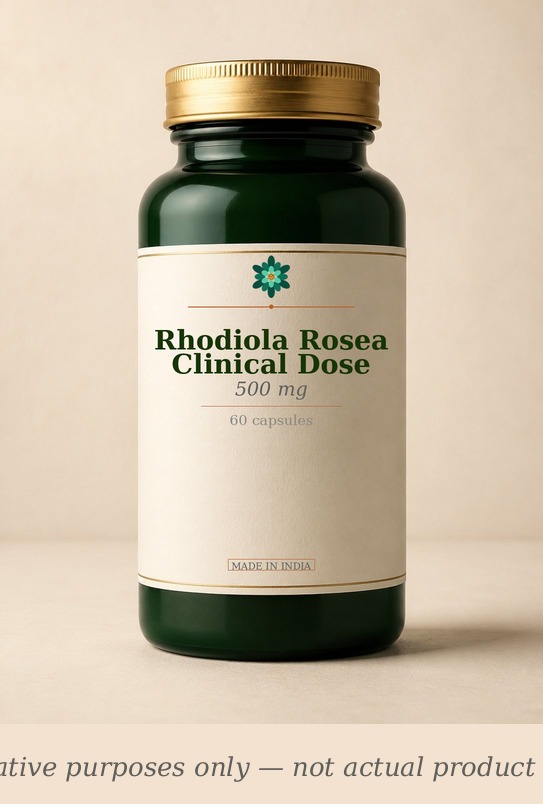
Rhodiola Rosea Clinical Dose — SacredBod supplement bottle (illustrative)
Supplement · Mood, Anxiety & Emotional Balance

Rhodiola Rosea Clinical Dose

500 mg · vegan · gluten-free · 60 caps

BurnoutStress-related fatigueMild depressionCognitive exhaustionDecreased motivationPhysical fatigueSeasonal affective disorder BrainAdrenal glandsMitochondria
BUY on Amazon →

Affiliate link · we earn from qualifying purchases. No paid placements.

What it is

Rhodiola rosea (golden root or arctic root) is a high-altitude adaptogen native to Siberia and the Himalayas. The SHR-5 extract and other standardised formulations (3.6% rosavins + 1% salidroside) have demonstrated clinical benefits in stress-related fatigue, mild depression, and burnout syndrome. It is one of the few adaptogens with RCT evidence for both physical and mental performance under stress.

How it works

Salidroside and rosavins modulate the hypothalamic-pituitary-adrenal (HPA) axis, reducing cortisol secretion under stress. They also inhibit monoamine oxidase (MAO), increase serotonin and dopamine levels, and enhance the expression of neuropeptide Y (NPY) — a resilience-associated neuropeptide. Rhodiola additionally improves mitochondrial function and ATP production, explaining its anti-fatigue effects.

Who should take it

Adults with stress-related fatigue, burnout syndrome, or mild-to-moderate depression; students and professionals under chronic work pressure; athletes seeking stress resilience; and individuals with seasonal affective disorder or depression who prefer a stimulating (rather than sedating) antidepressant.

Avoid / careful

Pregnant or breastfeeding women; individuals with bipolar disorder (may trigger mania); those with severe anxiety disorders (stimulating effect may worsen symptoms); people taking stimulant medications. Side effects: Mild insomnia, anxiety, or jitteriness at high doses or when taken late in the day. Rare dry mouth, dizziness, or headache. Very well tolerated overall.

When to take it

Morning
Noon
Evening
Night

How to take it

With food
Empty stomach
Before food

FAQs

Frequently asked

How long before I see results?
For fatigue and burnout, benefits appear within 1–2 weeks. The SHR-5 trial showed significant reductions in Pines' burnout scale and improved attention (omissions, Hit RT SE) after just 28 days. For depression, the sertraline comparison trial showed clinically meaningful odds ratios by week 12, though sertraline had slightly greater HRSD reduction. Rhodiola is faster-acting than most antidepressants.
Will it keep me awake?
Possibly. Rhodiola has a mild stimulating effect due to its impact on dopamine and norepinephrine. Take it in the morning with breakfast. If you experience insomnia, reduce the dose or take only on alternate days. Do not take after 2 PM.
Is it safe for long-term use?
Rhodiola is generally safe for 3-month cycles. We recommend cycling — 6–12 weeks on, 2 weeks off — to prevent tolerance and maintain adaptogenic sensitivity. There are no serious long-term safety concerns at standard doses.

In plain English

A plain-English read of the literature behind this supplement. Not a clinical recommendation.

Key citations: PMID 19016404 (SHR-5 for stress-related fatigue — Olsson et al. 2009), PMID 28379882 (Silexan dose range — pooled data, complementary anxiolytic), PMID 26089573 (Rhodiola vs sertraline for mild-moderate depression — Kasper et al. 2015)

Editorial notes

SacredBod's longer take on Rhodiola Rosea Clinical Dose — context the structured blocks above don't capture.

What Rhodiola Rosea Clinical Dose Is

Rhodiola rosea, commonly called golden root or arctic root, is a perennial flowering plant that grows at high altitudes in the Arctic regions of Europe, Asia, and North America. It has been used in traditional Siberian and Scandinavian medicine for centuries to combat fatigue, enhance physical endurance, and improve mental resilience under harsh conditions.

The SHR-5 extract — developed by the Swedish Herbal Institute — is the most clinically studied Rhodiola preparation, standardised to 3% rosavins and 1% salidroside. Modern commercial extracts often use 3.6% rosavins + 1% salidroside for enhanced potency. This standardisation is essential because raw Rhodiola root contains hundreds of compounds, and only the rosavin/salidroside ratio correlates with clinical efficacy in mood and fatigue trials.

How It Works

  1. HPA axis modulation — Rhodiola reduces the cortisol response to stress by modulating the hypothalamic-pituitary-adrenal axis. In the SHR-5 trial, cortisol awakening response was significantly blunted in the treatment group.
  2. Monoamine enhancement — Salidroside inhibits MAO-A and MAO-B, increasing serotonin, dopamine, and norepinephrine levels. This provides both antidepressant and energising effects.
  3. Neuropeptide Y (NPY) upregulation — NPY is associated with stress resilience and emotional stability. Rhodiola increases NPY expression in the amygdala.
  4. Mitochondrial support — Enhances ATP synthesis and mitochondrial biogenesis, reducing physical fatigue.
  5. Neuroprotection — Salidroside activates the Nrf2 antioxidant pathway, protecting neurons from oxidative stress.

Who Benefits Most

  • Burnout patients — The Olsson trial demonstrated significant improvements in Pines’ burnout scale and attention after 4 weeks.
  • Mild depression sufferers — The Kasper trial showed odds ratios of 1.4 for global improvement by week 12, with far fewer side effects than sertraline (30% vs 63.2%).
  • Students and professionals — Improved concentration, reduced mental fatigue, and better stress resilience.
  • Athletes — Enhanced oxygen utilisation and reduced exercise-induced cortisol spikes.
  • Seasonal affective disorder — The stimulating profile is ideal for winter depression with fatigue and hypersomnia.

Dosage Guide

GoalDoseDuration
Burnout / fatigue200–400 mg/day4–8 weeks
Mild depression340–600 mg/day6–12 weeks
Cognitive performance200–400 mg/day2–4 weeks
Athletic support200 mg before exerciseAcute

Take in the morning with breakfast. Avoid evening doses to prevent insomnia.

Safety & Interactions

  • Insomnia: Most common side effect — take before 10 AM.
  • Bipolar: May trigger mania; avoid or use under psychiatric care.
  • Stimulants: Additive effect with caffeine, amphetamines, modafinil.
  • MAOIs: Additive MAO inhibition — avoid combination.
  • Pregnancy: Not recommended.

India-Specific Context

  • Availability: Rhodiola is available on Amazon.in from multiple brands. NutriJa 500mg (B0BMQDKZTP — 3% rosavins, 1% salidroside), Trexgenics 500mg with Piperine (B08BHY7S2Q), and Adorreal 700mg (B0F8R9Z529) are all listed. QPUYT 500mg (B0FNML8RRL) is currently unavailable. Prices range from ₹400–₹800 for 60–120 capsules.
  • Regulatory status: Sold as a dietary supplement. Not a Schedule H drug.
  • Ayurvedic parallel: Rhodiola is not in classical Ayurvedic texts (Charaka Samhita, Sushruta Samhita). However, it is functionally similar to Ashwagandha — both are adaptogens that modulate the HPA axis. In modern Indian integrative medicine, Rhodiola is increasingly used alongside Ashwagandha for a “stimulating + calming” adaptogen stack.
  • Himalayan connection: Rhodiola grows in the Himalayas at 3,000–5,000m altitude (Ladakh, Sikkim, Himachal Pradesh). Local Himalayan communities have used it traditionally as a stamina tonic, though this is not part of mainstream Ayurveda.
  • Cost: At ₹400–₹800 for a 2-month supply, Rhodiola is moderately priced and offers dual physical-mental benefits.
Added to your stack.