
What it is
A standardised saffron stigma extract rich in crocin and crocetin — apocarotenoids that protect photoreceptors, improve macular electroretinogram responses and reduce oxidative stress in the retina.
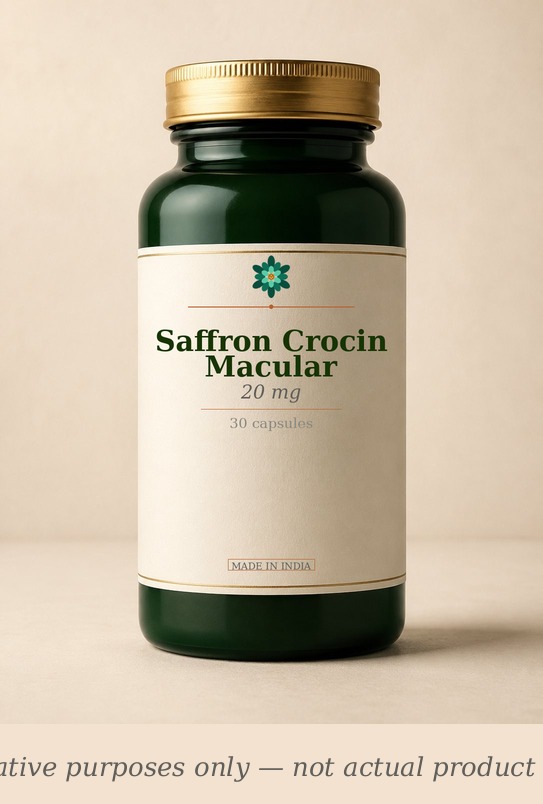
20 mg · vegan · gluten-free · 30 caps
Affiliate link · we earn from qualifying purchases. No paid placements.
A standardised saffron stigma extract rich in crocin and crocetin — apocarotenoids that protect photoreceptors, improve macular electroretinogram responses and reduce oxidative stress in the retina.
Crocin and crocetin cross the blood-retinal barrier, quench reactive oxygen species in photoreceptor outer segments, modulate microglial activation and improve retinal flicker sensitivity measured by focal electroretinography.
Adults with early or mild-to-moderate age-related macular degeneration, and those with a family history of AMD seeking neuroprotective eye support.
Avoid during pregnancy or breastfeeding; use caution in bipolar disorder or if taking serotonergic medications. Side effects: Very well tolerated; occasional mild headache, nausea or anxiety at doses above 30 mg/day.
A plain-English read of the literature behind this supplement. Not a clinical recommendation.
Key citations: PMID 20688744 (Falsini 2010 — saffron improves retinal flicker sensitivity in early AMD), PMID 22852021 (Piccardi 2012 — sustained benefits over 14 months), PMID 24067115 (Marangoni 2013 — benefits independent of CFH/ARMS2 risk genotypes), PMID 30343354 (Broadhead 2019 — RCT in mild/moderate AMD), PMID 29550187 (Sepahi 2018 — crocin reduces central macular thickness in diabetic maculopathy)
SacredBod's longer take on Saffron Crocin Macular — context the structured blocks above don't capture.
Saffron Crocin Macular provides a standardised extract of Crocus sativus stigma, standardised to its key apocarotenoids — crocin and crocetin. Saffron is known in India as Kesar (केसर) and has been used in Ayurveda for centuries as a Chakshushya (vision-promoting) and Vayassthapana (anti-ageing) herb. Modern clinical trials have confirmed that 20 mg/day of saffron extract improves retinal flicker sensitivity, best-corrected visual acuity and multifocal electroretinogram responses in patients with early and mild-to-moderate AMD.
| Condition | Dose | Duration |
|---|---|---|
| Early AMD prevention | 20 mg/day | Ongoing |
| Mild-to-moderate AMD | 20–30 mg/day | Minimum 3 months |
| Diabetic maculopathy adjunct | 15 mg crocin/day | 3 months, then reassess |
Take with food to minimise any stomach upset. Saffron is fat-soluble; a meal containing some fat improves absorption of crocetin.
Saffron is remarkably safe at culinary and supplemental doses. Trials using up to 30 mg/day for >1 year report no significant difference in adverse events versus placebo. However:
In Ayurveda, Kesar is considered Tikshna (penetrating) and Laghu (light), with a Madhura (sweet) post-digestive taste. It is used in Netra Roga (eye disorders) as an ingredient in Saptamrita Lauha, Triphala Ghrita and Kumkumadi preparations. Traditional practitioners prescribe 50–100 mg of stigma powder (not extract) mixed with honey or ghee for eye health — far higher than the 20 mg extract dose used in modern trials, but the extract is far more concentrated.
Peptides are physician-only. Tell us a bit and we'll route you to the right specialist.